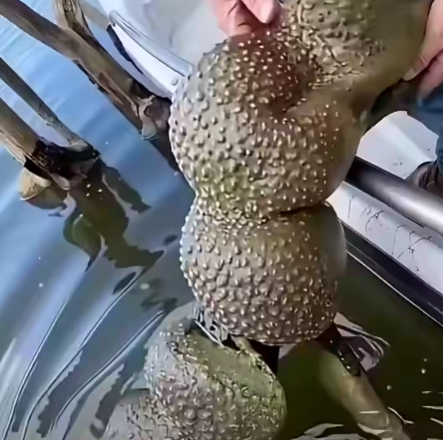
Unusual translucent formations spotted beneath the water may belong to a fascinating group of tiny freshwater animals
Boaters exploring McGee Creek Reservoir in Atoka County, Oklahoma, noticed something unusual attached to submerged branches. Beneath the water were translucent, jelly-like clusters that looked very different from the plants and familiar aquatic life typically seen in freshwater lakes.
The formations had soft, irregular shapes and a gelatinous appearance. Some resembled rounded blobs, while others appeared to hang from underwater branches.
Continue reading on next page…
Although they might initially look like fungus, eggs, or unfamiliar plant material, formations like these can be produced by freshwater bryozoans — small aquatic animals that live together in colonies.
These organisms are an interesting example of how much life exists beneath the surface of lakes and reservoirs. Despite their unusual appearance, freshwater bryozoans are generally harmless and play a role in aquatic ecosystems.
However, identifying a particular specimen requires more than appearance alone. Without a confirmed scientific identification of the McGee Creek formations, it is more accurate to discuss bryozoans as a possible explanation rather than claim that the clusters have been definitively identified.
What Are Freshwater Bryozoans?
Bryozoans are small aquatic invertebrates sometimes called moss animals. They are found in freshwater and marine environments, where many species attach themselves to solid surfaces.
A colony consists of numerous individual animals known as zooids. Each zooid is small, but the connected colony can grow into a structure large enough to be seen without magnification.
Depending on the species, a colony may look like a thin coating, a branching growth, or a soft, rounded mass. Some freshwater bryozoans produce gelatinous colonies that can resemble transparent jelly.
This explains why a formation attached to an underwater branch might look like one large organism, even though it contains many individual animals living together.
Why Do the Clusters Look Like Jelly?
The distinctive appearance of certain freshwater bryozoans comes from the gelatinous material surrounding their individual zooids.
This material helps hold the colony together and gives it a soft, translucent appearance. Because it contains a substantial amount of water, light can pass through it, making the formation look almost transparent.
The shape can vary considerably. Some colonies are rounded, while others have uneven or lobed outlines. Their appearance may also depend on water clarity, lighting, the surface they are attached to, and the species involved.
Submerged branches provide a stable surface where colonies can develop. As the colony grows, additional zooids become part of the structure, gradually increasing its size.
These features make freshwater bryozoans particularly interesting to people who encounter them for the first time.
How Do These Tiny Animals Feed?
Despite their unusual appearance, freshwater bryozoans are active filter feeders.
They obtain food from tiny particles suspended in the surrounding water rather than hunting larger animals.
Each zooid has a specialized feeding structure called a lophophore. It contains a crown of fine, tentacle-like extensions covered with microscopic hairlike structures called cilia.
The movement of these cilia helps create water currents that bring small food particles toward the animal. Depending on the species and environment, these particles can include microscopic algae, bacteria, and other organic material.
The food is then collected and transported toward the zooid’s mouth.
Because a colony contains many feeding individuals, the combined activity allows it to collect nourishment from the water around it.
This feeding process makes bryozoans part of the wider freshwater food web. They interact with microscopic organisms and suspended organic particles, contributing to the movement of energy through aquatic environments.
Are Bryozoans Ancient Organisms?
Yes. Bryozoans belong to an animal group with a fossil record extending back hundreds of millions of years.
Their fossils have been discovered in rocks from many geological periods. Scientists study them to learn more about ancient aquatic environments, biodiversity, and the history of marine ecosystems.
However, describing modern freshwater bryozoans as prehistoric survivors requires some clarification.
The animal group has an ancient evolutionary history, but a colony found in an Oklahoma reservoir today is made up of living, modern organisms. It is not an individual colony that has survived unchanged for millions of years.
The distinction is important: an ancient group of animals can still contain species living and reproducing in modern lakes.
How Do Freshwater Bryozoans Reproduce?
Freshwater bryozoans have life cycles that allow them to grow, reproduce, and survive changing environmental conditions.
Depending on the species, reproduction can involve both sexual and asexual processes. New zooids may develop within an existing colony, allowing it to expand.
Some freshwater species also produce specialized structures called statoblasts.
Statoblasts are resistant reproductive structures that help certain bryozoans survive unfavorable conditions. They can remain dormant until the environment becomes suitable for further development.
This ability is useful in freshwater habitats, where temperatures, water levels, and food availability may change throughout the year.
When conditions improve, a statoblast can develop into a new colony.
These structures can also contribute to the spread of bryozoans through natural processes, including water movement and transport by animals.
Why Do They Grow on Submerged Branches?
Submerged branches can become small habitats for a variety of aquatic organisms.
Once wood falls into a lake or reservoir, its surface may be colonized by algae, microorganisms, and tiny invertebrates. It can also provide an attachment point for organisms such as freshwater bryozoans.
The wood does not need to be alive. Dead branches that remain underwater can provide suitable surfaces for aquatic communities to develop.
Several environmental factors influence where colonies can grow, including:
- Water temperature.
- Light availability.
- Water movement.
- The stability of the attachment surface.
- The presence of suitable food particles.
These conditions can vary across a reservoir, which helps explain why colonies may be visible in one area but difficult to find elsewhere.
A branch covered with a gelatinous colony may look as though the formation is floating freely. In reality, the colony may be attached directly to the wood.
Are Jelly-Like Freshwater Formations Dangerous?
Freshwater bryozoans are generally considered harmless to people during ordinary recreational activities.
They are not human parasites, and their filter-feeding structures are not designed to bite or attack people. Their jelly-like appearance does not automatically indicate that they contain a harmful substance.
Nevertheless, not every translucent formation found in a lake is a bryozoan colony.
Other biological materials can have a similar appearance, including certain egg masses, algae, and fungal growths. Correct identification may require close examination by someone familiar with freshwater organisms.
For this reason, people should avoid handling unfamiliar aquatic formations unnecessarily. Taking a photograph from a safe distance can provide useful information for an expert.
If an unusual formation appears alongside strong odors, unusual water discoloration, or dead fish, contacting the relevant environmental authority or lake management agency is a sensible precaution.
Those signs would not establish that the gelatinous material caused a problem, but they may warrant further investigation.
Do They Harm Fish or Other Wildlife?
Freshwater bryozoans are part of aquatic ecosystems and are not generally regarded as direct threats to fish.
Their colonies may provide surfaces used by other small organisms, while their filter-feeding activity allows them to consume particles suspended in the water.
Their ecological role can vary depending on the species, abundance, and surrounding conditions.
It is also important not to confuse the presence of an unusual organism with evidence of an environmental problem.
For example, changes in water quality or increased algal growth can occur for several reasons. Finding a bryozoan colony in the same area does not prove that it caused those changes.
Determining whether an organism is native, introduced, or ecologically disruptive requires reliable identification and information about its distribution and environmental effects.
A jelly-like appearance alone is not enough to establish that a colony is invasive or harmful.
Why Might People Notice Them Suddenly?
Someone can visit the same lake for years without noticing organisms that have been present beneath the surface.
Visibility depends on several factors, including seasonal growth, water clarity, changing water levels, and the location of submerged objects.
Some freshwater bryozoan colonies become more noticeable when conditions favor their development. As a colony grows, it may become large enough to attract attention from boaters, anglers, and shoreline visitors.
Changes in water levels can also expose submerged branches to better viewing conditions. A formation that was previously too deep to see may become visible from a boat or along the shore.
The observer’s position matters as well. A person looking down through clear water may notice a colony that would be almost impossible to see from another angle.
This is one reason observations from recreational lake visitors can be useful to naturalists and researchers.
What the Oklahoma Discovery Teaches Us About Freshwater Life
The unusual formations reported at McGee Creek Reservoir offer an opportunity to explore a part of freshwater ecology that often goes unnoticed.
Lakes are not simply bodies of water containing fish and aquatic plants. They support complex communities of microorganisms, invertebrates, algae, and other organisms, many of which are rarely seen by casual visitors.
Freshwater bryozoans are one example. Their colonies can look unfamiliar, but they are part of a much larger animal group with a long evolutionary history.
The most important point is that unusual appearance does not necessarily mean danger or environmental damage.
At the same time, accurate identification matters. Without a confirmed examination of the specific McGee Creek formations, their exact species and identity should not be stated as fact.
Final Thoughts
Jelly-like formations attached to submerged branches can be among the more surprising sights in a freshwater lake. One possible explanation is freshwater bryozoans, tiny aquatic animals that form colonies surrounded by gelatinous material.
These colonies filter food particles from the water, reproduce through specialized life-cycle processes, and form part of freshwater ecosystems.
Their ancient evolutionary history makes them especially interesting, while their unusual appearance offers a reminder of how much life exists beneath the surface.
For visitors who encounter similar formations, observing and photographing them without disturbing the surrounding habitat is a sensible approach.
Sometimes, what first appears to be an unfamiliar underwater object turns out to be a fascinating example of ordinary freshwater biology.