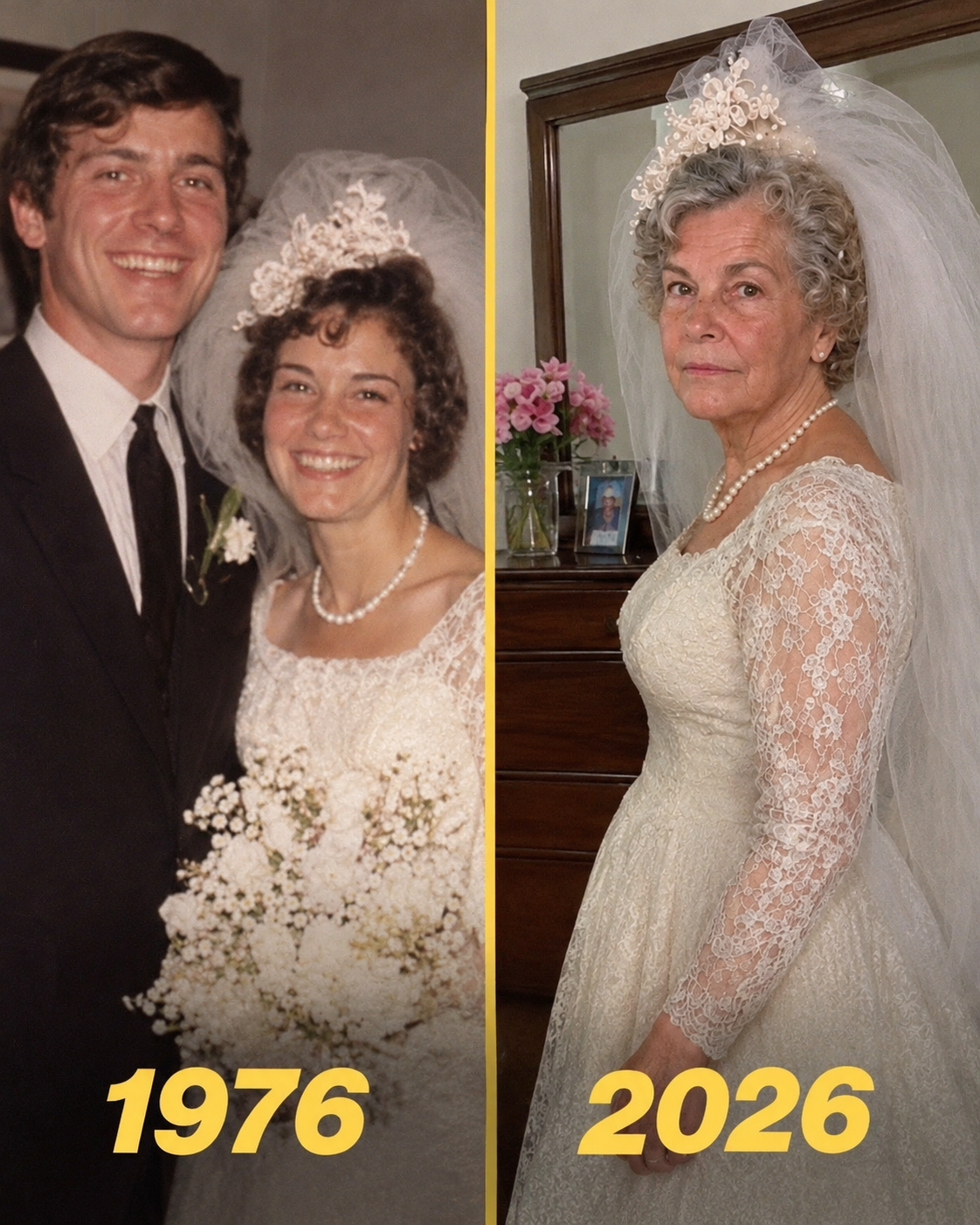
She and Henry had known each other since she was sixteen. He walked her home from the library on cold evenings, saved money for a small diamond engagement ring, and insisted that the difference between his family’s comfortable circumstances and her family’s struggles did not matter.
His mother, Evelyn, felt differently. Margaret remembered her as openly disapproving, with frequent remarks about Margaret’s background and whether she was suitable for Henry.
Still, Henry had stood by her. Their wedding was set for May 8, 1976. Margaret and her mother spent months at the kitchen table sewing her dress and attaching tiny pearls by hand.
On the afternoon of the ceremony, Margaret walked into the church with her father. Henry stood at the altar in a dark suit. When he saw her, his eyes filled with tears.
Then the minister asked whether he accepted her as his wife.
Henry looked at Margaret and said, “I don’t.”
He released her hand and walked out of the church.
Margaret stood there with her bouquet while the guests stared. For weeks afterward, people asked what had happened. Some wondered aloud if Henry had learned something about her. Margaret had no answer, because Henry never gave her one.
A new life after the old question
Eventually, Margaret left for Chicago with little money and found work in a small diner. There she met Robert Doyle, an English teacher who came in regularly for coffee and apple pie.
Robert did not push her to talk about the past. He was patient, kind, and steady. In time, Margaret trusted him.
They married in 1979. Together they raised three children, bought a modest home, celebrated family moments, and faced everyday troubles as a team. Robert was not perfect, Margaret would later say, but he was dependable, thoughtful, and attentive in the small ways that matter.
They shared forty-two years before his death. Four years after losing him, Margaret found herself sitting at her kitchen table with Daniel Ashford and the box Henry had sent.
Inside the box was a letter she had never written
Daniel placed the box between them. Inside were old photographs, Margaret and Henry’s original wedding invitation, and an envelope containing a letter that appeared to bear Margaret’s name.
The letter claimed she had never truly loved Henry. It suggested she wanted to marry him for his family’s money and had no intention of becoming a devoted wife.
Margaret recognized the lie immediately.
“I never wrote this,” she said.
Daniel told her Henry now knew that.
According to Daniel, Evelyn had given Henry the letter on the morning of the wedding, saying she had found it in a book Margaret had returned to the Ashford home. Henry believed the handwriting was Margaret’s.
Then Daniel showed her more papers. They included handwritten practice pages, notes about the shapes of Margaret’s letters, the way she crossed her T’s, and how she signed her name.
The documents appeared to show that someone had studied Margaret’s old letters before producing the false one. A handwriting specialist later examined the material and concluded that Evelyn had written both the practice pages and the forged letter.
For fifty years, Margaret had wondered whether something about her had caused Henry to leave. Now she was being told that his mother had manufactured the misunderstanding.
The truth had been known for twelve years
One question came to Margaret at once.
“When did Henry discover the truth?”
Daniel’s answer stunned her.
“Twelve years ago.”
Henry had known for more than a decade that Margaret had not written the letter. He had even hired someone to find her. But after learning she had built a happy family life with Robert, he decided not to contact her.
To Margaret, that silence felt like another wound. Once again, a major decision about her life had been made without giving her any say.
After sitting with the news, she decided she needed to speak with Henry herself.
A visit in Dixon
A few days later, Margaret drove to the care facility in Dixon where Henry was staying. When she entered his room, she barely recognized the man by the window. His hair was white, and age had changed him completely.
But his eyes were familiar.
“Margaret,” he whispered.
They sat quietly before she asked the question she had carried for decades.
“Why didn’t you simply ask me whether I had written that letter?”
Henry said Evelyn had presented the letter as proof that Margaret had deceived him. He had been hurt and angry, and instead of confronting Margaret, he let that anger decide for him.
“I wanted you to understand how I felt,” he admitted. “I thought you had made a fool of me.”
Margaret told him the truth he could have heard in 1976.
“You could have asked me one question,” she said. “I would have told you the truth. I was home with my mother the entire evening before the wedding, finishing my dress.”
Henry acknowledged that he had made a terrible mistake. He also said that when he discovered Evelyn’s deception years later, he was afraid to reach out. He thought Margaret had moved on and feared that contacting her would reopen pain.
Margaret answered gently but directly.
“You weren’t protecting me,” she told him. “You were protecting yourself from hearing what I might say.”
What Henry had kept
Henry then told her something she had not expected: he had never married.
Beside his chair was a shoebox holding more than two hundred letters Margaret had written during his college years. He had kept them all and reread them, especially around the anniversary of their wedding.
Margaret recognized her handwriting at once. The letters brought back the young woman who had believed completely in the future she and Henry were building.
But that young woman had lived another life. She had found love, raised a family, and built happiness with Robert.
When Henry asked whether she could forgive him, Margaret answered with care.
“I forgive you for the mistake you made when you were young,” she said. “But I cannot pretend that the years of silence never happened. I have a family and a life that I love. I am not going to start again with the past.”
Before she left, she wished him comfort and peace.
An answer, but not a return
A few weeks later, Daniel called to say Henry had died peacefully in his sleep. He told Margaret that after her visit, Henry had seemed calmer and had slept better than he had in years.
Margaret did not attend the funeral, but she sent white roses and baby’s breath.
That evening, she returned to her kitchen and took out Robert’s old recipe card for oatmeal-chocolate-chip cookies. He always added an extra pinch of cinnamon and insisted it made them special.
Her daughter and grandchildren were coming over that Sunday, so Margaret began preparing the ingredients. As she mixed the dough, she thought about the years she and Robert had shared: their children, their home, their celebrations, and the ordinary days that had quietly become the center of her life.
The answer to the old question did not change what had happened. It could not give back the years she had spent wondering. But it did tell her something she had needed to know: the young woman left at the altar had done nothing wrong.
Margaret placed the cookies in the oven and read Robert’s handwritten instructions again.
Some chapters close without the answers people deserve. Others make sense only after many years. For Margaret, the past finally had an explanation, but it was not the life she chose to treasure.
Her story with Henry had ended long ago. Her life with Robert, their children, and their grandchildren remained the one she carried forward.