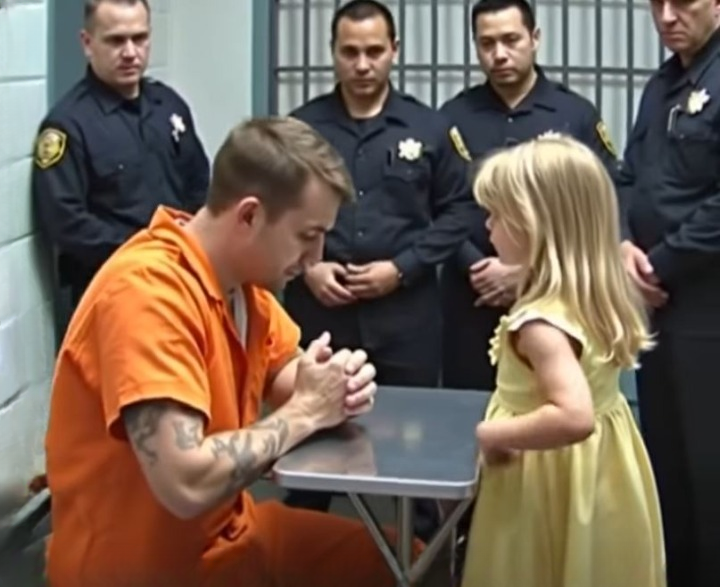
He does not ask for a press conference or a public appeal. He wants a few moments with the daughter whose childhood has continued while he has been absent.
Emily is now eight years old. She has grown through years of birthdays, school days, and ordinary family moments that her father has experienced only from a distance.
For Daniel, the meeting represents the possibility of saying goodbye. For Emily, it is a chance to see her father again under circumstances she may not fully understand.
The request reaches Robert Mitchell, the fictional warden responsible for overseeing the prison.
Mitchell is portrayed as a veteran official accustomed to the strict routines and difficult decisions associated with death row. Yet Daniel’s case has left him with questions he cannot easily dismiss.
The story does not establish that the warden possesses evidence of Daniel’s innocence. Instead, his unease introduces the central tension: even when a conviction appears settled, what should happen if credible new information emerges?
In a real criminal case, doubts must be examined through appropriate legal procedures. A prison official’s personal feelings would not, by themselves, establish innocence or authorize an execution to be stopped.
But in this fictional drama, the final visit becomes the moment when unresolved questions begin to surface.
The Evidence That Put Daniel Behind Bars
Daniel’s conviction is described as resting on several pieces of evidence, including fingerprints, bloodstains, and a witness who placed him near the crime scene.
At first glance, those details appear damaging.
Yet evidence must be understood in context. Its significance depends on how it was collected, analyzed, preserved, and presented during the investigation and trial.
Fingerprints can help establish contact with a surface, but their meaning depends on where they were found and whether there is a plausible explanation for their presence.
Blood evidence can help investigators reconstruct events, but conclusions depend on laboratory findings, the circumstances of collection, and the possibility of contamination or transfer.
Witness testimony can be important, too. However, human memory is not perfect, and identification can be affected by stress, viewing conditions, the passage of time, and the way questions are asked.
None of these limitations automatically proves that evidence is unreliable. They demonstrate why investigators and courts must evaluate evidence carefully rather than treating any single detail as conclusive.
In Daniel’s fictional case, the narrative does not provide forensic reports, trial transcripts, or independently verifiable records. Readers therefore cannot determine whether the evidence was sufficient or whether his conviction was correct.
That uncertainty is part of the story’s central conflict.
Why Wrongful Convictions Deserve Serious Attention
Wrongful convictions can have devastating consequences.
A person who is convicted of a crime they did not commit may lose years of freedom, suffer lasting damage to relationships, and face significant obstacles to rebuilding a life after release.
When a death sentence is involved, the stakes are even higher. An execution cannot be reversed if new evidence later establishes that the person was innocent.
Legal systems provide procedures for challenging convictions and reviewing claims of error, although the available options differ by jurisdiction and case.
Possible grounds for further review can include newly discovered evidence, unreliable forensic conclusions, mistaken identification, false testimony, undisclosed information, or significant legal errors.
A claim of innocence does not automatically establish that a conviction was wrongful. Equally, a conviction should not be treated as beyond examination merely because it has stood for years.
The strength of a case depends on the evidence and the applicable law, not on how confidently someone presents a conclusion.
The fictional story draws its tension from that distinction. Daniel’s insistence that he is innocent creates an emotional dilemma, but the question of whether he is telling the truth must ultimately depend on what the evidence shows.
The Moment That Changes the Visit
When Emily finally enters the visiting room, Daniel struggles to find the right words.
He has imagined this moment for years, but the reality is more difficult than he expected. His daughter is older than he remembers, and the distance between them cannot be erased by a single embrace.
He tries to reassure her.
He tells her that none of what happened is her fault. He tells her that he loves her. And he tries to prepare her for the possibility that they may not see each other again.
Then Emily says something unexpected.
The narrative does not immediately reveal every detail of their conversation. Instead, it focuses on Daniel’s reaction and the attention of the officials nearby.
His expression changes.
The farewell he had prepared himself to deliver gives way to a question he needs answered.
Emily’s words appear to connect to something about the case that has not previously been addressed. A guard notices the change in Daniel’s behavior, and the visit takes an unexpected turn.
At this point, the story deliberately leaves the revelation unresolved long enough to raise the stakes: could a child’s information expose a mistake, or is the significance of the conversation being misunderstood?
A credible revelation would need to be examined rather than accepted automatically. Officials would need to determine what Emily knows, how she learned it, and whether it can be corroborated through reliable evidence.
That process matters because an emotionally powerful statement is not the same thing as proof.
What Happens When a Conviction Is Questioned?
In the story, the possibility of new information forces officials to reconsider whether every relevant question has been answered.
Any genuine legal challenge would require more than a sudden reaction in a visiting room. Depending on the circumstances, it might involve preserving the information, notifying appropriate legal authorities, consulting defense counsel, and pursuing the available procedures for reviewing the conviction or seeking a stay of execution.
The precise response would depend on the evidence, the timing, and the governing law.
The fictional narrative compresses those complicated steps into a dramatic turning point. Its emotional premise is that a final family visit may reveal a reason to look again at a case that others have stopped questioning.
That is a powerful storytelling device, but real cases require careful verification. A revelation must be investigated, and any legal decision must be made by the appropriate authorities through established procedures.
More Than a Story About Death Row
At its heart, Daniel and Emily’s fictional reunion is about the relationship between a parent and a child separated by a criminal conviction.
The approaching execution gives their meeting urgency, but the emotional center is the time they have lost.
Emily has grown up without her father present for ordinary milestones. Daniel has been left to imagine the childhood unfolding beyond prison walls. Their reunion cannot recover those years.
The story also examines the responsibility of institutions that make decisions with irreversible consequences. Justice requires accountability, reliable evidence, and procedures that allow legitimate concerns to be examined.
Most importantly, the narrative asks readers to distinguish between certainty and proof.
A person may insist on being innocent without being believed. An official may feel uneasy without having evidence. A child may disclose something important without fully understanding its implications.
The task is to determine what is true through careful investigation rather than allowing emotion or assumption to decide the outcome.
Daniel’s final visit begins as an attempt to say goodbye to his daughter. By the end, it has become a reminder that even the most settled-looking story may contain unanswered questions.
Whether those questions change the outcome is the mystery at the center of this fictional drama.