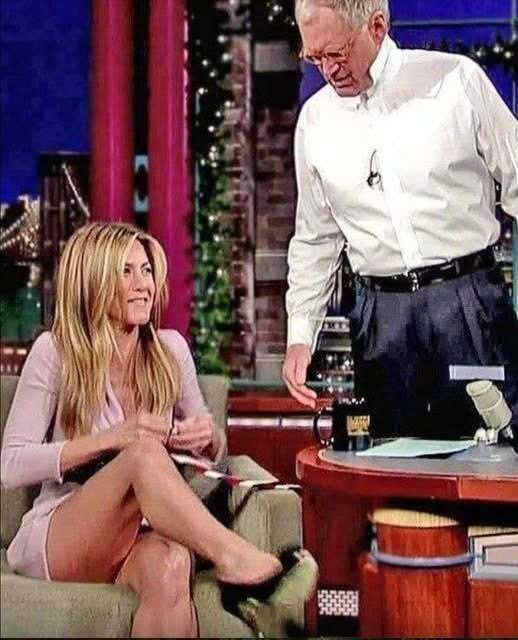
Afterward, Letterman offered her a tissue so she could wipe her hair.
The studio audience laughed, and the interview continued.
Years later, however, the footage received renewed attention when it circulated on social media.
In February 2021, entertainment publications reported that viewers were criticizing the interaction and questioning whether it respected Aniston’s personal space.
The renewed discussion became part of a broader examination of how female celebrities were treated during television interviews in previous decades.
Jennifer Aniston’s Memorable Return in 2008
Despite the attention surrounding earlier appearances, Aniston returned to Letterman’s program in December 2008 while promoting Marley & Me, her comedy-drama with Owen Wilson.
This appearance featured a lighter moment involving a fashion accessory that had recently attracted considerable attention.
Aniston had appeared on the cover of GQ magazine wearing a distinctive necktie.
During the interview, she surprised Letterman by presenting him with a similar tie as an early Christmas gift.
The host removed his existing tie, and Aniston helped him put on the new one.
The exchange produced an amusing moment, with Aniston joking about dressing the famous television personality.
Their conversation also touched on her personal life, including questions about musician John Mayer.
The appearance demonstrated Aniston’s ability to participate in spontaneous television humor while keeping the atmosphere entertaining.
Why These Hollywood Interviews Are Being Reconsidered
Television entertainment has changed considerably since the 1990s and early 2000s.
During that period, late-night talk shows frequently relied on unexpected questions, celebrity gossip, and unpredictable exchanges between hosts and guests.
David Letterman was particularly well known for his unconventional humor and willingness to create surprising television moments.
For many audiences, this approach helped make his show a major part of American popular culture.
However, changing expectations surrounding workplace professionalism, public interactions, and personal boundaries have influenced how older interviews are interpreted.
The renewed attention surrounding Aniston’s appearances illustrates that shift.
Some viewers regard the conversations as examples of entertainment from a different era, while others believe certain moments deserve criticism regardless of when they occurred.
Importantly, Aniston’s own interpretation of these specific exchanges should not be assumed solely from short video clips or online reactions.
Jennifer Aniston’s Career Goes Far Beyond These Moments
Although her Letterman interviews continue to attract interest, they represent only a small part of Jennifer Aniston’s remarkable entertainment career.
The actress became an international star through her portrayal of Rachel Green on the television sitcom Friends.
The show’s enormous popularity established her as one of the most recognizable performers of her generation.
She subsequently built a successful movie career through productions such as Along Came Polly, The Break-Up, Marley & Me, and Just Go with It.
Aniston also earned critical recognition for dramatic performances, including her role in The Morning Show.
Her continued success across television and film demonstrates her versatility and lasting appeal.
While older interviews occasionally return to public attention, her professional achievements remain central to her Hollywood legacy.
What These Interviews Reveal About Changing Television Standards
The discussions surrounding Aniston and Letterman raise a broader question about entertainment history.
Should older television moments be judged according to the standards of their original era, or should modern expectations influence how audiences interpret them?
There is no single perspective shared by every viewer.
What is clear is that public expectations for celebrity interviews have evolved.
Today’s audiences increasingly recognize the importance of allowing performers to discuss their creative work without unwanted pressure to reveal personal details.
At the same time, archived television appearances provide an opportunity to understand how entertainment formats and public attitudes have developed.
For Jennifer Aniston, these interviews remain part of a much larger career filled with memorable performances, professional achievements, and enduring popularity.
Ultimately, the renewed discussion is not simply about a handful of unusual television moments. It reflects how audiences continue to reconsider the entertainment culture of the past—and what they expect from it today.