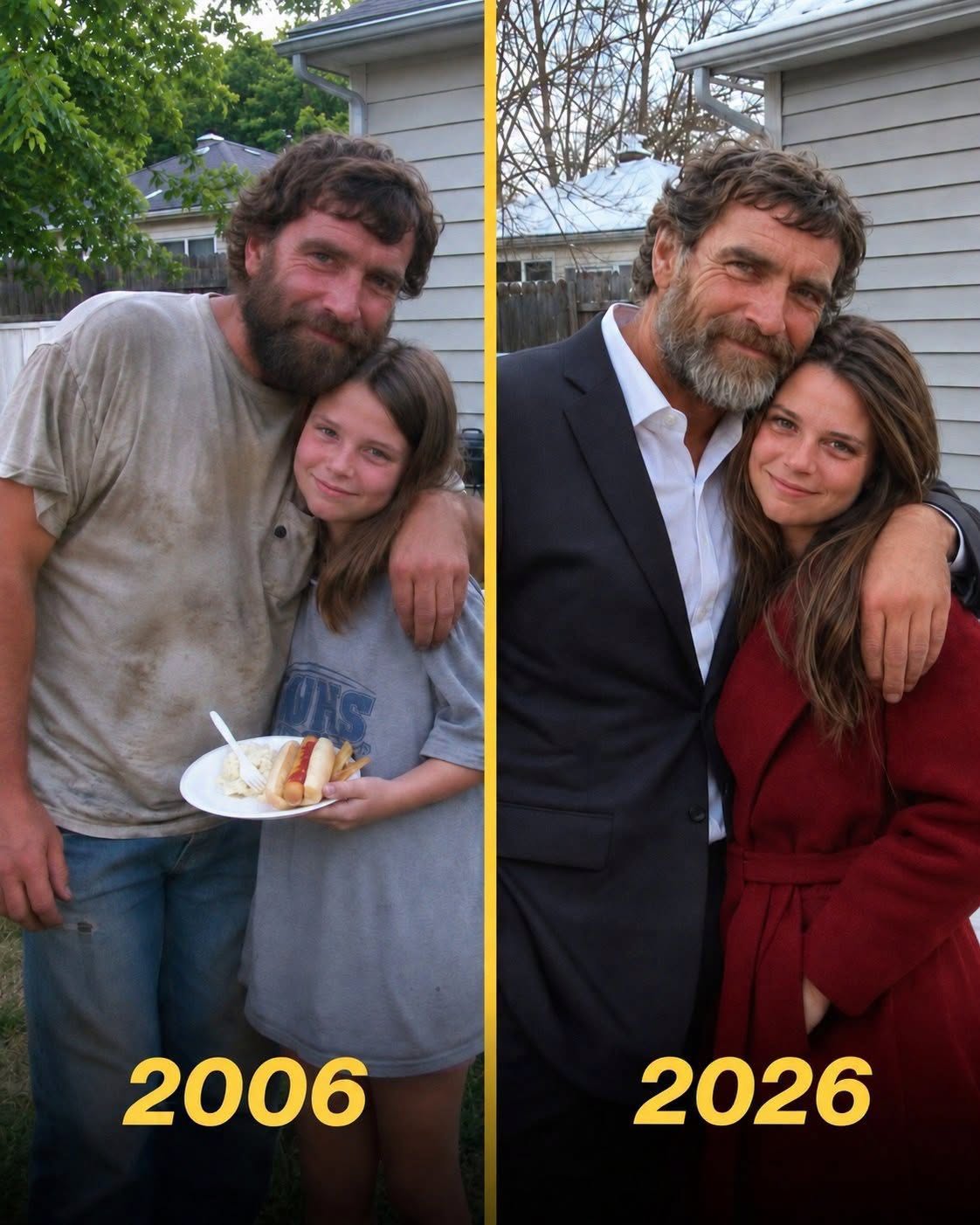
That morning, however, his usual shelter was empty. His blankets were folded, his belongings were gone, and the space behind the fence looked unfamiliar.
Then Fiona saw a black SUV near the driveway.
A man in a clean dark coat stepped toward her. Without the heavy beard and worn clothes she remembered, Fiona needed several seconds to recognize him.
It was Victor.
When she told him she had brought dinner, he looked at the container and said softly that her mother would have liked that. Then Fiona noticed the object in his hand: a small silver locket.
She knew it immediately. It was the necklace Stephanie had worn in old family photographs, the one she had once said was lost when Fiona was eight.
The necklace her mother had never lost
Fiona asked where he had gotten it.
Victor told her Stephanie had given it to him.
That answer made no sense to Fiona. Her mother had said the necklace was gone years earlier. But Victor explained that Stephanie had only wanted Fiona to believe that.
Then he told her that Stephanie had asked him to keep something private until after her death. She believed the truth might one day bring the family together again.
Fiona asked him directly who he was.
His answer changed the way she understood her childhood: Victor was Stephanie’s brother.
Fiona had known of one uncle, Mark. She had never been told there was another sibling. Victor understood her shock, but said there was more she needed to see.
Why the extra meal had always hurt
As a child, Fiona had watched her mother stretch ordinary dinners into one more portion. Sometimes it was chicken and vegetables. Other days it was soup, rice, or whatever was available.
Fiona remembered asking why Victor always received food when they also needed it.
Stephanie’s answer had been simple: Victor needed it, and he was important to her.
That explanation only frustrated Fiona. She did not understand why a man outside the fence seemed to occupy such a permanent place in her mother’s life.
Victor was polite when Fiona delivered the containers. He asked about school and sometimes about Stephanie’s health. Fiona usually answered briefly. To her, his attention felt too familiar for someone she believed was a stranger.
There were other things she had not understood at the time. Victor repaired a loose fence board, cleared branches after storms, helped with groceries, and seemed to notice when something around the house needed fixing.
One winter, Fiona found a new pair of boots beside her schoolbag. Stephanie said they were a donation. Fiona later saw Victor arranging firewood near the fence and wondered whether he had helped, but she never asked.
For years, she assumed his quiet work was repayment for Stephanie’s kindness. She did not imagine he was trying to remain close to family.
Stephanie’s final warning
When Stephanie became seriously ill, Fiona visited often and helped where she could. During one visit, Stephanie asked her to sit closer and made her promise not to stop looking after Victor.
Fiona wanted to know why they were still talking about him. Stephanie told her that Victor mattered more than she realized, but she did not explain everything then.
Instead, she gave Fiona another instruction. If Uncle Mark came around after her death, Fiona was not to let him take the blue box from her bedroom closet.
The box was beneath the blankets, Stephanie said. Inside was everything Fiona deserved to know.
Before Fiona left, Stephanie said something that stayed with her: she had never loved Fiona less because she helped Victor.
A few days later, Stephanie died peacefully.
The blue box under the blankets
After the funeral, relatives gathered at Stephanie’s house. Mark quickly began sorting through papers, photographs, and belongings, saying he wanted to make things easier.
Fiona remembered her mother’s warning and told him to leave the bedroom alone. Later, she found the blue box beneath a stack of old blankets. Her name was written on the lid in Stephanie’s handwriting.
Inside were photographs, envelopes, and handwritten letters.
One picture showed two children sitting together on the steps of an old house. One child was Stephanie. The other was Victor. On the back, Stephanie had written that Victor had walked her home again.
Then Fiona opened the first letter.
In it, Stephanie explained that Victor had been the person who protected her when they were children. Their family had little money, and the two of them had depended on each other in difficult times.
Stephanie described Victor as protective, thoughtful, and generous. During one harsh winter, he had taken an old family bracelet and tried to exchange it for blankets so they would have something warm. Their parents misunderstood what he had done. Over time, the misunderstanding grew, and Victor became separated from the people he loved.
Stephanie wrote that she never stopped caring about him. When she became a mother, she wanted Victor nearby, but family disagreements made the situation difficult. Mark strongly opposed Victor’s return, and Stephanie feared losing the stability she had built for Fiona.
So she made a choice she later regretted: she let Fiona believe Victor was only a man in need.
The meals, Stephanie wrote, were not charity alone. They were her way of staying connected to the brother who had once given so much to her. She wanted Fiona to understand that she had never chosen Victor over her daughter.
Stephanie also asked Fiona, if possible, to give Victor a chance to be part of her life.
A family truth finally spoken aloud
Fiona read the letter more than once, then looked through the remaining photographs. There were images of Stephanie and Victor at family gatherings, with an old bicycle, and during holidays. In one picture, Victor held a little girl.
Fiona began to see her memories differently: the boots, the firewood, the quiet questions about school, the way Victor always seemed nearby when Stephanie needed help.
The next morning, Fiona returned to Victor with the letter. Mrs. Bell, a longtime neighbor, was near the driveway and seemed to understand at once that Stephanie had finally told her daughter the truth.
Mrs. Bell said Stephanie had tried to keep the family together by staying silent. There had been disagreements, and she believed secrecy would prevent more arguments. Mark, Mrs. Bell said, had never accepted Victor’s return and wanted the family to move on without discussing the past.
Victor told Fiona that Stephanie had loved her deeply and talked about her constantly. When Fiona asked why he had never told her the truth, he said he had promised Stephanie he would not. She had wanted to explain it herself.
He also said he never wanted Fiona to feel she owed him anything. Knowing she was doing well had been enough.
Then Victor gave Fiona the silver locket. Inside was an old photograph of him and Stephanie. On the back were three handwritten words.
Mark could no longer avoid the past
When Fiona and Victor went back into the house, Mark was waiting in the living room. He noticed the photographs immediately.
Fiona placed Stephanie’s letter on the table and asked why no one had told her Victor was her mother’s brother. Mark called it a family matter.
Fiona answered that Stephanie was her mother and Victor was her brother, which made it her family too.
Mark said he thought the past had been left alone. Victor remained calm and said Stephanie had wanted Fiona to know the truth.
Aunt Linda, who had arrived with Mark, looked at one of the photographs and said Mark had told them Victor was no longer part of the family.
Fiona did not want another argument. She wanted the truth acknowledged. She said Victor was her uncle and that she wanted him welcome in the house.
For the first time, no one changed the subject.
A chair at the kitchen table
That evening, Fiona returned to the kitchen she knew so well: the old cupboards, the familiar table, and the small window facing the backyard.
She prepared two bowls of soup. Victor stood near the doorway, still unsure of his place. He asked whether he should sit outside.
Fiona told him no. She called him Uncle Victor and said he belonged there.
For years, Stephanie had carried meals through the back door without explaining the full reason. She had not simply been feeding a man who needed help. She had been caring for her brother, the person who had cared for her when they were children.
Victor sat at the table and looked toward the empty chair where Stephanie used to sit. He said she would have been happy to see it.
Fiona placed the locket beside his bowl and said she thought her mother had known that day would come.
They ate quietly and shared stories about Stephanie. Victor spoke about childhood games, small adventures, and the memories that had nearly been lost to silence.
The next morning, Fiona began arranging the photographs into albums. Victor helped identify the people and places in them. Their relationship would take time to rebuild, but something important had changed.
Victor no longer had to remain behind the fence.
He had a place at the kitchen table, and Fiona had a chance to know the story her mother had protected for so many years.
Each time Fiona prepared dinner after that, she remembered the lesson Stephanie had left behind: sometimes the people we misunderstand are the ones who have been quietly holding a family together.