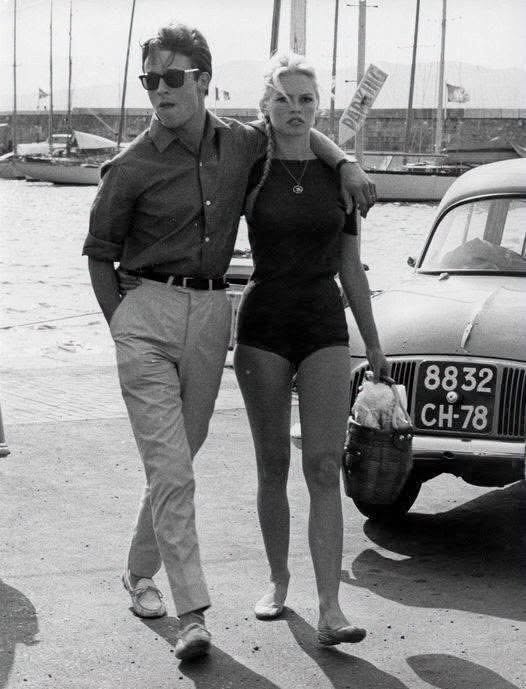
She began appearing in magazines as a model while still young, which helped introduce her to the world of entertainment. Her early film roles gradually increased her visibility and opened the door to larger opportunities in French cinema.
Her international breakthrough came with the 1956 film And God Created Woman, directed by Roger Vadim. The movie attracted considerable attention outside France and helped establish Bardot as an international film star.
Becoming an International Cultural Figure
Following the success of And God Created Woman, Bardot’s popularity grew rapidly. Her appearance, fashion choices, and screen presence attracted attention well beyond the film industry.
She became associated with the changing cultural landscape of the 1950s and 1960s. Her style influenced fashion, photography, and popular culture, while her films helped introduce international audiences to a new generation of French cinema.
Rather than being known only for individual performances, Bardot became a cultural figure whose influence extended beyond the screen.
A Notable Film Career
During her acting career, Bardot appeared in more than 40 films and worked with several prominent European directors.
Among her best-known films is Contempt (1963), directed by Jean-Luc Godard. She also starred in Viva Maria! (1965) alongside Jeanne Moreau.
Her filmography included comedies, dramas, and other productions that reflected the changing styles of European cinema during the period. Her international fame also made her one of the most recognizable French entertainers of her generation.
Stepping Away From Acting
Bardot retired from acting in 1973, when she was 39 years old.
After leaving the film industry, she increasingly directed her attention toward animal welfare. The decision marked a significant change in her public life. Instead of continuing to build a career in entertainment, she focused on issues involving the treatment and protection of animals.
Her transition demonstrated that her public identity would continue to evolve long after her film career had ended.
The Brigitte Bardot Foundation
In 1986, Bardot established the Brigitte Bardot Foundation, an organization dedicated to animal protection.
The foundation has worked on a range of animal welfare issues, including the treatment of domestic animals, wildlife protection, and concerns surrounding animal exploitation.
Through her foundation and public advocacy, Bardot became increasingly associated with animal welfare. Her work helped keep the subject in the public conversation and established a second major chapter in her career.
A Career With Two Distinct Chapters
Bardot’s life in the public eye can be viewed through two very different periods.
The first was defined by cinema, fashion, and international celebrity. During the height of her acting career, she became a symbol of French popular culture and one of Europe’s most recognizable film stars.
The second began after her retirement from acting. Animal welfare became a central focus of her public activities, and her foundation provided an institutional platform for that work.
These two chapters make Bardot’s career unusual. Few entertainers have made such a visible transition from international cinema to long-term advocacy.
Her Lasting Cultural Legacy
Brigitte Bardot continues to be remembered for her contribution to French cinema and for the influence she had on fashion and popular culture during the mid-20th century.
At the same time, her later work in animal welfare has become an important part of her legacy. Her career demonstrates how a public figure can move from entertainment into advocacy and build a new identity around a different cause.
Whether remembered primarily as an actress, style icon, or animal welfare advocate, Bardot remains an influential figure in French cultural history. Her journey from ballet student in Paris to international film star and dedicated animal welfare campaigner spans several decades and reflects the many different ways a public career can evolve.