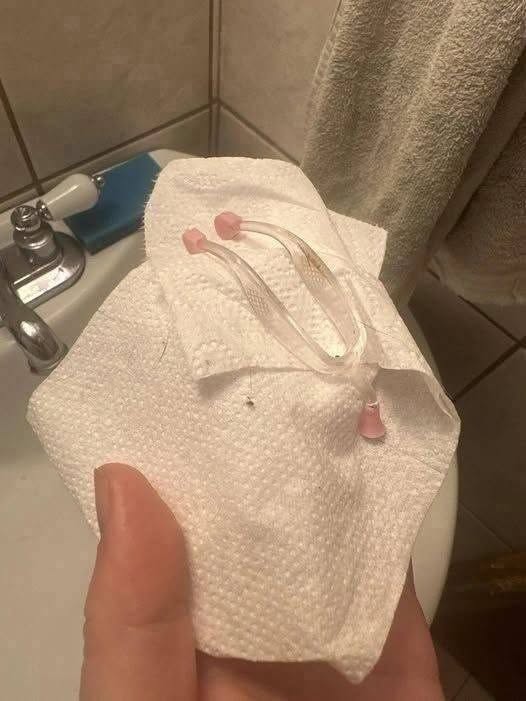
Many bathroom products are designed with similar materials and shapes. Small plastic tubes, protective caps, applicator components, and cosmetic accessories can look remarkably alike when separated from their original packaging.
Why bathroom accessories can be difficult to identify
Bathrooms contain products used for many different purposes, including:
- Menstrual and feminine hygiene
- Hair care and styling
- Skin care and acne treatment
- Dental hygiene
- First aid and personal care
- Cosmetic application
- Travel-sized toiletries
These products often use white or translucent plastic, silicone, cotton, and other lightweight materials.
A narrow plastic piece might be part of a cosmetic dispenser, a hygiene product, or a medical accessory. A colored end could be a cap, grip, handle, or protective component.
Without additional details, the shape alone cannot establish its purpose.
Why parents should avoid jumping to conclusions
An unfamiliar object does not automatically reveal who bought it, who owns it, or whether it has been used.
It may be a common hygiene product, an accessory from a package, or something that belongs to another family member.
If you are unsure, a simple and respectful conversation is usually more helpful than making assumptions. Teenagers should feel comfortable asking questions about personal hygiene without worrying about embarrassment or judgment.
Chapter 2: Could They Be Tampon Applicators?
One plausible explanation is that the objects are components of a tampon applicator.
Tampons are menstrual-care products designed to absorb menstrual fluid inside the vagina. Some are inserted using the fingers, while others come with an applicator that helps position the tampon.
Applicators are commonly made from smooth plastic or cardboard. Their design varies depending on the manufacturer and product type.
The objects in the photograph appear somewhat consistent with small applicator components, but the image does not show enough detail to confirm that identification.
How a tampon applicator works
A conventional tampon applicator usually has two main parts:
1. The outer tube
The outer tube holds the tampon and helps guide it into position. Its tip is often rounded or shaped to make insertion more comfortable.
2. The inner plunger
The plunger is a smaller component that moves the tampon out of the outer tube and into position.
Once the tampon has been inserted, the applicator is removed and discarded. The tampon remains in place, with its removal string outside the body.
Some applicators are long and rigid, while others are compact and designed for discreet storage. Their materials, colors, and shapes vary by brand.
Why do some applicators have colored ends?
Manufacturers sometimes use different colors for grips, product components, or packaging designs.
A pink-colored end could simply be a design feature that makes a component easier to recognize or handle.
However, there is no universal color system shared by all tampon manufacturers. A pink tip alone cannot identify a specific brand, product size, or type.
That is why the original packaging or a clearer photograph would be much more useful for identification.
Chapter 3: What Other Products Could Look Similar?
Although tampon applicators are one possibility, other small personal-care accessories may have a similar appearance.
For example, some cosmetic products use narrow plastic tubes or removable tips. Certain hygiene products also include protective covers, caps, or small applicator components.
The photograph does not provide enough information to rule out these alternatives.
A closer look at the following details could help:
- Shape: Is the object straight, curved, or tapered?
- Material: Does it appear to be hard plastic, soft silicone, or cardboard?
- Construction: Does it separate into two pieces?
- Packaging: Is there a nearby wrapper or product label?
- Size: Can it be compared with a familiar household object?
Even these clues may not provide a definite answer, but they can help narrow down the possibilities.
Chapter 4: How to Approach an Unexpected Discovery
When parents find an unfamiliar personal-care item, curiosity is natural. However, the way the discovery is handled can make a difference.
A teenager may feel embarrassed if a parent reacts with alarm or turns a simple question into an interrogation.
Instead, consider approaching the subject calmly.
You might say, “I noticed something in the bathroom that I didn’t recognize. Is it a personal-care product?”
A relaxed question gives your teenager an opportunity to explain without feeling accused.
It can also create a useful opportunity to discuss menstrual health, hygiene, and access to appropriate products.
If the item is a menstrual product, there is nothing inherently unusual about a teenager having access to one. Menstrual care is a normal part of health and personal hygiene.
Parents can help by making sure teenagers have accurate information, suitable products, and a comfortable environment in which to ask questions.
Chapter 5: The Most Responsible Conclusion
So, what are the strange white objects in the photograph?
They could be parts of a tampon applicator or another menstrual-care accessory. Their pale color, narrow shape, and pink-colored ends make that a possibility worth considering.
But there is not enough visual evidence to identify them with certainty.
Without a clearer image, original packaging, or additional information, naming a specific product would be speculation.
The best approach is to consider the ordinary explanations first and avoid attaching unnecessary meaning to an unfamiliar object.
Sometimes, what looks like a mystery is simply an everyday personal-care product that someone has never encountered before.
What do you think these objects could be? Have you ever come across an unfamiliar bathroom accessory that took you a moment to recognize? Share your thoughts respectfully in the comments.