He noticed everything about me.
He remembered that I liked too much honey in my tea, disliked cilantro, and preferred a chair with a cushion because of my troublesome knee. He even noticed that I hummed the same few bars of an unidentified song whenever I washed dishes.
At first, I thought he was simply observant.
I would later understand that he was remembering far more than I realized.
Carl never pretended his illness wasn’t serious. He spoke openly about his prognosis and the things he feared most.
“I’m not afraid of the end,” he told me one afternoon. “I’m afraid of the middle.”
“What do you mean?”
“The part where I can’t do things anymore,” he explained. “And somebody has to watch.”
Even when pain or exhaustion interrupted our conversations, he tried to return to the subject as soon as he could. He wanted to talk about books, teachers, and the small details of ordinary life.
One afternoon, while we were playing Scrabble, Carl began telling me about a teacher from his childhood. The teacher kept a jar of Juicy Fruit gum on his desk and gave a piece to students who asked genuinely thoughtful questions.
Carl was describing the sound of the jar opening when his speech suddenly became difficult.
His illness had begun affecting his ability to speak. The harder he tried to force the words out, the more frustrated he became.
I could see his embarrassment.
Rather than asking him to finish, I looked out the window and started telling him a ridiculous story about a volunteer who had accidentally locked herself inside a supply closet.
I exaggerated every detail, including the part where a maintenance worker supposedly mistook her for a raccoon.
Carl’s shoulders gradually relaxed. His grip on the table loosened, and eventually, he smiled.
“You did that on purpose,” he said quietly.
“Did what?”
He didn’t answer.
I didn’t understand why that moment seemed to matter so much to him.
A Proposal I Never Expected
A few weeks later, I arrived at Carl’s house and found him wearing a freshly pressed blue shirt. A small velvet box sat beside his tea.
“Marry me, Selena,” he said.
I nearly dropped my groceries.
We had known each other for only four months. I had never imagined he would ask me such a question.
Carl explained that he had recently completed hospital paperwork. Several sections asked for a next of kin, an emergency contact, and someone authorized to make decisions if he became unable to do so.
All three spaces were blank.
He turned the small box in his hand.
“I’m not asking you for a lifetime,” he said. “I know what my situation is. I’m asking whether the last chapter of mine can have somebody holding my hand.”
I sat down.
“You deserve better than pity, Carl.”
“I agree completely.”
“Then why me?”
He looked toward the bookcase.
“Because you’ve never once made kindness feel like charity.”
I thought carefully about his question. I knew the importance of boundaries in hospice care. I had attended the training sessions and understood how easily compassion could become confused with obligation.
But what I felt for Carl wasn’t simply a desire to help someone who was dying.
I cared about him. I enjoyed his company. I didn’t want to be somewhere else.
“All right,” I said.
Carl closed his eyes and sat quietly for a moment.
“Thank you,” he whispered.
Then he noticed the can of soup I had dropped under the table.
“You should probably pick that up.”
That was Carl.
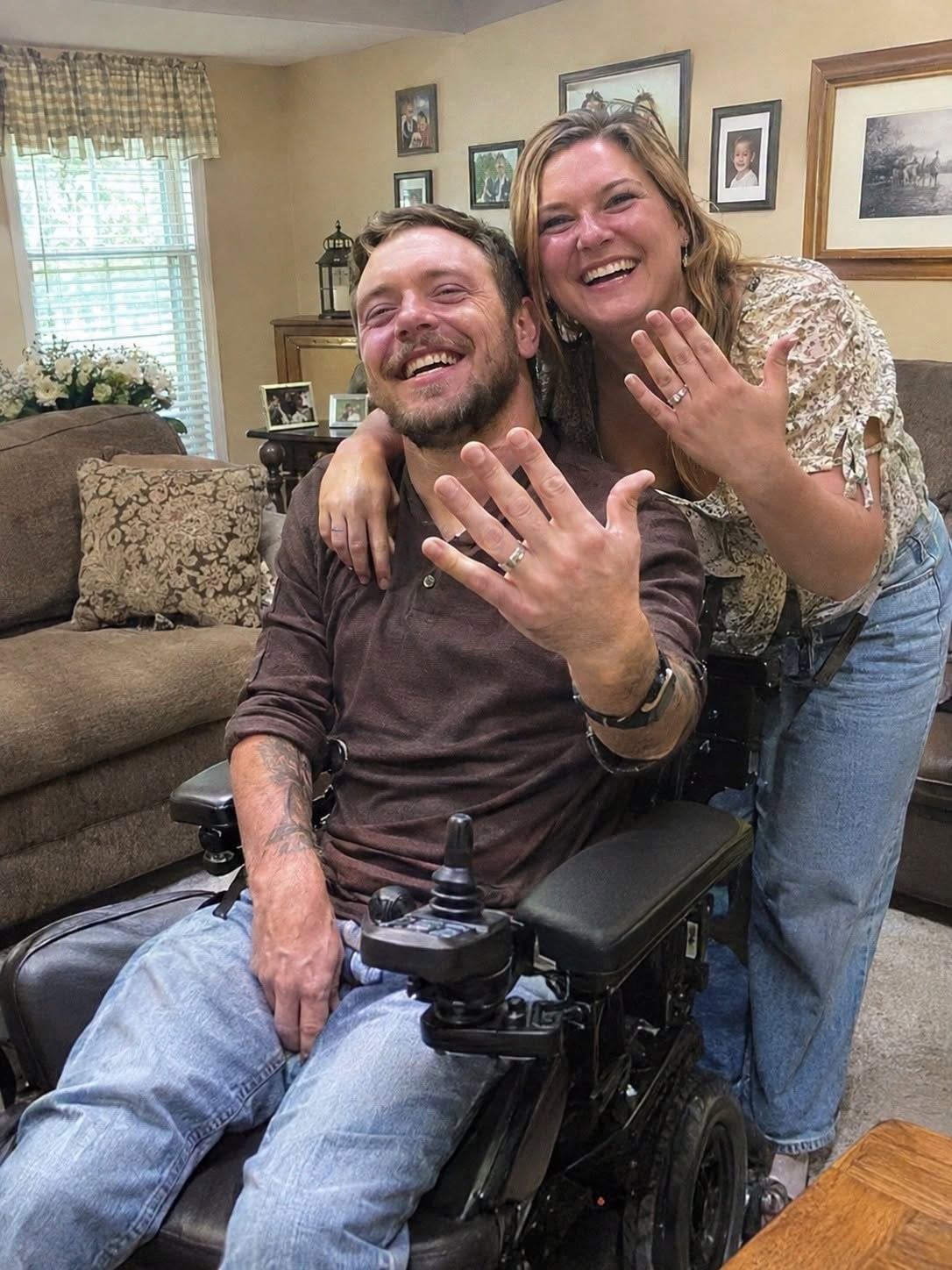
The following afternoon, a priest married us in Carl’s living room. My best friend, Dana, attended, along with Father Tomasz, who had been visiting Carl regularly.
Carl insisted on standing throughout the ceremony, holding the back of a chair for support. When it came time to place the ring on my finger, his hands shook so badly that he struggled to guide it.
I gently covered his hand with mine and helped him.
He smiled when the ring finally slipped into place.
For the next ten days, I was his wife.
Ten Days Filled With Ordinary Happiness
I moved into Carl’s house and slept on a small cot beside his hospital bed.
We watched old movies, argued about actors, and played Scrabble. I read books aloud when his eyes became too tired to follow the pages.
He continued offering cooking advice despite having little appetite himself.
“More garlic,” he would say.
“There’s already four cloves in it.”
“There’s no such thing as too much garlic.”
On my birthday, I came into the living room and found a chocolate cupcake beside his bed. It had one candle.
“How did you know?” I asked.
Carl smiled.
He said the teenager next door had picked it up for him. I assumed my birthday must have been written somewhere in my volunteer paperwork.
We shared the cupcake, although Carl could manage only a couple of bites.
A few days later, I noticed him holding an old paperback against his chest.
It was clearly important to him, but he wouldn’t let me see the cover.
That night, I woke around three in the morning and found him awake, still holding the book.
“Are you okay?” I whispered.
“I’m good,” he replied. “Go back to sleep.”
“What are you doing?”
He was quiet for a moment.
“Just making sure.”
I was tired and didn’t ask what he meant.
I wish I had.
Two mornings later, Carl died with my hand beneath his.
His final words were too quiet for me to understand. I leaned close, but I couldn’t make them out.
For a long time afterward, I wondered what he had tried to tell me.
The Envelope That Changed Everything
Carl’s funeral was small. Eighteen people attended, including former students and friends I had never met.
Several people approached me afterward to say that Carl had been their favorite teacher.
One young man told me he hadn’t even known Carl was married.
“He never talked about anyone,” he said. “We used to ask if he had a girlfriend. He always said he was waiting for someone to stop by.”
Beside the casket, someone had left a plain brown paper lunch bag. Another person had placed a small blue birdhouse with a white door.
I didn’t understand either gift.
That evening, a man arrived at my apartment. He introduced himself as Elliot Baron, Carl’s attorney.
He carried a worn leather briefcase and explained that Carl had asked him to wait until after the funeral before contacting me.
He handed me a sealed envelope with my name written in Carl’s familiar handwriting.
“Carl said you needed time to grieve the man you knew before learning who he had been,” Mr. Baron explained.
I opened the letter.
The first sentence made my knees feel weak.
Our meeting was not an accident.
Carl explained that before becoming the man I had married, he had been the quiet boy who lived two houses down from me when we were children.
His grandfather, Arthur, had raised him after Carl lost his parents in a house fire.
I suddenly remembered the neighborhood.
I remembered Arthur’s bicycle workshop, the smell of sawdust and grease, and a shy boy who struggled to speak.
His name had been Carl.
The Afternoon He Never Forgot
When I was thirteen, I often visited Arthur’s workshop. One afternoon, Arthur had stepped out to buy a part when an impatient customer arrived.
Carl tried to explain that the customer’s bicycle wasn’t ready.
But his stutter made it difficult to get the words out.
The man grew angry, told him to hurry up, and pulled the bicycle from his hands. Carl stumbled into the workbench, knocking a coffee can full of bolts onto the concrete floor.
The customer left without another word.
Carl went outside and sat beneath the maple tree at the end of the alley.
I found him there.
I was thirteen and had no idea how to comfort someone who was embarrassed and hurting. So instead of asking what had happened, I sat beside him and started talking about a kitten under our porch.
The kitten refused to drink milk, played with shoelaces, and had even bitten my father.
My mother wanted to call it Mittens. My father preferred Thumb-Biter.
I thought both names were terrible.
Carl listened quietly.
Then, after several minutes, he suggested a different name.
“B-b-Biscuit,” he said.
I looked at him.
“Biscuit?”
He nodded.
“That’s perfect,” I told him.
By the time we returned to Arthur’s workshop, Carl was smiling. We picked up the scattered bolts together and sorted them into little piles.
I forgot about that afternoon within weeks.
Carl never did.
In his letter, he explained that he had been so ashamed of his stutter that he had decided he would stop speaking altogether. He believed one humiliating moment had changed the way everyone in the neighborhood saw him.
Then I sat beside him and talked about a kitten.
I hadn’t tried to fix him or make him explain what had happened. I had simply treated him like a friend.
You gave me an ordinary afternoon when pity would have finished me, he wrote.
I pressed the letter against my face and cried.
The Journal He Kept for Twenty-One Years
Mr. Baron then handed me a leather journal.
Inside the cover was my name.
The first entry had been written when I was fifteen. Carl had written one short hope for me each year.
At sixteen, he hoped someone would ask how my day had gone and wait for the answer.
At eighteen, he hoped I would find a place where nobody packed my life into bags.
At twenty, he hoped somebody would laugh when I laughed.
At twenty-three, he hoped I wasn’t still doing everything alone out of habit.
At twenty-seven, he hoped I had a chair that was mine.
He had continued writing these entries for years.
I understood then why he had known my birthday. The cupcake hadn’t been an accidental surprise. He had remembered the date for more than two decades.
Mr. Baron explained that Carl had become a history teacher. He worked with teenagers and made sure students who couldn’t afford lunch always had something to eat.
He kept brown paper bags in his desk, filled with sandwiches, fruit, and snacks.
When a student took one, Carl pretended he had made too many.
He also stayed after school for children who didn’t want to go home. Some studied. Others slept or simply sat in his classroom.
In winter, he taught students to build birdhouses using tools that had belonged to Arthur.
They were always painted blue, with little white doors.
The birdhouse at Carl’s funeral suddenly made sense.
So did the lunch bag.
Carl had taken the kindness he remembered from his childhood and quietly passed it on to others.
Why He Had Never Looked for Me
I asked Mr. Baron why Carl had never contacted me.
He explained that Carl had tried once, when he was seventeen. After discovering which foster care office I had been sent to, he mailed me a letter.
But I had already moved to another home.
The envelope had been returned.
Arthur later advised Carl that I deserved the chance to build a new life without someone from my old neighborhood appearing unexpectedly.
Carl was young, and he accepted his grandfather’s advice.
He didn’t try again.
Years passed. Arthur died, Carl became a teacher, and life continued.
Then Carl received his diagnosis.
An oncology social worker gave him information about hospice volunteer services. On the back of a pamphlet was a list of volunteers.
My name was there.
He requested me.
He hadn’t expected me to remember him. In fact, he had decided not to tell me about our childhood connection.
He wanted to know how I had turned out. He wanted to see whether life had treated me kindly.
And he wanted me to choose him without feeling that I owed him anything.
That was why he proposed without telling me the truth.
He wanted my answer to be free.
The Book, the Leaf, and His Final Words
Mr. Baron then placed the old paperback on my coffee table.
It was Carl’s favorite copy of To Kill a Mockingbird.
He opened it carefully.
Between the pages was a pressed maple leaf, faded and brittle after twenty-two years.
I recognized it immediately.
When I was thirteen, I had borrowed that very book from Arthur’s house. When I returned it, I had picked up a red maple leaf and slipped it between the pages.
“There,” I had joked. “Now you’ll never lose your place.”
It had taken four seconds.
Carl had kept it for twenty-two years.
He had carried that little reminder through difficult days, personal disappointments, and eventually his final illness.
I finally understood why he had held the book so tightly during those last days.
Mr. Baron also told me that Carl had practiced saying something in his office before he died.
He wanted to say the name of the kitten we had named together.
“Biscuit,” Mr. Baron told me.
I began to cry again.
The last word Carl had hoped to share with me wasn’t a grand declaration. It was the name of a little kitten from an afternoon neither of us had ever expected to remember in the same way.
The People Whose Lives He Changed
In the days that followed, I learned more about the people Carl had helped.
The young man who left the lunch bag at the funeral was named Darnell. His mother had been seriously ill during his freshman year, and his family struggled to afford groceries.
For an entire school year, Carl made sure Darnell had lunch.
He never asked why the boy needed it. He simply found him and offered a bag, pretending he was doing Carl a favor by taking the extra food.
Darnell had kept the little notes Carl wrote on those bags.
Another former student, Rosa, had left the blue birdhouse. Carl had taught her how to use woodworking tools and allowed her to stay in his classroom after school when home wasn’t a place where she felt comfortable.
She became an art teacher and now teaches her own students to build birdhouses every winter.
They are always blue, with little white doors.
Carl hadn’t spent his life waiting for me.
He had spent it becoming the kind of person that one afternoon had shown him he could be.
That was the truth I needed to understand.
A Small Kindness Becomes a New Beginning
Six weeks after the funeral, I returned to Silver Oak Street.
Arthur’s workshop was gone. The alley had been replaced by an apartment building and a parking lot.
But the maple tree was still standing.
I parked nearby, sat beneath its branches, and opened Carl’s old book. The pressed leaf slipped onto my knee.
For twenty-two years, Carl had carried that ordinary afternoon with him. Whenever life became difficult, he could remember a girl sitting beside him on a curb, talking about a kitten.
I had never known how much that moment mattered.
I placed the leaf at the base of the tree.
It wasn’t discarded.
It was returned.
Later, I moved into Carl’s house on Baldwin Street. I kept his books, repaired the broken couch, and began drinking my morning tea from his chipped blue mug.
In January, I started a small program at the library.
Every Tuesday afternoon, children could come into the community room without signing up or explaining why they were there.
There were books, board games, and a Scrabble set. There were also brown paper lunch bags filled with sandwiches, fruit, and snacks.
I wrote a small note on each one.
I’m glad you came today.
You’re smarter than you think.
Take your time.
Some children did homework. Others read or rested. A few simply sat quietly.
I didn’t ask them to explain themselves.
One afternoon, a thin boy with dark hair began coming regularly. He rarely spoke, and he had a noticeable stutter.
After three weeks, he sat down at the Scrabble board.
On his fourth visit, he looked at me and asked:
“D-d-do you ch-ch-cheat?”
I studied him for a moment.
“Only when necessary,” I replied.
He smiled and placed his first word on the board.
I still volunteer with hospice three days a week. I still believe that kindness should never make someone feel like a burden.
But I understand something now that I didn’t fully understand before.
You may never know what someone is carrying when you meet them. You may never know how much a small gesture matters, or how long another person will remember it.
Sometimes, an ordinary conversation can become a turning point in someone’s life.
Sometimes, sitting beside a person without demanding an explanation is the most meaningful thing you can do.
And sometimes, the kindness you barely remember becomes the reason someone keeps going.
Ordinary kindness is never ordinary to the person who needs it.