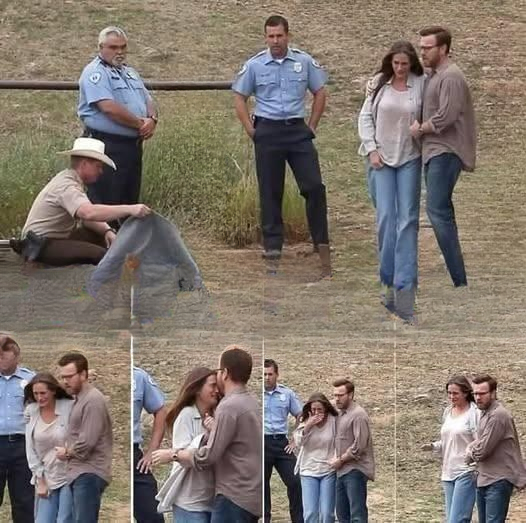
For Roberts, the part required a deliberate move away from the charm and brightness often associated with her screen presence. Barbara is not written as an idealized heroine. She is grieving, impatient, protective and deeply worn down by the emotional demands around her.
Why the stripped-down look mattered
The transformation was visible from the start. During filming in Bartlesville, Oklahoma, Roberts appeared in simple shirts, loose trousers, minimal makeup and unstyled brown hair. The choices were not decorative; they helped place Barbara in a world of pressure, fatigue and unresolved pain.
The absence of red-carpet polish allowed the character’s distress to come forward. Barbara’s appearance reflected a woman who has no energy left for performance, social grace or illusion. In that sense, Roberts’s natural look was not presented as a rejection of beauty, but as a way to make the character feel recognizable and honest.
Much of the film’s power depends on that realism. Barbara’s sharp words, long silences and exhausted expressions reveal a person trying to survive the emotional demands of being both daughter and caretaker.
Bartlesville and the atmosphere of the film
The production took place in Bartlesville, Oklahoma, a setting that matched the story’s sense of isolation and pressure. The quiet surroundings gave the family drama a stark backdrop, emphasizing the tension inside the Weston home.
Accounts from the production described Roberts as approachable during filming, often seen in low-key moments away from the set. That grounded presence contrasted with the intensity of the material she was performing.
One scene with Ewan McGregor, who played Barbara’s husband Bill Fordham, centered on the presumed death of Barbara’s father and required controlled grief rather than open melodrama. The film repeatedly asks its actors to communicate what their characters cannot fully say, and Roberts’s performance relies heavily on that restraint.
A cast built around tension
August: Osage County is also remembered for its ensemble. Meryl Streep’s Violet Weston is a sharp, volatile matriarch struggling with addiction, and her scenes with Roberts form the emotional center of the film. Their mother-daughter exchanges move between cruelty, need, disappointment and a longing neither character can easily admit.
The supporting cast included Ewan McGregor, Juliette Lewis, Benedict Cumberbatch, Abigail Breslin, Chris Cooper and Dermot Mulroney. Together, they shaped a portrait of a family where affection and harm are often tangled together.
The production also saw casting changes. Andrea Riseborough had originally been attached to play Karen Weston but withdrew, and Juliette Lewis took on the role. The final ensemble helped preserve the story’s central focus: a family gathering that exposes more than anyone intended.
Barbara Weston as a portrait of family strain
Barbara’s struggle is not only with Violet or with the immediate tragedy that brings everyone home. She is also wrestling with the weight of old patterns, the fear of becoming like her mother and the exhaustion of trying to impose order on people who resist it.
That is why the role stands out in Roberts’s career. She does not play Barbara as simply noble or simply harsh. The character can be compassionate and cutting, responsible and resentful, hopeful and defeated. Those contradictions make her feel closer to real family life than to a conventional movie heroine.
The film’s emotional honesty lies in showing that love does not erase anger, and family loyalty does not prevent lasting wounds. Roberts’s performance keeps that conflict visible without softening it too much.
Working opposite Meryl Streep
Before the film was released, much attention centered on seeing Roberts and Streep share such difficult scenes. Their pairing became one of the defining elements of the movie. Streep’s Violet attacks, deflects and provokes; Roberts’s Barbara pushes back while also revealing how deeply she still wants recognition from her mother.
Their dynamic is not built on simple opposition. Beneath the confrontations are dependence, history and the painful knowledge that both women understand each other too well. The result is a screen relationship full of tension even in quieter moments.
The source material included a quote attributed to Roberts about working with Streep, but without a verifiable citation here it is safer to focus on what is clear from the film: their scenes depend on close, responsive acting rather than showy competition.
Recognition for the performance
When August: Osage County reached audiences, its performances drew significant awards attention. Julia Roberts and Meryl Streep were both nominated for Academy Awards for their work in the film.
The movie also received recognition from major awards bodies including the Golden Globes, BAFTAs and the Screen Actors Guild Awards. Much of the discussion around Roberts focused on her restraint and her willingness to let Barbara appear difficult, depleted and emotionally exposed.
That approach helped the role become one of the notable dramatic performances of her later career. Rather than relying on the qualities that had long made her a beloved star, Roberts leaned into discomfort and imperfection.
The lasting meaning of the transformation
Roberts’s appearance in August: Osage County drew attention because it was so different from the polished image associated with many of her best-known roles. But the more important change was not cosmetic. It was emotional.
By allowing Barbara Weston to look tired, angry and unguarded, Roberts made the character’s pain feel immediate. The transformation served the story’s larger purpose: to show a family without soft focus, where truth comes out through arguments, silences and moments of collapse.
For viewers familiar with Roberts as a symbol of warmth and grace, the film offered another side of her work. It showed an actor willing to surrender glamour when the role demanded something rougher, quieter and more human.