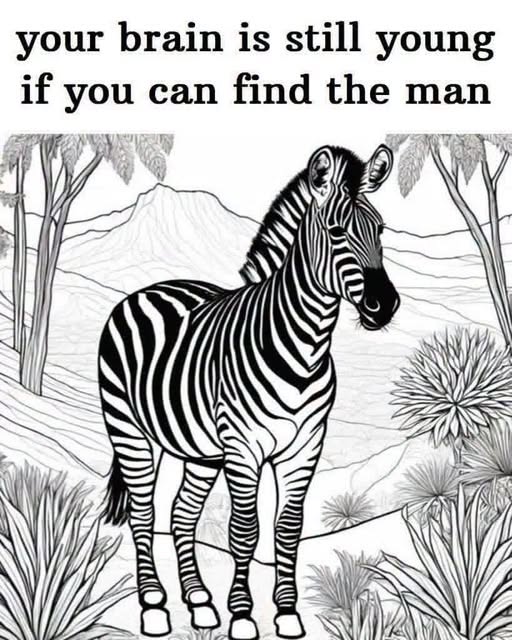
Look carefully at the trees, plants, hills, and unusual shapes throughout the illustration. Somewhere among these elements, the artist has supposedly hidden another figure.
Can you find the man in less than 30 seconds?
If you spotted him immediately, congratulations! If not, don’t worry. These puzzles are designed to make even the simplest details surprisingly difficult to recognize.
Why the Zebra Makes Such a Clever Distraction
One reason this optical illusion is challenging is the zebra itself.
Its contrasting black-and-white stripes naturally attract attention. Instead of examining the entire illustration, viewers often spend most of their time looking directly at the animal.
This is a clever visual distraction.
The artist uses the zebra as the main focal point, encouraging your eyes to overlook the surrounding shapes where the hidden figure might be concealed.
Optical illusions frequently use this technique. They encourage the brain to interpret an image in one particular way, making it harder to recognize alternative shapes or patterns.
The secret is to stop looking at the picture as a complete landscape and start examining its individual details.

6 Simple Tricks to Find the Hidden Man
Still searching? Before giving up, try these techniques. They can make hidden-picture puzzles much easier to approach.
1. Stop Looking at the Zebra
The zebra is the most noticeable object in the illustration, but that doesn’t mean it’s where you should concentrate.
Try directing your attention toward the background instead. Examine the trees, hills, and plants surrounding the animal.
2. Examine Every Corner
Divide the picture into smaller sections.
Start at the upper-left corner and gradually move across the illustration. Then examine the lower sections, paying attention to shapes that seem unusual.
A hidden figure can be surprisingly easy to miss when you’re looking at the entire picture at once.
3. Look for Facial Features
Instead of searching for a complete human figure, look for familiar facial features.
Could a curved line represent a nose? Do two small shapes resemble eyes? Does a dark outline look like a forehead or chin?
Many hidden-face puzzles use ordinary landscape elements to create recognizable human features.
4. Pay Attention to Empty Spaces
Sometimes the secret isn’t inside an object but in the space between two objects.
Look between the trees, around the plants, and near the zebra’s legs.
The spaces between shapes can create entirely different images when viewed from another perspective.
5. Zoom In and Out
Try enlarging the illustration on your phone.
Then return to the original size and look at the entire scene again.
Some optical illusions become easier when you change the viewing distance because your brain begins interpreting the shapes differently.
6. Turn the Picture Upside Down
If you’re still struggling, rotate your phone and examine the illustration from another angle.
Certain hidden-picture puzzles use shapes that become more recognizable when the image is turned sideways or upside down.
You might notice something that was practically invisible before.
Where Is the Hidden Man? The Answer Isn’t So Simple
Here’s something important about this particular zebra puzzle: despite its popularity online, a clearly verified solution from the original creator is difficult to establish.
Different versions of the illustration have circulated on social media and entertainment websites, often accompanied by captions challenging viewers to find the hidden man.
However, without an authenticated answer from the original artist, it would be misleading to point to a particular area and claim that it is definitely correct.
Some viewers believe the man’s face is formed by shapes in the surrounding landscape, while others interpret the plants and background outlines differently.
This uncertainty has become part of the puzzle’s appeal.
Rather than accepting an unverified answer, take another look and decide what you can actually identify in the drawing.
You can also share your interpretation with friends and compare what everyone notices.
Does Finding the Man Really Mean You Have a Young Brain?
The caption makes an intriguing suggestion, but there’s no scientific evidence that finding the hidden man proves someone’s brain is younger or healthier.
These challenges are entertainment puzzles, not validated cognitive assessments.
However, visual puzzles can encourage people to practice several useful mental skills, including:
- Visual attention: Concentrating on specific details within a larger image.
- Pattern recognition: Identifying shapes and similarities between objects.
- Visual perception: Understanding how different elements combine to form an image.
- Concentration: Taking time to examine information carefully.
The important distinction is that enjoying an optical illusion is not the same as measuring cognitive health.
Your age, intelligence, or mental abilities cannot be determined by whether you solve one internet puzzle.
Why Our Brains Sometimes See Faces in Unexpected Places
Have you ever looked at a cloud and noticed what appeared to be a human face? Perhaps you’ve seen a smiling expression in the front of a car or a familiar shape in the pattern of a wall.
This common experience is known as pareidolia.
Pareidolia occurs when the brain recognizes familiar patterns, particularly faces, in objects that aren’t actually human.
Our visual system is especially sensitive to facial patterns, which helps explain why we sometimes recognize faces in completely ordinary surroundings.
Artists often take advantage of this natural tendency when creating hidden-picture puzzles.
They combine lines, shadows, curves, and everyday objects to create images that can be interpreted in more than one way.
That’s why one person might immediately recognize a face while another sees nothing unusual in the same illustration.
Challenge Your Friends With This Zebra Optical Illusion
One of the best things about visual puzzles is how easily they bring people together.
You don’t need special equipment, complicated instructions, or any particular experience. Just show someone the picture and give them a little time to find the hidden figure.
For an extra challenge, try these ideas:
- Set a 30-second timer and see who spots the figure first.
- Ask everyone to explain exactly where they believe the man is hiding.
- Compare different interpretations of the illustration.
- Share the puzzle in your family or friends’ group chat.
- Come back to the image later and see whether you notice anything new.
You might discover that the person sitting next to you spots something you completely missed.
Did You Find the Hidden Man?
It’s time for one final look.
Forget the zebra’s stripes for a moment. Examine the surrounding landscape, study the unusual outlines, and pay attention to the spaces between the objects.
Can you identify the hidden man?
Remember, the claim about having a young brain is simply a playful caption, not a medical fact. The real enjoyment comes from taking on the challenge and seeing how differently people interpret the same image.
Now it’s your turn: Did you find the hidden man? How long did it take you? Share your answer in the comments and challenge someone else to solve this tricky zebra optical illusion!