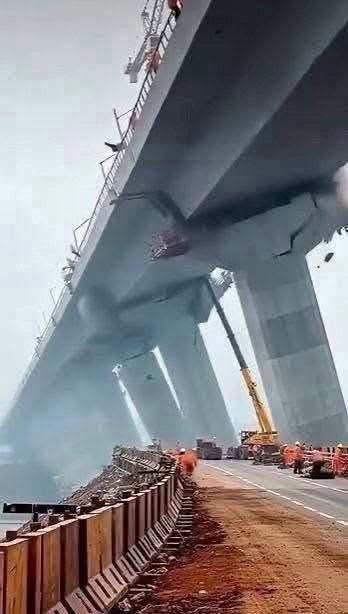
An NHAI official described the incident as a problem involving the launching girder system during its movement.
Authorities began examining the equipment and working conditions to determine what caused the failure.
A launching girder is an important piece of specialized machinery used during bridge construction.
These machines help lift, move, and position heavy components that form the bridge’s supporting spans.
Because of their size and the weight of the materials they handle, their operation requires careful planning, equipment inspection, and established safety procedures.
Was the Bridge Itself Damaged?
One of the most important clarifications came from the National Highways Authority of India.
The agency stated that the bridge structure had not sustained damage in the incident.
This distinction matters because the collapse of construction equipment is different from the structural failure of a completed bridge.
The accident happened while construction work was still underway.
Authorities did not confirm claims that motorists were driving across the bridge when the machinery fell.
Descriptions of cracking concrete, a collapsing support section, and traffic escaping a damaged roadway were not substantiated by the official accounts reviewed.
The Importance of the NH-139W Highway Project
The affected bridge forms part of the Bakarpur–Manikpur highway development project in Bihar.
The corridor is intended to improve regional transportation connections between communities in Saran, Vaishali, and Muzaffarpur districts.
Infrastructure projects of this scale involve significant construction activity, including bridge foundations, elevated spans, heavy machinery, and road development.
Improved highway connectivity can support transportation, trade, and access to services.
However, large construction projects also require strict safety procedures to protect workers and surrounding communities.
The Vaishali accident has brought renewed attention to those responsibilities.
Authorities Review Construction Safety Procedures
Following the accident, officials began examining the circumstances surrounding the equipment failure.
NHAI stated that safety standards and procedures were being reassessed to help prevent similar incidents.
Investigators were expected to review how the launching machine was being moved and whether appropriate precautions had been followed.
An equipment failure does not automatically establish negligence or poor construction quality.
Determining responsibility requires technical evidence, inspection records, and findings from the relevant authorities.
Why Heavy Equipment Safety Matters in Bridge Construction
Bridge construction frequently involves lifting and positioning extremely heavy structural components.
Launching girders, cranes, and specialized lifting systems are used to move these materials into place.
Safe operation depends on equipment condition, ground stability, load limits, operator training, and coordination among construction teams.
Routine inspections and adherence to engineering procedures can help reduce the risk of accidents.
When equipment becomes unstable, the consequences can be serious for workers positioned nearby.
The Vaishali incident highlights the importance of maintaining strong safety practices throughout the construction process.
What Happens Next?
The September accident left seven workers injured and prompted a review of safety arrangements at the project site.
Authorities stated that the main bridge structure remained undamaged.
The investigation was intended to establish why the launching equipment failed and whether additional safety measures were necessary.
The findings may help determine what changes are needed before similar work continues.
The incident serves as a reminder that major infrastructure projects require not only sound engineering design but also careful equipment management and consistent protection for the people building them.