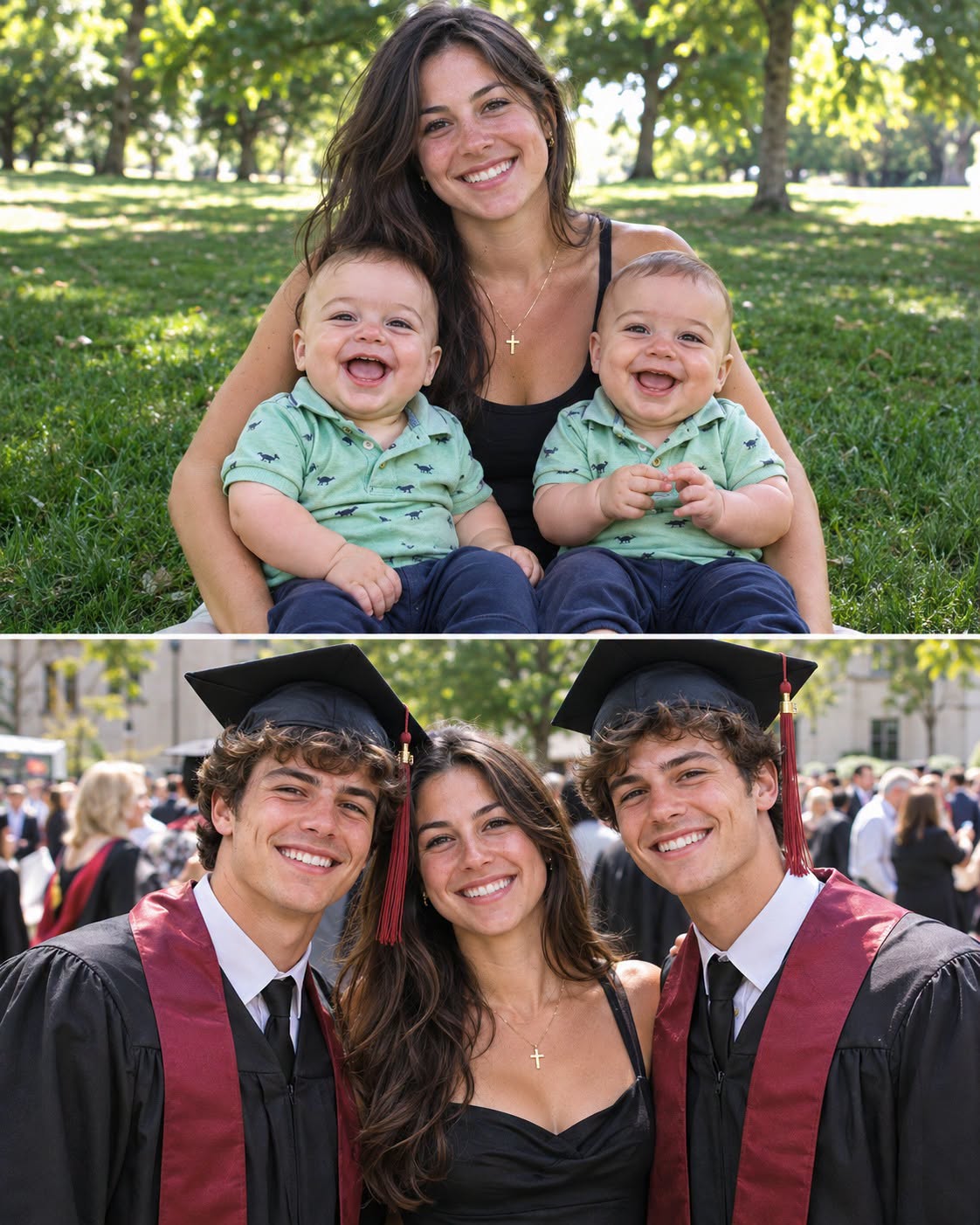
By the time Diego and Álvaro were ready to graduate from Rio Grande State, that broken frame was only one piece of a life Marina had built around them. She thought she knew every part of their story. Then, a few weeks before graduation, they began whispering.
The Sunday the Twins Arrived
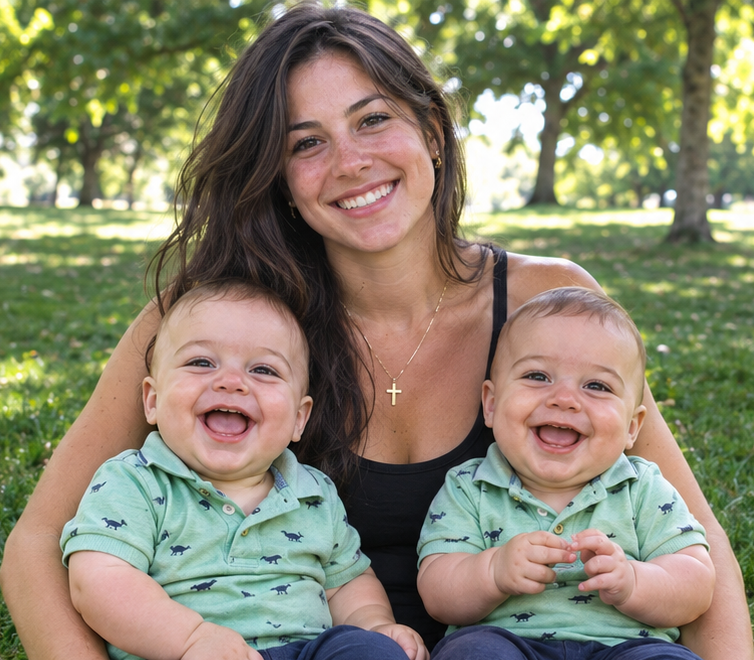
Marina was 20 years old when her father left two six-month-old babies outside her apartment above Sandoval’s Bakery in Las Cruces, New Mexico.
There were two infant car seats and a note written on the back of an electricity bill.
“I’m sorry, Marina. I can’t do this.”
Their mother had died eleven days earlier. Their father, Héctor, had lasted less than two weeks before leaving.
At the time, Marina was a second-year nursing student at Rio Grande State. She worked the 4 a.m. bakery shift rolling conchas before class. She had $312 in her checking account and no real idea how to care for one baby, much less two.
Her neighbor across the hall, Mrs. Dolores Patterson, heard the crying. She came to Marina’s door in her bathrobe, looked at the babies, and said plainly that Marina could not raise twins alone.
Marina almost called someone for help. Her aunt in El Paso. Child services. Anyone.
Then the smaller twin, Álvaro, wrapped his hand around her finger. He did not cry. He simply held on.
Marina put the phone down.
A Life Measured in Small Sacrifices
Marina would later understand that sacrifice did not usually arrive as one grand heroic act. It came in small, ordinary losses.
She left nursing school with three semesters remaining because daycare on Solano Drive cost $1,140 a month for two infants, and she earned $11.25 an hour. She worked long bakery shifts, then took a medical billing job at a clinic on Telshor Boulevard. It was as close as she came for years to the hospital career she once imagined.
She learned to cut the boys’ hair from an online video and did such a poor job once that Diego wore a beanie for his second-grade picture. He kept reminding her of it at Thanksgiving.
She kept a spiral notebook on top of the refrigerator with fevers, medicine doses and pediatrician phone numbers, terrified she might forget something important.
At some point, “Sister Marina” became “Mom.”
Álvaro said it first at age three in a grocery store. Diego took longer, waiting until kindergarten. Marina never asked either of them to use the word.
The boys were twins, but not alike. Diego was tender, cautious and quick to worry. He cried at movies and sad commercials. Álvaro was loud, restless and generous, once giving away his whole lunch on the bus and returning home hungry but proud.
Marina showed up for all of it: middle-of-the-night fevers, science fairs in overheated gyms, parent-teacher conferences where she was always the youngest parent in the room, and the teenage years when both boys seemed angry at her at once.
The Words She Had Been Waiting to Hear
The most painful night came when the boys were 14.
Marina grounded Álvaro after he skipped school to go to the river with older kids. He slammed his bedroom door so hard that a framed photo fell from the hallway wall. The glass cracked across the White Sands picture.
Then he shouted that Marina was not his real mom.
She picked up the frame and answered through the door that he was right. His real mother, she said, would have grounded him for two weeks; Marina had planned on one.
An hour later, Álvaro knocked on her bedroom door in his socks, holding the broken frame. He apologized and promised to pay for the glass. It cost $6.99 at Walgreens, and he repaid her in quarters.
Marina missed things for the boys, too. Her best friend Carla’s wedding in San Diego. A trip to Mexico City with coworkers. A future with Ben, a kind high school history teacher who asked her to marry him when Diego and Álvaro were 11.
Ben wanted to move to Denver for a job and believed they could make it work as a family of four. Marina said no. The boys were finally settled, and she had decided long before that when people left, someone had to stay.
What she had not realized was that staying did not have to mean disappearing.
The Boys Got Into the School She Left Behind
Diego and Álvaro both earned scholarships to Rio Grande State, the university Marina had walked away from years earlier.
Diego studied accounting. Álvaro chose kinesiology, joking that it meant learning why people fall down. Their dorm was only 20 minutes from Marina’s apartment, and they still came home on Sundays with laundry and big appetites.
Graduation was scheduled for Saturday, May 16.
Marina, then 42, bought a $54 dress from Dillard’s on sale. She asked for the day off and practiced in the bathroom mirror how not to cry. On the back of a bakery receipt, she wrote a practical list: sunscreen, tissues, camera batteries, and a reminder not to yell their names too wildly.
There was another list she kept only in her head: everything that would change after graduation. Diego had accepted a job in Albuquerque, three and a half hours away. Álvaro was considering graduate programs in Colorado.
For 22 years, her days had revolved around two boys who needed her. She did not know who she would be when they no longer did.
Then, in March, she noticed them hiding conversations.
A Student ID, a Strange Question and a Receipt
One Sunday, Marina walked into the kitchen and the boys stopped talking too quickly. Álvaro loudly said it was nothing. Diego stared at the salt shaker.
Not long after, Diego asked if she still had her old student ID number from Rio Grande State. He said it was for a financial aid form with a family education section. Marina found the old card in a shoebox. It showed a younger version of her with a ponytail. Diego took a photo of it and handed it back.
Two weeks later, Álvaro asked whether their mother had ever called Marina mija, or by another name.
They almost never discussed their mother. Marina told him she had called her Mari, and only she used that name. Álvaro claimed he was just wondering, which Marina did not believe.
At the end of March, the boys said they were driving to Phoenix for a career fair. Marina packed burritos in foil and told them to text when they arrived.
The next Sunday, while checking Álvaro’s jeans pockets before washing them, she found a folded parking stub.
It was from Casa de la Luz Hospice in Tucson, Arizona, dated Saturday, March 28.
Tucson was not really on the way to Phoenix. And Marina knew of only one person connected to Tucson: her father. Years earlier, her aunt in El Paso had heard that Héctor was working construction there.
Marina did not confront the boys immediately. Instead, she watched. Diego took calls from a 520 area code outside. Álvaro closed his laptop when she passed behind him. They spoke about graduation plans using “we,” as though Marina was outside them.
Finally, on April 19, over enchiladas at the kitchen table, Marina asked who they knew in Tucson.
Diego looked at Álvaro, then asked if she could trust them for four more weeks.
Marina asked if it was their father.
The boys said nothing.
To Marina, their silence answered everything.
The Call From Tucson
Two days later, Marina’s phone rang at 7:40 in the morning as she was locking up after an early bakery shift.
The voice asked for Marina Ortiz. She recognized him before he said his name.
It was Héctor.
He told her the boys had found him, though he had not searched for them. According to him, a hospice social worker found Diego’s name through an old insurance form and reached out. The boys had visited.
Héctor said he had stage four lung cancer and had been told he had weeks, perhaps a month. He wanted to see Marina once.
She did not answer him that day. She said she needed time.
That night, she sat with a checkbook and calculator. A round-trip flight from El Paso to Tucson was $418. Missing two clinic shifts would cost another $310. She had $2,940 in savings, most of it intended for the boys’ graduation dinner and a used car for Diego’s job in Albuquerque.
But the money was not the real question. The real question was whether she could face the man who had left two babies at her door and walked away.
Mrs. Patterson, now 89 and still living across the hall, listened while Jeopardy! played on mute. She told Marina she did not owe Héctor a visit, but she might owe herself one.
Marina flew to Tucson on Friday, April 24.
What Héctor Had Kept
At Casa de la Luz, Marina found her father much smaller than she remembered. He was 66 but looked older, with a tube under his nose and his hands resting on the blanket.
She sat with her purse in her lap and told him she was not there to say what he did was okay. It was not. She would stay for one hour.
They mostly spoke about Diego and Álvaro. Héctor asked what Álvaro had been like as a child and whether Diego still cried at movies. Marina was startled that he knew that. Héctor said Diego had cried in his hospice room twice.
Then Marina asked the question she had carried for 22 years: why had he left the twins with her instead of with Aunt Rosa or at a hospital?
Héctor said their mother, Lucía, had told him to. If he could not manage, she had said, he should take the babies to Mari, because Mari would know what to do.
He admitted that this did not make his choice right. He said he had been drowning, and Marina was the only person he knew who could swim.
Near the end of the hour, he told Marina he had kept something that belonged to her for 22 years. He called it possibly worse than leaving.
He had given it to the boys. They had asked to be the ones to give it to her.
Marina left after exactly one hour, wondering what could have been hidden from her for so long.
The Presentation After Graduation
On May 16, the Pan American Center was hot and bright with graduation excitement. Marina sat in Section G, Row 14, wearing her sale dress and holding a cheap Canon camera. Mrs. Patterson sat beside her in a wheelchair with the program in her hands.
Diego’s name was called first: Bachelor of Business Administration, Accounting. He was crying before he reached the steps.
Then came Álvaro: Bachelor of Science, Kinesiology. He stopped onstage, found Marina in the crowd and waved his whole arm the way he had as a child.
Marina thought that was the moment she had waited for since she was 20.
Then the dean, Dr. Patricia Whitfield, returned to the microphone and announced one more presentation.
Diego and Álvaro walked back onto the stage together.
Álvaro took the microphone and began by saying their mother could not be there. Her name was Lucía Ortiz. She had died when the twins were six months old from a heart condition called peripartum cardiomyopathy, which can occur after childbirth. She had learned she was sick when the babies were three weeks old.
Marina had known her mother was ill. She had not known Lucía had known so early.
Álvaro explained that Lucía had written something and asked Héctor to give it to Marina if anything happened. Héctor had never delivered it. He kept it for 22 years and gave it to the twins in March.
Diego pulled out an old folded paper, yellowed along the creases.
Álvaro opened the letter carefully and read the first line.
“Mari, if you are reading this, then you did exactly what I was afraid you would do. You stayed.”
Marina’s legs gave out. One moment she was standing with the camera; the next she was on her knees on the concrete between rows while someone behind her held her shoulders.
Álvaro continued reading. In the letter, Lucía said she knew Marina would give the boys everything: time, money, sleep and her whole life. Lucía asked on Marina’s behalf that she finish school, no matter how long it took, and let the boys grow up and care for her someday. She wrote that family was for that.
Lucía also wrote that Héctor would try, and if he could not, Marina should not hate him too long, because hate was heavy.
She ended by saying she was sorry to leave her boys, but she could not think of better hands.
The arena went silent.
Then Diego took the microphone. Their mother had asked Marina to finish school, he said, and had asked the boys to take care of her one day.
He produced a second, newer envelope.
Dr. Whitfield read it aloud. Marina’s application for readmission to the Bachelor of Science in Nursing program had been approved. Her previous 41 credit hours had been reinstated. Her first semester’s tuition, $4,312, had been paid in full.
The Secret Behind the Gift
Later, at the Applebee’s on Lohman Avenue because Álvaro wanted to celebrate there, the boys explained everything.
The hospice social worker had reached Diego in early March. Héctor had asked only that his children be told he was dying. Diego and Álvaro had spent a week deciding whether to tell Marina.
They went first because they did not want him to hurt her again. They wanted to make sure he was safe for her.
Marina realized then that the boys had done for her what she had done for them for 22 years. They had stood between her and the door.
The tuition money came from two years of savings. Diego had worked as a tax-prep assistant each spring. Álvaro had worked weekends at a physical therapy clinic, folding towels and cleaning equipment.
The old student ID number had been for the readmission application. Álvaro’s question about mija had been about verifying the letter. When Marina said only Lucía had called her Mari, the boys knew the letter was real.
Marina told them they were never again allowed to keep secrets from her about Héctor, even good ones. Both agreed.
Héctor died on June 9, 24 days after graduation. Marina did not fly back, but a week before he died she mailed him the blurry photograph of Álvaro waving from the stage. On the back, she wrote that the boys had turned out good, that it had been her doing, and thanked him for finally giving the letter back.
A hospice nurse later told her he kept the picture on his tray table until the end.
Marina’s Turn
In January, Marina returned to Rio Grande State at 42. On the first day, a student asked if she was the professor. Marina said no, she was only a little late.
She reduced her clinic hours to part-time. Diego, now working for an accounting firm in Albuquerque, made her a color-coded budget spreadsheet and sent monthly reminders to stop paying for things for him and Álvaro. Álvaro moved back to Las Cruces to work full time at the physical therapy clinic and brought Marina dinner on Wednesday nights when she had late labs.
During her first clinical rotation at Memorial Medical Center, she wore navy blue scrubs and a badge that read: Marina Ortiz, Student Nurse.
Before the shift, she found a small package on her car seat. Inside was the Canon camera she had dropped at graduation. Álvaro had picked it up and kept it.
A sticky note on the lens, in Diego’s careful handwriting, said it was her turn to be in the picture. Álvaro had added, in messy capital letters, that they had bought new batteries.
Both brothers were waiting in the parking garage. Álvaro took the photograph. Diego cried.
Marina framed her mother’s letter and hung it above the kitchen table where the boys had once done their homework. Some mornings before class, she reread the last line.
I couldn’t think of better hands.
For years, she believed staying meant giving up her own life so the boys could have one. In the end, staying had built a life large enough for all three of them.