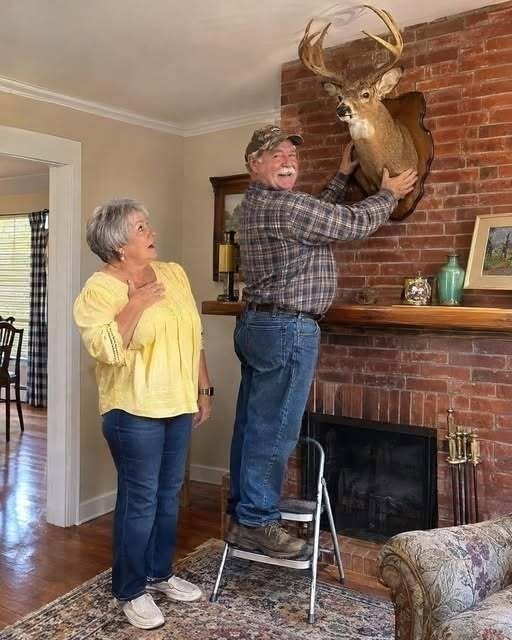
“Those photographs have been in this house for years.”
“Well, Mama should feel comfortable.”
The following morning, he asked me to prepare a large Sunday dinner.
“Fried chicken and coconut cake,” he said. “Mama loves coconut cake.”
“I’ll have something special ready,” I replied.
That night, I lay awake beside him.
I had married Lamont because the house had felt painfully quiet after Wardell died. I missed having someone to talk to over breakfast and someone waiting at the door when I returned from the grocery store.
Perhaps I had mistaken companionship for love.
The thought brought tears to my eyes.
The next morning, I decided to make one phone call.
I found Lamont’s mother’s number in the address book beside the coffee maker.
Her name was Clementine Sizemore. She was eighty-nine years old, and I remembered her as a sharp, observant woman.
“Miss Clementine, this is Dorinda. I wanted to make sure you knew we’re expecting you Sunday.”
There was a long silence.
“Expecting me? Honey, Lamont told me you had invited us. He said you were struggling to manage that big house by yourself.”
I sat down.
“He said I was struggling?”
“Yes. He also said he had bought the house for you.”
I stared at the kitchen wall.
“Miss Clementine, there’s something you should know about this house.”
For the next twenty minutes, I explained the situation.
I told her about the deer head, the bedrooms, the sewing room, and Lamont’s announcement that his family would be moving in.
She listened without interrupting.
When I finished, she asked one question.
“Is his daddy’s deer head hanging over your fireplace?”
“Yes, ma’am.”
“Well, leave it there for now. I’ll see you Sunday.”
The Sunday Visit
Sunday arrived.
I didn’t prepare the fried chicken Lamont had requested.
Instead, my neighbor Nedra came over to help me straighten the porch and arrange the rocking chairs.
Lamont was in the shower, singing as usual.
Just after lunch, we heard a vehicle coming up the driveway.
His father’s old blue pickup pulled in.
Patricia was driving, and Miss Clementine sat in the passenger seat.
There were no suitcases or moving boxes in the truck bed.
Lamont hurried outside, buttoning his shirt.
“Mama! Y’all made it!”
Miss Clementine stepped out carefully. She wore a blue Sunday dress, white gloves, and a small flowered hat.
She looked at the porch, the flowerpots, and the rocking chairs.
Then her eyes moved toward the living room window.
She could see the mounted deer head above the fireplace.
“Lamont,” she said, “what in the world have you done?”
He laughed nervously.
“What do you mean, Mama?”
“Did you really hang your daddy’s deer head in this woman’s home?”
Lamont shrugged.
“It’s our house now.”
Miss Clementine turned toward me.
“Is that what he’s been telling you?”
I greeted her and invited everyone onto the porch.
She took my hands.
“Honey, before anybody brings a suitcase into this house, I believe we need to have a conversation.”
Lamont sighed.
“Mama, we already discussed this.”
“No, son. You talked. I listened. Those are two different things.”
She settled into one of the rocking chairs and asked me to explain what had happened.
I told her everything.
Patricia looked genuinely surprised when she heard that Lamont had promised her my sewing room.
“Where is Dorinda supposed to sew?” she asked.
“She can find somewhere else,” Lamont replied.
Nedra quietly lowered her coffee cup.
Miss Clementine closed her eyes for a moment.
Then she looked directly at her son.
“Did you tell me Dorinda begged you to bring us here?”
Lamont shifted in his chair.
“I was trying to make you feel welcome.”
“Did you tell me she couldn’t afford to maintain this house?”
He said nothing.
“Did you tell me you bought it for her?”
Lamont raised his voice.
“We’re married! What’s mine is hers and what’s hers is mine.”
His mother shook her head.
“That wasn’t my question.”
She reached into her handbag and removed a folded letter.
“I brought something with me.”
Lamont’s expression changed immediately.
“Mama, don’t.”
But she unfolded the paper.
What His Mother Knew
Miss Clementine explained that Lamont’s late father had left him some money. It wasn’t an enormous inheritance, but it was enough to help him establish himself financially.
Instead of saving or investing it, Lamont had spent most of it on vehicles, vacations, hunting equipment, and several unsuccessful business ideas.
After the money was gone, he had repeatedly asked his mother for financial help.
“I wanted to believe he was simply having a difficult time,” she explained. “But then he came to me with another plan.”
She looked at me.
“Six months before your wedding, Lamont told me he had met a woman with a beautiful home and a good pension. He said marrying her would give him the stability he needed.”
I felt my stomach tighten.
Lamont stood.
“That’s not what I said!”
His mother calmly removed another paper.
“Then perhaps you can explain this letter.”
It was a message he had written to her describing his plans for the future.
According to Clementine, he had discussed convincing me to sell the house eventually and use the proceeds to finance a business.
I looked at Lamont.
“Is this true?”
He rubbed his forehead.
“I was trying to build a future for us.”
“A future that involved selling my house?”
“I thought we could make something together.”
“You never asked me.”
He had no answer.
Then Miss Clementine reached into her handbag again.
She showed me a photograph.
It was a picture of Lamont standing outside my house with a real estate agent.
The date was four months before we had met.
I recognized the agent immediately. He was the same man who had helped Wardell and me purchase the property decades earlier.
I looked up.
“Why were you meeting with him?”
Lamont stared at the photograph.
“I was asking about property values.”
“Before you even knew me?”
He remained silent.
His mother explained that Lamont had asked about purchasing the property and had discussed the possibility of eventually selling it.
I felt deeply disappointed.
I had believed our marriage was built on affection and companionship.
Now I was beginning to understand that he had been thinking about my home long before he became my husband.
A Difficult Decision
Patricia finally spoke.
“Lamont, is this why you kept asking me for money?”
He turned toward her.
“Stay out of it.”
“No. I’m tired of staying out of it. You borrowed seven thousand dollars from me last year. You said you had a business opportunity.”
Miss Clementine added that Lamont had borrowed more than eighteen thousand dollars from her over several years.
He had repaid very little.
I looked at him.
“How much do you owe?”
“That’s none of your business.”
“You were planning to bring your family into my home and sell my property. I believe it has become my business.”
He finally lost his temper.
“You’re sixty-seven years old, Dorinda! What do you need all these rooms for?”
The comment hurt.
But before I could respond, Miss Clementine stood.
“That’s enough, Lamont.”
She looked at her son with disappointment.
“Your father taught you that respect is something you earn. He never taught you that being a husband gives you the right to control another person.”
Then she turned toward me.
“I didn’t come here to move in, honey. I came because I wanted to understand what was happening.”
Her voice softened.
“When you called me Saturday, I heard a woman trying to be polite while someone ignored her wishes. You deserve better than that.”
I wiped my eyes.
“I didn’t want trouble.”
She squeezed my hand.
“Sometimes keeping the peace means allowing someone else to take more than they should. You have every right to stand up for yourself.”
Lamont picked up his suitcase and walked toward the driveway.
“You’re making a mistake, Dorinda.”
I looked at him.
“No. I made one three weeks ago. I’m correcting it now.”
He drove away.
For several moments, nobody spoke.
Then Patricia sat beside me on the porch steps.
“I’m sorry,” she said. “I didn’t know he had planned all this. I lost my apartment when the building was sold, and Lamont told me you had invited us.”
I listened.
She explained that she had been staying with her mother and was embarrassed about her housing situation.
I felt sympathy for her.
But I also understood that her difficulties did not make my home available without my permission.
“I’m sorry things have been difficult,” I told her. “I hope you find a comfortable place of your own.”
She nodded.
“I should have called you myself.”
“Yes, you should have.”
Nedra finally spoke.
“Well, at least somebody learned something today.”
We all laughed.
And for the first time that Sunday, I felt that my home was mine again.
Protecting What I Had Worked For
The following Monday, I called my attorney, Rebecca Collins.
She had helped me organize my estate after Wardell passed away.
I explained what had happened and asked her to review my property documents.
She advised me not to sign anything or agree to any financial arrangements until we had reviewed the relevant paperwork.
At her office, we examined my deed, mortgage records, and other documents.
The mortgage had been paid off, and the deed remained in my name alone.
Lamont had never contributed to the purchase of the house.
Rebecca explained that marriage does not automatically transfer ownership of every asset to a spouse, although property rights can depend on state law and individual circumstances.
She recommended that we review everything carefully and make sure my estate planning and financial records reflected my wishes.
I was relieved.
I didn’t want Lamont’s money or belongings.
I simply wanted to protect the home I had worked so hard to own.
That evening, I removed the deer head from the fireplace.
My handyman helped me restore the living room to its original arrangement.
I put Wardell’s wedding-ring quilt back above the mantel and returned his photograph to its place.
Then I stood in the middle of the room.
Everything looked familiar again.
I had not realized how much I had missed that feeling.
Learning to Start Again
A few days later, Lamont called.
He apologized for announcing that his mother and sister would move in without consulting me.
He also admitted that he should not have spoken as though he controlled the property.
But when he asked whether he could come home, I knew my answer.
“Lamont, we could have shared a life. We could have shared meals, laughter, holidays, and memories. But sharing a life doesn’t mean one person gets to control everything the other person has worked for.”
He asked me to forget what had happened.
I couldn’t.
There had been too many decisions made without my knowledge. Too many promises made using my home and my resources.
I told him I wanted to end the marriage.
The process took time, but my attorney helped me handle the separation properly. We reviewed the relevant financial and property matters and reached an agreement through the appropriate legal process.
Eventually, the divorce was finalized.
On the day I received the final paperwork, I sat on my porch with a glass of lemonade.
Nedra came over carrying a pie.
“Well?”
I held up the envelope.
“It’s official.”
She smiled.
“How does it feel?”
I looked at my white house, the flowerpots, and the rocking chairs.
“Peaceful,” I said. “It feels peaceful.”
An Unexpected Friendship
In the months that followed, Miss Clementine and I remained in touch.
She called every Sunday afternoon.
Sometimes we talked about recipes. Sometimes we discussed the weather. Occasionally, she shared stories about Lamont as a child.
She never excused his behavior, but she never stopped loving him either.
Patricia eventually found a small apartment near her workplace.
She sent me a photograph of her new living room, which had a sunny window and a little balcony.
I was happy for her.
One Saturday, Miss Clementine invited me to lunch.
After we finished eating, she brought out an old family photo album.
There were photographs of Lamont as a child, pictures of family holidays, and several photographs of her late husband, Earl.
“He wasn’t perfect,” she said, pointing to one photograph, “but he understood that marriage was supposed to be a partnership.”
I smiled.
“That sounds like a valuable lesson.”
She nodded.
“One I wish my son had learned sooner.”
Then she looked at me.
“I hope you don’t regret trying again after losing Wardell.”
I thought about that for a moment.
“I don’t regret wanting companionship. I only regret ignoring the warning signs.”
She took my hand.
“Being alone is not the worst thing that can happen to a person. Being with someone who makes you feel alone can be much harder.”
I remembered those words for a long time.
The Home I Chose to Keep
Almost a year after that Sunday, I invited Miss Clementine, Patricia, and Nedra over for dinner.
This time, I made the fried chicken and coconut cake Lamont had requested.
We ate together around my dining table.
Nobody made demands about the bedrooms.
Nobody questioned my furniture.
Nobody told me how to arrange my home.
After dinner, Miss Clementine stood beside the fireplace.
She looked at Wardell’s photograph and the quilt hanging above it.
“That’s a beautiful memory,” she said.
“It is,” I replied.
She smiled.
“Then let’s leave it where it belongs.”
We spent the evening talking and laughing.
Looking around the room, I realized that my home had become something more meaningful than a property I had paid off.
It was a place where people could visit without expecting to own it.
A place where kindness was freely given.
A place where I could make my own decisions.
Today, I am sixty-eight years old.
I still live in the same little white house in Madison, Georgia.
My mortgage is paid, my sewing room is exactly where I want it, and Wardell’s wedding-ring quilt remains above the fireplace.
Miss Clementine is one of my closest friends.
Patricia visits occasionally, and Nedra still comes across the road with coffee and neighborhood news.
Lamont eventually began working regularly and made efforts to repay some of the money he owed his family. I genuinely hope he continues making better decisions.
But I no longer wait for him to change.
I have learned that forgiveness does not require reopening a door that you have every right to keep closed.
Sometimes, the most important decision a person can make is to protect their peace.
I often think about the Sunday when Lamont’s mother stepped out of that old blue pickup.
He expected her to walk into my house and claim a bedroom.
Instead, she looked at my porch, took my hands, and helped me understand that I had every right to say no.
She didn’t take my house.
She didn’t fight my battles for me.
She simply told the truth.
And that made all the difference.
The deer head is long gone.
The quilt is back.
The photographs remain.
And every morning, when I walk into my living room, I remember something I should never have forgotten:
A home is more than a building. It represents years of work, memories, independence, and the freedom to decide who belongs in your life.
Marriage should add to that life, not take it away.
At sixty-seven, I learned that starting over is possible.
At sixty-eight, I finally understood that peace is worth protecting.
And I have never been happier to call this little white house my home.