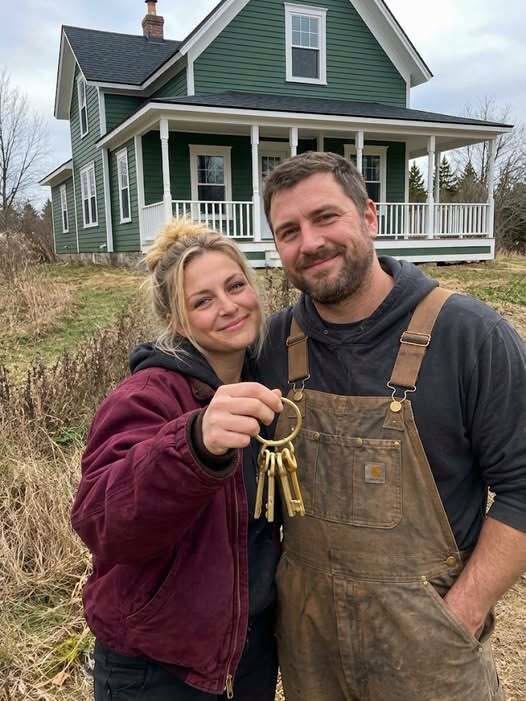
I helped her up the single wooden step we’d reinforced the previous week. Nate was in the kitchen replacing a section of the old floor when he heard us enter. He straightened, wiped his hands on his jeans, and stared.
“Grandma? What are you doing here?”
Opal smiled. “Making sure my grandson hasn’t lost his mind.”
Nate laughed and hugged her carefully.
For a while, we gave her a tour. We showed her the kitchen where the cabinets still needed sanding, the living room where we’d uncovered an original brick fireplace, and the two bedrooms where we planned to sleep once the electrical work was finished. The house was rough, but it was ours.
Opal listened without interrupting. She ran her fingers along the old mantel, examined the repaired window frames, and asked how much we’d paid for the property.
“Forty-one thousand five hundred dollars,” Nate answered.
She nodded slowly. “And how much have you spent fixing it?”
We exchanged a glance.
“About four thousand so far,” I said. “We’ve done almost everything ourselves.”
“Four thousand,” she repeated. “And where did you get that money?”
“Extra work. Savings. A few things we sold.”
Nate didn’t mention the fishing boat. He’d loved that boat since he was twenty-three. Selling it had been one of the hardest decisions he’d made, but he’d never complained.
Opal looked from him to me. “You’ve both been working yourselves into the ground, haven’t you?”
Neither of us answered.
She gave a small sigh. “I thought so.”
We sat around a folding table in the kitchen while I made tea on the portable hot plate. Opal placed her handbag on her lap and stared at the zipper for several seconds. Then she looked directly at Nate.
“I heard about Easter dinner.”
His expression changed immediately.
“Grandma, that was two years ago.”
“And yet you remember it.”
He lowered his eyes. “Of course I remember it.”
“So do I,” she said. “Your mother told me all about it.”
I nearly dropped the spoon I was holding.
“Judy told you?”
Opal nodded. “She thought it was a wonderful idea. She said the other three children needed help getting established, while you and Nate were capable enough to manage on your own.”
I felt the familiar sting return. Even after two years, I could still see those envelopes beneath the plates. I could still hear the excitement in Kim’s voice when she discovered the check inside hers. And I could still remember opening our envelope and finding nothing but a greeting card.
Opal watched my face. “Did you ever ask them why?”
I shook my head. “No. We didn’t want to turn a family dinner into an argument.”
“Of course you didn’t,” she murmured. “That’s always been your trouble. You’d rather swallow a hurt than make someone else uncomfortable.”
Nate leaned forward. “Grandma, we aren’t asking for anything now. We bought this place ourselves, and we’ll finish it ourselves.”
“I know you will.”
She opened her handbag and removed a small envelope. It was old, cream-colored, and sealed with a strip of clear tape. My name was written on the front.
Not Nate’s.
Mine.
I stared at it. “What’s this?”
“Something I’ve been holding onto for a long time,” Opal replied. “And something I think you deserve to understand.”
She slid the envelope across the table. Inside was a folded letter and a photocopy of a document bearing a county clerk’s stamp.
I unfolded the letter first. The handwriting was unmistakably Opal’s, though it was shakier than it had been on the birthday cards she sent every year.
Dear Nate and Emily,
If you’re reading this, then you’ve found a place to build your life together. I hope you’ve made it into a home, not simply a house.
There are things about this family that you may not understand. Some have been kept quiet for years because I believed silence would prevent trouble. I’ve come to realize that silence sometimes allows unfairness to continue.
I stopped reading. Nate reached across the table and took my hand.
I continued.
Your grandfather believed that every child should have an opportunity to build a stable future. But he also believed that help should be given with an honest heart, not used to measure which child deserves more love.
I have watched you both work, sacrifice, and make difficult decisions without asking anyone to rescue you.
I am proud of you.
At the bottom, Opal had written one final sentence.
Please examine the enclosed document before you decide what to do next.
I unfolded the photocopy. It was a page from a trust agreement created years earlier by Nate’s grandfather, Walter. I recognized his name, but the legal language meant little to me at first.
Nate leaned over my shoulder.
Then he stopped breathing for a moment.
“What is it?” I whispered.
He read the page again. “Grandma, is this real?”
Opal folded her hands. “Yes.”
He turned toward me. “Grandpa established an education and housing assistance fund for the grandchildren.”
I blinked. “What?”
“It’s right here,” he said, pointing to a paragraph near the bottom. “The fund was supposed to provide equal assistance to each grandchild when they reached adulthood, subject to the terms of the trust.”
I looked at Opal. “But Kim, Jeff, and Stacy received money from your parents?”
“They received money from their parents,” she corrected gently. “Whether that money came from the trust is a different question.”
She took a breath. “Your grandfather made me a trustee before he died. Later, Ronald and Judy took over much of the family’s financial administration. I trusted them to handle the paperwork properly.”
Nate’s face had grown pale. “Are you saying my parents used the trust to give everyone else money and left us out?”
“No,” Opal replied firmly. “I’m saying I don’t know exactly how they handled every transaction. I won’t accuse anyone without seeing the full records.”
That answer surprised me. She wasn’t there to stir up an argument. She wanted the truth.
“And what does the document mean for us?” I asked.
Opal reached for the photocopy. “It means you have a legitimate reason to ask whether the fund was administered according to its terms. It doesn’t automatically mean you’re owed $20,000 today. We need the complete agreement, the account records, and a clear explanation of what happened.”
Nate leaned back in his chair. For two years, he’d carried the embarrassment of that Easter dinner without saying much about it. He’d worked late nights and sold something he loved because he wanted us to have a home of our own.
Now he was looking at evidence that there might have been a family fund intended to help all the grandchildren.
He rubbed his face. “Why didn’t you tell us sooner?”
Opal looked genuinely sad. “Because I didn’t have the complete records, and because I made the mistake of assuming your parents had handled everything fairly. I should have asked questions earlier.”
She reached across the table and touched his wrist. “I’m sorry, sweetheart.”
Nate stared at the old document. Then he folded it carefully.
“What do we do now?”
Opal gave him a small smile. “First, you finish this house. Second, you don’t make any decisions out of anger. And third, we find out what happened.”
For the next hour, she told us what she remembered about Walter’s plans. He’d worked for decades, saved carefully, and believed that money should give younger generations a chance to establish themselves. He had never promised anyone a particular amount, but he’d created the fund to help the grandchildren with education, housing, or other approved needs.
After his death, the family had changed. Ronald had become increasingly involved in financial decisions. Judy handled much of the correspondence. The younger children had received help with their homes, but Opal couldn’t say whether the payments had come from the trust, their parents’ personal savings, or a combination of the two.
That distinction mattered.
We agreed not to accuse anyone until we knew more.
Before Opal left, I helped her back to the car. She paused at the front door and looked around the little living room.
“You know,” she said, “your grandfather would have liked this place.”
“Even with the roof still leaking?”
She laughed. “Especially with the roof still leaking. He always said a home was worth more when someone cared enough to repair it.”
Then she turned serious. “Emily, promise me something.”
“What?”
“Don’t let this discovery turn your marriage into a competition with the other grandchildren. Whatever the records show, your life is not worth more or less because of what someone else received.”
I nodded. “I promise.”
She squeezed my hand before getting into the car.
I watched her drive away, then returned to the kitchen. Nate was still sitting at the table with the photocopy in front of him.
“Are you all right?” I asked.
He shook his head. “I don’t know.”
I sat beside him. “Neither do I.”
He looked at the letter again. “For two years, I told myself that the card was just a card. I told myself that Mom and Dad thought we were strong enough to manage. I kept saying that we didn’t need their money.”
“You’re right about one thing,” I said. “We don’t need their money to make this house a home.”
He nodded. “But if Grandpa set something aside for all of us, I want to know whether it was handled properly.”
“So do I.”
That evening, we put the documents in a folder and went back to work. There was a kitchen floor to finish and a roof to repair. We couldn’t afford to stop living while we waited for answers.
Three weeks later, Opal arranged for us to meet with an attorney who specialized in trusts and estates. We brought the photocopy, the letter, the auction receipt, and every document Opal could locate.
The attorney reviewed the paperwork carefully. She explained that the photocopy was evidence of a possible obligation, not proof that the family had violated the agreement. We would need the full trust document, its amendments, the financial statements, and records of the distributions.
She also explained that the answer could depend on the trust’s exact language, who qualified as a beneficiary, when assistance could be provided, and whether any payments had been made from the trust at all.
We left with a list of records to request.
For the first time, the situation felt less like a family wound and more like a question that could be answered.
A few days later, Nate called his father. He kept the conversation calm.
“Dad, Grandma Opal showed us a copy of Grandpa’s trust agreement. We want to understand how the housing assistance was handled.”
Ronald was silent for several seconds. Then he said, “Why is your grandmother involving herself in this?”
“Because she was a trustee, and she believes the records should be clear.”
His father sighed. “Your mother and I have always treated all our children fairly.”
“Then it should be straightforward to explain.”
Another silence followed.
“Come over Sunday,” Ronald finally said. “We’ll talk about it.”
Nate hung up and looked at me. “I’m nervous.”
I took his hand. “That’s all right. We can be nervous and still ask the question.”
On Sunday, we drove to his parents’ house. The same dining table stood in the center of the kitchen. The same china cabinet held the same wedding photographs. The room looked almost exactly as it had on Easter two years earlier.
Judy greeted us with a tight smile. Ronald was already seated, a thick folder resting beside his coffee cup. Opal sat at the far end of the table. She had insisted on being there.
Nobody mentioned the Easter dinner.
Ronald opened the folder. “We’ve reviewed the old records,” he began. “There was a fund, but things weren’t as simple as that photocopy suggests.”
He explained that the trust had been amended after Walter’s death and that several expenses had been paid from different family accounts. Some assistance, he said, had come from his and Judy’s personal savings. Other payments had been connected to the trust.
The paperwork was incomplete, and several transfers needed to be traced.
Judy looked at us. “We never intended to hurt you. We believed you were in a better position to manage without assistance.”
I took a slow breath. “Perhaps you believed that. But we weren’t in a better position. We were working extra shifts, selling our belongings, and saving every dollar we could.”
Judy lowered her eyes. “I didn’t know about the boat.”
“You never asked,” Nate said quietly.
Nobody spoke.
He continued, “We aren’t here to demand that you make our lives equal to our siblings’. We chose to buy this house, and we’re proud of it. But if Grandpa established a fund with rules about how it should be used, we want those rules followed.”
Ronald stared at the papers. For once, he didn’t have an immediate answer.
Opal spoke gently. “Then let’s have the accounts reviewed properly. If everything was handled according to the agreement, the records will show it. If something needs correcting, we can address it.”
After a long discussion, everyone agreed to provide the attorney with the available documents.
It wasn’t a dramatic reconciliation. Nobody stood up and confessed to a secret scheme. Nobody handed us a check.
We left with unanswered questions, but at least the family had stopped pretending there was nothing to discuss.
The following months were difficult. Our attorney requested the remaining records. Some were located in old filing cabinets. Others had to be obtained from the financial institution that had administered the trust.
We learned that the trust had been amended several times, and that the original housing provision no longer operated exactly as Walter had first intended.
The attorney had to compare the amendments with the distributions and determine which payments, if any, had been authorized.
It took patience.
In the meantime, Nate and I kept working on the house. We replaced the roof, repaired the porch, and planted a small garden beside the kitchen window. I found an old wooden table at a yard sale and refinished it myself.
One evening, as we ate supper in our nearly finished kitchen, Nate looked around the room.
“Do you ever wish we’d accepted money from my parents?”
I thought about it. “No,” I said. “I wish we’d been treated fairly. Those aren’t quite the same thing.”
He nodded slowly. “That’s what I keep coming back to.”
We had learned that independence didn’t mean refusing every offer of help. It meant being able to make decisions without shame, pressure, or the need to prove that we deserved a place in the family.
We had bought the Miller property because we wanted a home. We were going to keep building our life there, regardless of what the records revealed.
Then, late one Tuesday afternoon, our attorney called.
The review was complete.
She had found evidence that some of the payments to the other grandchildren had come from the trust. But the amendments and distribution rules meant the answer wasn’t as simple as dividing the total by four.
There were questions about the timing of the payments, the purposes they were intended to serve, and whether the trust’s requirements had been met.
The attorney needed to meet with all the relevant parties to explain her findings and discuss the appropriate next steps.
Nate listened without interrupting. When he finally hung up, he sat down beside me on the porch.
“Well?” I asked.
He looked toward the road. “We finally have an answer to some of the questions.”
“Are we owed anything?”
“We don’t know yet. The attorney says there may be grounds for further action, but we need to follow the process.”
I took his hand. “Then that’s what we’ll do.”
He leaned back and closed his eyes. “Grandma was right about one thing.”
“What was that?”
“This house was never going to be just about money.”
I looked at the white siding, the repaired porch, and the garden we had planted together.
“No,” I said. “It was about having somewhere nobody could make us feel we hadn’t earned our place.”
He nodded.
The meeting took place two weeks later. Opal attended, along with Ronald, Judy, Nate, me, and the attorney.
The attorney laid out the findings carefully. She explained which transfers could be documented, which provisions governed them, and which questions still required clarification.
Ronald listened with his hands folded on the table. Judy looked increasingly uncomfortable.
At the end, the attorney recommended a formal accounting and a written agreement about how any remaining obligations would be handled.
There was no theatrical revelation, no sudden windfall, and no instant transformation of the family.
There was something more useful: a documented path forward.
Ronald finally turned toward Nate.
“I thought you didn’t need help,” he said.
Nate considered his answer. “We managed because we had to. That doesn’t mean we never needed help.”
His father nodded slowly. “I understand that now.”
It was the first time I’d heard him say anything like that.
Judy reached into her handbag and pulled out a folded sheet of paper.
“I wrote something,” she said.
She slid it toward us.
It wasn’t a check.
It was a letter.
She apologized for the way the Easter gifts had been presented and acknowledged that praising our independence had been easier than having an honest conversation about our circumstances.
She didn’t ask us to forget what happened. She simply admitted that she’d been wrong to assume we didn’t need support.
I read the letter twice. Then I folded it and placed it in my handbag.
“Thank you,” I said. “That means something to me.”
I didn’t hug her. Not that day.
Forgiveness, I had learned, wasn’t a switch that could be flipped because someone finally said the right words. It was something I would have to decide for myself, in my own time.
But when we left the meeting, I felt lighter.
For two years, I’d wondered whether our family had mistaken our quiet determination for a lack of need.
Now, at least, the question had been spoken aloud. And the records—not anyone’s assumptions—would determine what happened next.
By the following spring, the Miller property had become the home we’d imagined when we first stood on its broken porch.
The weeds were gone. The roof no longer leaked. The kitchen smelled of fresh coffee instead of damp plaster, and the front windows let sunlight fall across the wooden floor.
We had a small garden, a repaired fence, and a porch swing that Nate built from reclaimed timber.
Opal came to visit whenever she felt up to the drive. She liked sitting on the porch, watching the birds, and telling us stories about Walter.
One afternoon, she brought a framed photograph of him and set it on our mantel.
“There,” she said. “Now he can see what you’ve done.”
I smiled. “I think he’d be proud.”
“He would,” she replied. “But not because you bought a house without help.”
She took my hand.
“He’d be proud because you didn’t let disappointment turn you bitter. You kept building your life, even when people you loved failed to understand what you needed.”
I looked at the photograph. For the first time, I thought about that Easter card without feeling the old sting quite so sharply.
You’ve always been such a capable couple. We know you can handle anything.
Perhaps we were capable. Perhaps we could handle difficult things. But capability should never have been used as a reason to overlook us.
We had earned our home through work, sacrifice, and a thousand ordinary decisions. Whatever the trust review ultimately required, that truth would not change.
Nate slipped his arm around my shoulders.
“Do you ever wonder what would have happened if we’d received the same twenty thousand dollars as everyone else?”
“Sometimes,” I admitted.
“We might have bought a different house.”
“Perhaps.”
“Maybe we’d have finished this one sooner.”
“Probably.”
He laughed.
Then I looked at him and added, “But I wouldn’t trade what we’ve learned about ourselves.”
He kissed my forehead.
Neither of us wanted to pretend the unfairness hadn’t mattered. It had. It had hurt, and it had changed the way we understood our family.
But it had also forced us to ask better questions, establish boundaries, and stop treating silence as the price of belonging.
Because the greatest measure of a family’s love isn’t whether every gift is identical. It’s whether every person is treated with honesty, dignity, and consideration.
We never needed a grand gesture to prove that we belonged. We needed the truth.
And when the truth finally came, it didn’t make our little farmhouse any larger, our work any easier, or our future perfectly certain.
It simply gave us something we should have had from the beginning: the knowledge that we were allowed to ask for fairness without apologizing for it.
And every evening, when I turned the key in the front door of the house we’d built together, I remembered why we’d bought it.
Not to prove his parents wrong. Not to compete with his brothers and sisters. But to create a home where our worth would never be measured by the size of an envelope beneath our plates.
And that, in the end, was a gift no one could take away from us.
THE END.