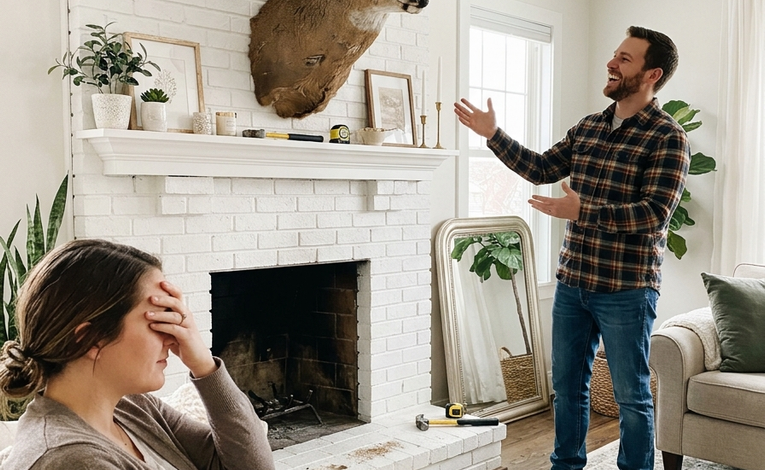
Not long afterward, my neighbor, Nedra Pope, called.
“Dorinda, is that a deer head I’m seeing through your front window?”
“It surely is.”
“Lord, have mercy.”
I stepped onto the back porch and explained what had happened.
By supper, Lamont had already started giving me instructions about his family’s arrival.
His mother liked soft eggs and coffee at five in the morning. His sister needed the good towels because she had sensitive skin.
Then he made another request.
“You might put Wardell’s pictures up in the attic,” he said while eating my pot roast. “So Mama’s comfortable.”
I stared at him.
“Wardell’s pictures?”
“It’s a new family now, darlin’.”
The next morning, Lamont asked me to prepare a large Sunday dinner.
“Fried chicken,” he said. “And your coconut cake. Mama loves coconut cake.”
“I’ll have something special waiting,” I replied.
That night, I lay awake beside him, listening to his snoring.
I had married Lamont because my house had become quiet after Wardell’s death. I had missed having someone to talk to, someone to share meals with, and someone who made ordinary days feel less lonely.
But perhaps I had confused companionship with genuine care.
I wondered whether I had made a mistake.
The following morning, while Lamont was out, I found his mother’s number in the address book beside the coffee pot.
Her name was Clementine Sizemore. She was 89 years old, and I had met her only once at our wedding.
I decided it was time to speak with her directly.
“Miss Clementine, this is Dorinda,” I said when she answered. “I wanted to say we’ll be ready for y’all Sunday.”
There was a long silence.
“Ready?” she finally asked. “Honey, Lamont told me you begged us to come.”
I sat down.
“He said you couldn’t keep up that big house he bought you.”
“That he bought me?”
“That’s what he told me.”
I took a deep breath.
“Miss Clementine, let me explain a few things about this house.”
For the next twenty minutes, I told her what had happened.
I explained that I had paid for the house myself, that it was in my name, and that I had never invited anyone to move in.
She listened without interrupting.
When I finished, she asked one question.
“Is his daddy’s deer head hanging in your living room?”
“Yes, ma’am.”
“Well,” she replied, “you leave it right where it is. I’ll see you Sunday.”
I had no idea what she had planned, but I was beginning to understand that she knew her son better than I did.
Preparing for Sunday
Sunday morning arrived.
I didn’t fry any chicken, and I didn’t make the coconut cake.
Instead, my neighbor Nedra came over to help me prepare the porch.
While Lamont was upstairs getting ready, we carefully packed his belongings.
His clothes went into boxes. His shoes were placed together, and his bathroom items were packed separately.
We wrapped the deer head so its antlers wouldn’t catch on anything. I even tied a red bow around its neck.
His recliner was the hardest item to move, but Nedra and I managed to get it outside.
I wasn’t trying to damage his belongings or embarrass him. I simply wanted everything that belonged to him ready to go.
When Lamont came downstairs, he was smiling and buttoning his shirt.
He seemed certain that everything was going according to plan.
Then we heard gravel crunching in the driveway.
His father’s old blue pickup had arrived.
His sister was driving, and Miss Clementine sat in the passenger seat.
There were no suitcases or moving boxes in the truck bed.
Lamont stepped outside.
“Mama! Y’all made it!”
Nedra stood beside the porch railing with her coffee, trying hard not to smile.
Miss Clementine slowly climbed out, using her cane for support. She looked at the porch, then at her son.
“Lamont Thurston,” she said firmly, “you’re going to load up your things and come home with me. Your old room is ready.”
The smile disappeared from his face.
His mother had heard the truth
Lamont looked from his mother to the boxes lined along the porch wall.
His recliner was beside them, and the deer head sat nearby with its red bow.
“What is all this?” he asked.
“I said your things are going home with you,” Miss Clementine replied. “Your old room is ready. You can sleep there tonight.”
Lamont stared at her.
“Mama, you can’t just tell me where I’m going.”
“I can tell you where I’m willing to take you,” she answered. “Get your things into the truck.”
Then she reminded him of what he had told her.
“You said Dorinda begged you to bring us here. You said she couldn’t manage this house and that you had bought it for her.”
Lamont tugged at his shirt cuff.
“I didn’t say it like that.”
“You did,” I replied.
My voice shook, but I continued.
“I paid this house off myself. It’s in my name. You know that.”
He turned toward his mother again.
“I sold my trailer. Where was I supposed to go?”
Miss Clementine looked at him.
“You moved in with Dorinda. You told me the house was yours to offer. Which one is it?”
He had no immediate answer.
I stepped forward.
“I never promised anybody my sewing room. I never invited anyone to move in. And I never agreed to take down Wardell’s pictures.”
Lamont glanced toward the deer head.
“You put that outside?”
“I did,” I said. “It belongs to you.”
He seemed more upset about the red bow than anything else.
For a moment, I felt the sadness beneath my anger. I had genuinely hoped this marriage would bring companionship and happiness. I had not expected to find myself defending the home I had worked so hard to keep.
But feeling disappointed didn’t mean I had to change my decision.
A welcome he would remember
“What did you expect me to do?” Lamont asked. “Mama and Sis drove all this way. You can at least put out lunch.”
Nedra looked down into her coffee.
“I didn’t make lunch,” I replied. “I didn’t make the cake, either.”
His expression tightened.
“You said you had something special waiting.”
I pointed toward the deer head.
“I did. I thought the bow was enough.”
His sister, who had been sitting in the driver’s seat, let out a brief laugh.
Lamont turned toward her.
“You think this is funny?”
“A little,” she admitted.
Miss Clementine shook her head.
“You made a promise using someone else’s house. You don’t get to be angry because she put your belongings outside.”
Lamont looked at me again, perhaps expecting me to soften my position.
But I had already made up my mind.
“Your things are packed,” I told him. “Your mother has a room for you. You’re leaving with her today.”
His face reddened.
“You can’t throw me out like I’m nobody.”
“I didn’t say you were nobody,” I replied. “I’m saying you cannot decide who gets to live in my house. I’m asking you to leave.”
Miss Clementine looked at her son.
“You heard her.”
For a moment, nobody moved.
Then Lamont picked up the first box and carried it toward the truck.
His sister got out to help. Together, they loaded the boxes and carefully moved the recliner.
The deer head was last.
Lamont carried it by its base, taking care not to catch the antlers on the doorframe.
The red bow swung beneath its chin.
Miss Clementine watched him place it in the truck.
“That thing belongs in your old room,” she said.
Lamont climbed into the passenger seat.
Before the truck pulled away, his sister looked through the open window.
“Well,” she said, fighting a smile, “at least the bow made it.”
I smiled back.
“I wanted it to feel welcoming.”
She laughed, then started the truck.
And just like that, they were gone.
Getting my home back
I stood on the porch with Nedra and watched the blue pickup disappear down the road.
My hands were shaking.
I felt relieved, but I also felt sad. I had wanted the marriage to work. I had believed Lamont was someone who valued me and wanted to build a life together.
Instead, he had treated my kindness as permission to make decisions without me.
Nedra picked up her coffee.
“Want me to help bring your quilt back in?”
“Yes, ma’am,” I replied. “That quilt’s been waiting long enough.”
We carried it into the living room together.
I placed it back above the fireplace and carefully smoothed its corners until it hung straight.
The room looked familiar again.
I sat down in my chair and looked at the wedding-ring quilt. It had belonged in that spot for years, and I was glad to see it there.
For the first time in days, I didn’t feel the need to keep moving around the house or find another chore to distract myself.
I simply sat and watched the afternoon light fall across the room.
I had lost a marriage, but I had not lost my sense of self.
And I had learned something important: companionship should never require giving up your independence, your voice, or the right to make decisions about your own home.
What would you have done in Dorinda’s position? Would you have handled the situation differently, or do you think she made the right decision by setting a firm boundary?