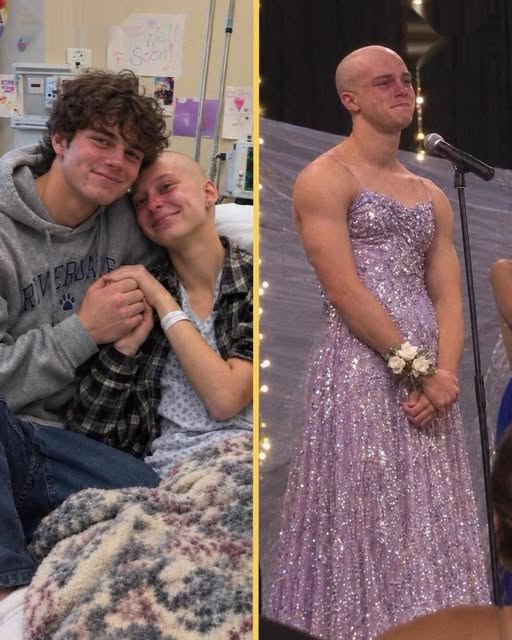
Mark thought Nate was mocking her. Olivia’s mother feared the same. But before anyone could stop him, Nate walked to the microphone and asked for a minute.
Prom had once been the easy thing to look forward to
Before the diagnosis, Olivia and Nate had spent weeks talking about prom. She had chosen a pale blue dress with delicate straps, and when it arrived, she tried it on right away.
Nate told her she looked like a princess. He was not a stranger to the family; he had been part of their routine for almost two years, even helping Mark wash cars on Sundays. He and Olivia had planned the photos, dinner and their first dance.
Then Olivia noticed a lump near her collarbone.
After appointments and a biopsy, doctors diagnosed her with lymphoma. Her family’s attention shifted to treatment plans, medication, hospital visits and days when Olivia had little energy.
When chemotherapy was discussed, one of Olivia’s first questions was whether she would still be able to go to prom. The answer depended on how she felt closer to the date.
When support started to feel like fear
Chemotherapy changed the way Olivia saw herself. Six weeks before prom, her hair began falling out. One afternoon, her mother found her on the bathroom floor holding strands of it in her hands.
Not long after, Olivia asked for help shaving the rest.
At first, Nate seemed steady. He brought homework, snacks and drawings from friends. He tried to make Olivia laugh. But as time passed, his concern became heavier.
He stopped joking the way he used to. He asked whether she needed help whenever she stood up. If she wanted to go somewhere, he worried she might get tired. He canceled his own plans to stay nearby, even when Olivia wanted room to breathe.
To her parents, it looked like devotion. To Olivia, it began to feel like another kind of confinement.
One day, her mother overheard Olivia tell him that she was sick, not made of glass.
A week later, the relationship was over.
Olivia told her mother only that Nate had said he could not do it anymore. She begged her parents not to contact him or his family. Nate stopped coming over. The blue dress stayed in the closet with its tags still attached.
Olivia chose to go anyway
Four days before prom, Olivia came downstairs and asked whether her dress would still fit.
She said she wanted to go even if no one asked her to dance. She also said she did not want to wear a wig.
Her mother told her that some people might stare, but she did not owe anyone a different version of herself.
On prom night, Olivia wore the pale blue dress, small silver earrings and no wig. Mark proudly took photos before driving to the school, where he and Olivia’s mother had volunteered to help with refreshments and the senior entrance.
At first, Olivia looked nervous. Then she began talking with classmates and laughing. For a moment, the evening seemed to belong to her again.
Then the gym doors opened, and Nate appeared.
Nate’s speech changed what everyone thought they knew
With students staring and Mark ready to confront him, Nate made his way to the microphone. His voice shook as he addressed the room.
He said he knew people believed he had broken up with Olivia because she got sick. Then he said that was not exactly what happened.
Nate explained that Olivia had asked him to end the relationship and had asked him not to tell anyone it was her decision.
Olivia’s eyes filled with tears. A murmur moved through the gym.
Nate admitted that he had agreed to stay silent, but also that he had disappeared afterward. He said he had let people think he did not care because telling the truth would have meant admitting he had handled things badly.
He apologized to Olivia. He also said the dress was not a joke about her. It was tied to something he had promised her long before.
There was no big round of applause. The room simply went quiet as students tried to understand what had been said.
The breakup had been more complicated than abandonment
Olivia left the gym in tears, and her mother found her near the restrooms. At first, Olivia did not want to explain. Then she admitted she had not wanted anyone to know she had asked Nate to leave.
She said Nate had been giving up everything for her. He had skipped a school trip because she had treatment. He stopped going to basketball games with friends. He even considered leaving an activity he loved.
Olivia had told him he did not need to do that, but he kept acting as though nothing else mattered anymore.
She said every time he looked at her, he looked scared.
What Nate meant as care felt to Olivia like being treated as fragile. When she suggested going to the movies, he wanted to stay home because she might get tired. He did not ask how she felt first.
Olivia already had doctors telling her what she could and could not do. She did not want her boyfriend to become one more person managing her life.
Eventually, overwhelmed and frustrated, she told him they needed a break. When he resisted, she said she no longer wanted to be with him. Nate believed her.
Olivia later admitted she had hoped he would fight for them, even though she had told him to go. When he stayed away, it hurt.
Both teenagers had been frightened. Neither had known how to say what they really needed.
The purple dress came from a private joke
After Olivia and her mother returned to the gym, Mark was standing near Nate at the refreshments table. He told Nate that making a public speech had not been his best idea.
Olivia asked to speak with Nate, and they moved to a quieter hallway.
Later, she told her mother what he said. Nate apologized for revealing the truth in front of everyone instead of talking to her first. Then Olivia asked why he had worn the dress.
Nate reminded her of a moment from months earlier, before the diagnosis. While shopping for prom clothes, Olivia had spotted a purple sequin dress on clearance. She held it up to him and joked that he should wear it to prom for one dance.
He had protested that people would never let him forget it. Olivia teased that he should hope she never needed cheering up.
Eventually, Nate had promised that if she ever needed cheering up, he would wear the dress for one dance.
After her diagnosis, Olivia had mentioned the promise again, then later told him to forget it when she began losing her hair. She did not want to draw more attention to either of them.
Nate remembered anyway.
He told her he had hoped that if people stared at him, maybe they would stop staring at her. He also admitted that he had been scared and ashamed of how helpless he felt. He had thought that if he did enough, she might get better.
Olivia told him he could not make her better. She also told him she had needed her boyfriend, not another person treating her like a patient.
One dance did not fix everything
When they came back into the gym, Nate kept his distance. Olivia stood with her father while the music continued.
Nate began to leave. Then Olivia called his name.
She looked at the purple dress and reminded him that he still owed her one dance.
The DJ was playing a slow song. Nate offered his hand, and Olivia took it. They stepped onto the dance floor together.
Some students softened. One complimented the dress. Another offered to help Nate with the hem. Olivia laughed, and her mother noticed it was the first laugh like that she had heard from her in weeks.
When the song ended, Nate did not try to kiss her or pretend everything had been repaired. He thanked her for the dance and stepped back. Olivia stayed with her friends.
Her mother was glad to see that the night had not become only about Nate’s return. Olivia was at prom on her own terms.
What came after prom
On the drive home, Olivia asked whether it was foolish to still love him. Mark told her she was 17 and allowed to have complicated feelings.
Olivia made clear that she and Nate were not suddenly back together. They were going to talk. That was all.
Her mother told her she did not have to decide anything that night.
Olivia still had treatment ahead of her. Nate’s entrance could not erase the hurt between them. One dance could not solve what fear, silence and illness had complicated.
But the following Sunday, Nate came to the house. He did not bring flowers or make another speech. He asked Olivia if she wanted to sit outside and talk.
Through the kitchen window, her mother watched them on the back steps. Sometimes they laughed. Sometimes they sat quietly. They did not seem to be trying to repair everything at once.
Later, Olivia hung her blue dress carefully in the closet.
For her mother, the dress no longer represented only what illness might take away. It also marked the night Olivia chose to show up, uncertain and visible, without letting lymphoma decide whether she belonged there.
Nate’s dress made everyone look. Olivia’s choice to walk into prom as herself mattered more.