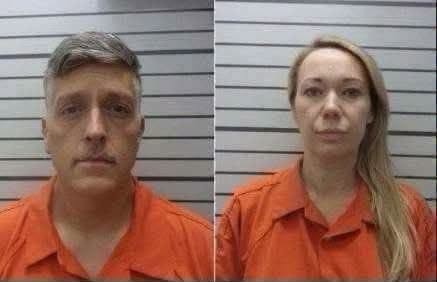
Jon and Carie Hallford operated Return to Nature Funeral Home, promoting environmentally conscious funeral services that included biodegradable burial options.
The concept appealed to families looking for alternatives to conventional funerals.
But behind the public image, investigators eventually uncovered serious problems.
Complaints about a persistent odor ultimately helped bring authorities to the company’s facilities.
What investigators found was far removed from the peaceful, environmentally friendly image presented to customers.
Investigators Discover Hundreds of Improperly Stored Remains
Authorities discovered nearly 200 bodies that had not been handled or stored as families had been led to believe.
Some remains had reportedly been left at the facilities for extended periods.
For families already coping with the death of someone they loved, the discovery created another layer of grief: uncertainty about whether their relatives had ever received the care and final arrangements they had paid for.
The investigation also uncovered allegations involving cremated remains.
In some cases, families reportedly received urns containing concrete rather than the ashes they expected.
Other families learned that the remains returned to them may not have belonged to their relatives.
The emotional consequences were enormous.
A Trust That Families Never Expected to Question
Funeral arrangements depend heavily on trust.
Families generally have no practical way to monitor what happens behind the doors of a funeral facility. They rely on professionals to identify, care for, transport, cremate, or prepare their loved ones according to the arrangements they selected.
That makes alleged misconduct in this industry especially painful.
Families aren’t simply purchasing a service.
They’re entrusting someone with a person they love at one of the most difficult moments of their lives.
El Paso County District Attorney Michael Allen described the impact on affected families as profound, emphasizing the trust that had been placed in the funeral home.
The Case Goes Beyond the Handling of Remains
The criminal investigation also expanded into financial matters.
Federal prosecutors accused the Hallfords of conspiracy to commit wire fraud and alleged that more than $800,000 in pandemic relief funds were improperly obtained and spent.
Prosecutors also alleged that customers paid more than $130,000 for funeral-related services that were never properly provided.
The financial allegations added another dimension to a case that had already devastated families.
The Hallfords Plead Guilty
Jon and Carie Hallford later pleaded guilty to 191 felony counts involving abuse of corpses as part of a plea agreement.
The case illustrates the difference between allegations made during an investigation and conduct established through a court proceeding. In this instance, the guilty pleas provided a formal legal resolution to the state charges while the broader consequences of the scandal continued to unfold.
The Hallfords also faced federal consequences related to the financial allegations.
For families, however, a criminal case could not undo what had happened.
Many were left trying to identify their loved ones, understand what occurred, and find some measure of closure.
Why Colorado’s Regulations Became Part of the Conversation
The scandal also prompted questions about how funeral homes are regulated in Colorado.
The state has been notable for its progressive approach to alternative burial practices, including the legalization of human composting.
At the same time, lawmakers and advocates have debated whether the state’s requirements for funeral-industry professionals provide enough oversight and consumer protection.
The Return to Nature case intensified those concerns.
If families are expected to place extraordinary trust in funeral providers, critics argue that the industry needs strong standards for training, licensing, recordkeeping, facility inspections, and the identification and handling of human remains.
A Call for Stronger Safeguards
The tragedy has therefore become bigger than one funeral home.
It has raised a fundamental question:
What protections should exist when families have no practical way to verify that a funeral provider is doing what it promised?
Potential reforms could include stronger licensing standards, more rigorous inspections, clearer documentation requirements, and safeguards designed to ensure that remains can be accurately tracked throughout the entire process.
Such measures would not erase the suffering experienced by affected families.
But they could help prevent another situation in which grieving people discover that the trust they placed in a funeral provider was badly misplaced.
The Human Cost Behind the Headlines
It’s easy to focus on the shocking details of the case.
But behind every investigation number was a person who had died and a family that expected to say goodbye with dignity.
For those families, the most painful part may not be the criminal charges or financial losses.
It may be the uncertainty surrounding something they believed had already been handled.
A funeral is often one of the final acts of care a family performs for someone they love.
That is why the responsibilities of funeral professionals are so significant.
A Difficult Lesson for the Industry
The Return to Nature scandal is a reminder that consumer protection matters even in industries people rarely think about until they desperately need them.
Families should be able to expect accurate records, clear communication, professional handling of remains, transparent pricing, and meaningful oversight.
Those expectations aren’t excessive.
They’re fundamental.
The case also demonstrates why allegations involving vulnerable consumers deserve careful investigation rather than sensational speculation. The most important facts are the ones supported by court records, official investigations, and verified evidence.
For Colorado’s funeral industry, the scandal may ultimately become a turning point.
For the families affected, however, it will remain something much more personal: a painful chapter in the aftermath of losing someone they loved.
The broader lesson is simple.
Grief should never make a family more vulnerable to exploitation.
Strong oversight, professional standards, and accountability are essential—not only to protect consumers, but to preserve the dignity that every family should be able to expect when saying goodbye.