Born in Paris on September 28, 1934, Brigitte Bardot initially trained in ballet before entering the worlds of modeling and acting. Her early modeling work brought her attention in French fashion publications, helping open the door to a film career.
Bardot’s appeal was distinctive. Rather than relying solely on the polished elegance traditionally associated with screen stars, she projected a more relaxed, spontaneous presence. Her expressive face, natural movement, and recognizable hairstyle helped create an image that was both glamorous and seemingly unrestrained.
By the mid-1950s, she was attracting increasing attention. Her international breakthrough came with And God Created Woman (1956), directed by Roger Vadim, her first husband.
In the film, Bardot played Juliette Hardy, a young woman whose desires and independence challenged the conservative expectations of the community around her. The movie generated controversy, but it also helped establish Bardot as an international sensation.
Her performance offered audiences a different vision of femininity: sensual, playful, independent, and resistant to conventional rules. Some viewers celebrated that image as liberating, while others considered it provocative. Either way, Bardot became a cultural figure whose influence extended well beyond the screen.
By 1958, she was no longer simply a rising actress. She had become a defining face of a changing era.
Saint-Tropez: The Riviera Town That Became a Legend
Saint-Tropez had long been a Mediterranean fishing community, but the postwar years brought a growing number of artists, writers, filmmakers, and wealthy visitors to its shores.
Its appeal was different from the formal luxury of some established resorts. Saint-Tropez offered a more relaxed atmosphere, with boats in the harbor, outdoor cafés, narrow streets, and beaches that seemed far removed from the routines of urban life.
Bardot helped bring this setting to international attention. Her association with the town reinforced an image of French glamour that was youthful, informal, and closely connected to the natural beauty of the Mediterranean.
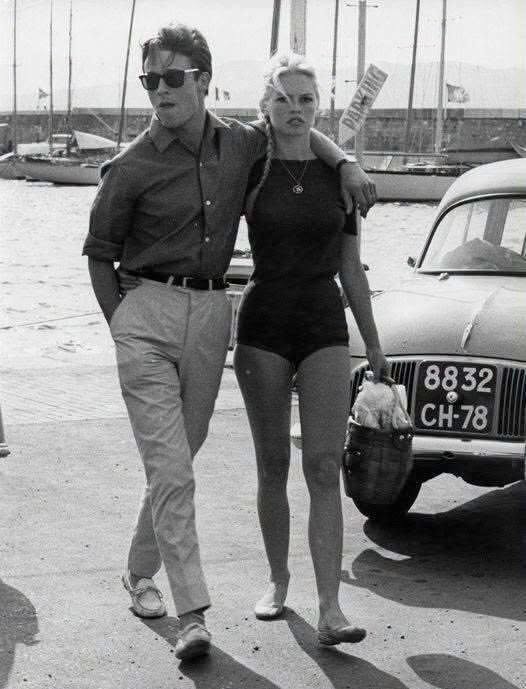
In photographs, she could appear in simple summer clothing, her hair loosely arranged, looking at ease in the sunlight. The effect was powerful: elegance seemed effortless, and celebrity life appeared to offer a kind of freedom from ordinary conventions.
As magazines circulated images of famous visitors enjoying the Riviera, Saint-Tropez became more than a geographical location. It became a symbol of leisure, romance, and sophisticated independence.
For many people around the world, Bardot helped define that image.
Jacques Charrier: The Actor Who Entered Bardot’s World
Jacques Charrier was born in Metz, France, on November 6, 1936. He trained as an actor and developed his career during a period when French cinema was attracting growing international attention.
Although Charrier had professional ambitions of his own, he was not as internationally famous as Bardot. Their difference in public recognition became an important part of how their relationship was perceived.
Being romantically involved with one of the world’s most recognizable actresses meant living under a spotlight that few couples experience. Public appearances could attract photographers, private decisions could become subjects of speculation, and ordinary moments could be transformed into entertainment news.
Charrier was more than simply Bardot’s partner. He was an actor with his own identity and career. Yet public interest in the relationship naturally centered on Bardot, whose fame had already reached extraordinary levels.
Their romance attracted attention partly because audiences wanted to know the woman behind the celebrated screen image. Could someone so famous find lasting love? What was her life like away from the cameras? How did a relationship function when the public seemed determined to follow every development?
The photographs encouraged those questions, but they could not provide all the answers.
The Glamour of 1958: Fashion, Freedom, and Celebrity
The late 1950s were a period of significant change in postwar Europe. Consumer culture was expanding, cinema was reaching increasingly international audiences, and younger generations were beginning to question established expectations about personal behavior, fashion, and relationships.
Bardot’s image captured much of this changing mood.
Her style was recognizable without appearing overly elaborate. Loose blonde hair, simple summer dresses, striped tops, fitted trousers, and casual footwear became associated with the relaxed elegance she represented.
Her look suggested that glamour did not always require formal gowns or carefully controlled appearances. Sometimes, a simple outfit and a confident presence could make a lasting impression.
This approach resonated particularly strongly on the French Riviera, where sunshine, beaches, and outdoor living provided a natural setting for informal fashion.
Bardot’s influence was not limited to clothing. She became associated with a broader idea of modern femininity in which a woman could be attractive, confident, and independent without conforming entirely to traditional expectations.
Her image was partly shaped by filmmakers, photographers, and fashion magazines, but her distinctive presence helped make it enduring.
When she appeared alongside Charrier, the combination of romance and Riviera glamour strengthened the public’s fascination with their relationship.
They seemed to belong to a world of sunlit afternoons, fashionable gatherings, and carefree sophistication. Yet the image of effortless happiness could never tell the whole story of their private lives.
A Romance Under the Camera’s Gaze
Celebrity photographs have a unique power. They allow audiences to feel close to people they have never met, offering glimpses of familiar faces in seemingly private settings.
A photograph of Bardot and Charrier might show them standing together, smiling, or enjoying the Riviera. Such an image can preserve a moment in time, but it cannot explain what the couple were thinking, what they discussed beforehand, or what difficulties they faced away from the camera.
That distinction is particularly important when looking back at famous relationships.
Bardot’s public image encouraged people to see her as spontaneous and unconstrained. Yet being widely admired did not mean she was free from pressure. Her appearance, romantic life, and personal choices were regularly subjected to public judgment.
The more famous she became, the harder it could be to separate her private identity from the character the public expected her to play.
For Bardot and Charrier, the relationship unfolded within that tension. Their romance belonged to them, but it also became a story that newspapers, magazines, and audiences wanted to interpret.
The photographs preserve the glamour of their public appearances. They do not establish that their relationship was always easy or that the couple’s private experiences matched the romantic image projected to the world.
Marriage in 1959: A New Chapter
Bardot and Charrier married in June 1959, bringing their relationship into an even more public phase.
For admirers, the wedding represented another development in the life of a woman whose film career and personal affairs had become major subjects of public interest.
But marriage involved more than the glamour of a celebrated couple. It required two individuals to navigate their ambitions, expectations, and responsibilities while living under extraordinary scrutiny.
Bardot’s career demanded time, travel, and professional commitments. Her fame also meant that her private life attracted attention that most people would never experience. Charrier had his own professional aspirations and personal needs.
These circumstances could make maintaining privacy and stability especially challenging. Like other couples, they had to navigate the realities of building a life together, but they did so while their relationship was being watched and discussed by strangers.
Their marriage became a significant chapter in Bardot’s biography, though it cannot be fully understood through public appearances or magazine photographs alone.
The Birth of Their Son
In January 1960, Bardot gave birth to her son, Nicolas-Jacques Charrier.
Motherhood brought new responsibilities at a time when her professional career and public image continued to attract intense attention. The birth was widely discussed, illustrating how even deeply personal events could become public spectacles when they involved a famous actress.
Bardot later spoke openly about the difficulties she experienced during this period and about her complicated feelings toward motherhood. Her reflections challenged the idealized assumptions often placed on women, particularly the expectation that becoming a mother must produce one uniform emotional response.
Her experience was personal and should not be treated as a universal account of parenthood. It does, however, illustrate how fame can intensify the pressure surrounding private experiences.
The public may imagine that wealth, beauty, and professional success protect celebrities from emotional difficulties. In reality, those advantages cannot eliminate the complexities of family life.
The arrival of their son also meant that Bardot and Charrier’s decisions affected more than themselves. Their relationship now included the responsibilities of raising a child, adding another dimension to a story that the public often viewed primarily as a glamorous romance.
Why Their Marriage Ended
Bardot and Charrier eventually separated, and their divorce was finalized in 1962.
Their marriage lasted only a few years, but it remains an important part of the story surrounding Bardot’s personal life.
It is tempting to look for a single explanation for why a high-profile relationship ends. Yet marriages usually reflect a combination of personal differences, changing circumstances, unmet expectations, and pressures that build over time.
Bardot’s demanding career and extraordinary fame formed part of the environment in which their relationship developed. Charrier also had his own ambitions and needs, while marriage and parenthood brought additional responsibilities.
It would be simplistic to attribute the separation to one factor without a clear and reliable account of the couple’s private circumstances.
What their story does demonstrate is that romance and public admiration do not guarantee long-term compatibility. Two people can share meaningful experiences and genuinely intend to build a future together without ultimately remaining married.
The end of their relationship did not erase its significance. Instead, it became one chapter in two lives that continued in different directions.
How Bardot Changed Fashion
Bardot’s influence on fashion outlasted the period in which she first became famous.
Her loose, voluminous hairstyles, distinctive fringe, and preference for casual yet feminine clothing became widely imitated. The Bardot neckline, which leaves the shoulders exposed, also became closely associated with her name.
She helped popularize an aesthetic that combined sensuality with informality. Simple summer dresses, striped tops, fitted trousers, and ballet flats could look elegant without appearing excessively formal.
The French Riviera provided a natural backdrop for this style. Against the Mediterranean landscape, Bardot’s appearance suggested that sophistication could be relaxed and spontaneous.
Her influence was not solely the result of her personal choices. Photographers, designers, filmmakers, and magazines helped circulate and reinforce her image. Nevertheless, she became one of the most recognizable representatives of a new approach to glamour.
For later generations, her style continued to offer a reference point for French Riviera fashion and effortless elegance.
Beyond the Romance: Bardot’s Lasting Legacy
Although her relationship with Charrier remains a point of interest, it represents only one part of Bardot’s larger legacy.
Her role in And God Created Woman helped establish her as a major international star and contributed to changing conversations about femininity and social conventions. Her influence on fashion and celebrity photography also helped shape how audiences imagined the French Riviera.
Later in life, Bardot became widely known for animal protection. After retiring from acting in the early 1970s, she devoted much of her public work to animal welfare and established the Brigitte Bardot Foundation in 1986.
Her legacy also includes controversial political statements and public positions that attracted criticism. A balanced account of her life must recognize both her cultural influence and the controversies associated with her later public conduct.
Bardot was never simply a beautiful actress or a symbol of freedom. She was a complex public figure whose life included artistic achievements, personal challenges, advocacy, and contentious views.
Reducing her story to a single romance would overlook that complexity.
Why the Photographs Still Fascinate Us
Images of Bardot and Charrier remain compelling because they capture several things at once: the rise of modern celebrity culture, the changing style of postwar France, the glamour of Saint-Tropez, and the public fascination with the private lives of famous people.
Their photographs also preserve the visual atmosphere of the late 1950s. The clothing, hairstyles, Mediterranean setting, and relaxed poses evoke a period that has since acquired a strong sense of nostalgia.
Yet the most meaningful aspect of these images may be the contrast between their apparent simplicity and the complicated lives behind them.
A photograph can preserve a smile, a gesture, or a moment of closeness. It cannot record every uncertainty, disagreement, or private emotion that shaped a relationship.
That is why historical images are most valuable when viewed as windows into a particular moment rather than complete explanations of the people they depict.
Bardot and Charrier’s story reminds us that public images can become timeless even when the circumstances behind them remain deeply human and imperfect.
Conclusion: A Romance Remembered Through the French Riviera
Brigitte Bardot and Jacques Charrier belonged to a remarkable chapter in French popular culture. Their relationship unfolded as Bardot’s international fame was growing, and their appearances together became part of the romantic mythology surrounding the French Riviera.
Saint-Tropez provided the setting. Bardot’s distinctive beauty and screen presence helped make the town a symbol of youthful glamour, while their marriage and family life brought another dimension to the public’s fascination with her.
Their relationship ultimately ended in divorce, revealing that the reality behind the photographs was more complicated than the polished images might suggest.
Today, those photographs remain evocative records of a period when cinema, fashion, romance, and celebrity culture were becoming increasingly intertwined. They allow us to appreciate the style and atmosphere of the era without assuming that a single image can tell an entire story.
Bardot’s legacy extends far beyond her marriage to Charrier. She helped reshape the image of the modern screen actress, influenced generations of fashion, and later became a prominent animal-welfare advocate.
Her connection to Saint-Tropez remains one of the most enduring elements of her public identity. Her relationship with Charrier, meanwhile, offers a glimpse into the personal life of a woman whose fame often made privacy difficult to preserve.
Ultimately, their story is about more than French Riviera glamour. It is also about the distance between public image and private reality—and the reminder that behind even the most memorable photograph are real people navigating love, family, ambition, and the unpredictable course of life.