Then they heard something approaching from a dark passage.
The sound was slow and unmistakable: a wooden stick tapping against stone.
The Day Layan Disappeared
Before her disappearance, Layan was a curious environmental science student who loved studying plants and exploring the natural world. She was careful about her trips and usually told her father where she planned to go.
That morning, she explained that she wanted to collect a few samples for a university project.
Her father was concerned about her going alone, but Layan assured him that she knew the trail and would return before sunset.
A nearby camera recorded her arriving at the trailhead. She adjusted her backpack, checked her equipment, and walked toward the trees.
It was the last confirmed sighting of her.
When evening arrived and Layan did not return, Mahmoud began calling her phone. His calls went unanswered. He contacted her classmates, hoping someone might know whether she had changed her plans.
Eventually, he drove to the trailhead and found her car still parked where she had left it.
The surrounding area was quiet.
With no sign of his daughter, Mahmoud contacted the authorities. A search operation began that night and expanded the following morning.
A Search Without Answers
Rescue workers and volunteers examined the mountain carefully. They searched established hiking routes, narrow ravines, streambeds, and difficult sections of terrain.
They looked for her backpack, clothing, camera, or anything else that might help establish her whereabouts.
On the sixth day, a volunteer discovered a small wooden owl resting on a moss-covered tree stump.
Mahmoud recognized the style because Layan collected handcrafted animal figures. However, he could not confirm that the carving belonged to her.
The object was photographed and examined, but it did not provide a clear answer.
As time passed, investigators considered several possibilities. Layan might have fallen into an inaccessible area, become lost, or encountered someone along the trail. Another possibility was that she had discovered an underground passage.
None of the explanations could be confirmed.
The search eventually became a longer missing-person investigation. Seasons changed, her classmates graduated, and ordinary life continued for everyone outside the mountain.
For Mahmoud, however, the uncertainty never disappeared.
He kept a photograph of Layan beside his bed and continued hoping that she would return.
The Discovery Beneath the Mountain
Three years later, a group of experienced cave explorers was mapping a remote limestone formation.
Heavy rain had exposed a narrow opening partly hidden by vegetation. Curious about the passage, the explorers secured their equipment and carefully entered.
Inside, they found signs that someone had previously used the underground network. There were old rope fibers, stacked stones, and a few pieces of fabric caught between rocks.
Eventually, the passage opened into a larger chamber.
One explorer noticed a figure sitting near the far wall.
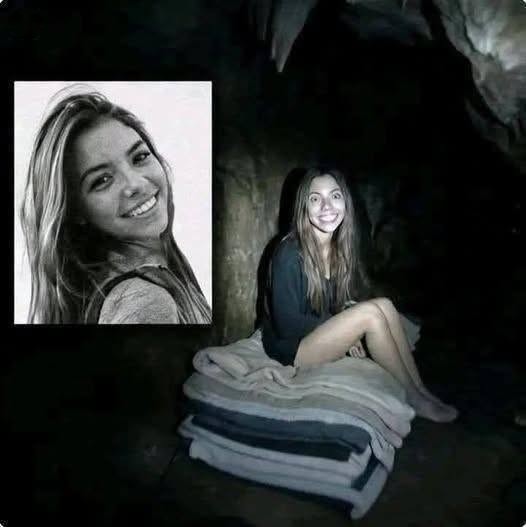
At first, the team thought they had found an injured visitor. But as their lights moved across the chamber, the woman looked up and smiled.
She was wearing simple clothes, and her hair was neatly tied back. She appeared thin and pale, but she did not seem as physically exhausted as the explorers had expected.
When they asked her name, she answered quietly.
“Layan.”
One member of the group remembered reports about the missing university student. He asked whether her full name was Layan Mahmoud.
She nodded.
The explorers were stunned. They had entered the cave to study its geological features, not expecting to find someone who had been missing for three years.
They offered her water and reassured her that help was available.
But when one explorer suggested returning to the surface, Layan became frightened.
“Please don’t go out there,” she repeated.
Then came the tapping sound.
An elderly man carrying a wooden walking stick appeared from a darker passage. His name was Imran, and he had apparently been living in the underground network with Layan.
The explorers wanted to know who he was and why the young woman had remained there for so long.
His answers were incomplete.
Layan, however, told them something unexpected.
“He saved me.”
The Man Who Helped Her Survive
The explorers soon learned that Layan had fallen through an unstable section of rock on the day she disappeared.
According to her account, she had left the established trail to photograph plants growing near a limestone formation. The ground shifted beneath her, and she fell through a narrow opening into an underground chamber.
She injured her leg and could not climb back out.
Her phone eventually stopped working, and she was unable to contact anyone.
After spending a frightening period alone, she heard a voice calling from the darkness.
It belonged to Imran.
He knew the cave system well and had been using parts of the mountain for years. He brought Layan water and food, helped her reach a safer chamber, and provided basic supplies while she recovered.
The chamber contained blankets, containers, clothing, and simple cooking equipment. Imran also knew of another route to the surface, which helped explain how the pair had obtained provisions.
However, getting Layan out was not easy.
The rockfall had blocked a passage, and other sections were narrow and unstable. Imran feared that trying to move her through them could cause another accident.
At first, Layan believed she would be rescued quickly. But as time passed, repeated frightening experiences made her increasingly afraid of attempting the journey out.
She tried exploring nearby passages and once thought she heard other people calling for help. When an attempt to follow the sounds ended in another fall, her confidence weakened.
The cave gradually became a familiar place, even though she desperately missed her family.
Why Had No One Been Told?
The discovery raised an important question.
If Imran could reach the outside world to collect supplies, why had he never informed anyone that Layan was alive?
During questioning in this fictional account, Imran explained that he had initially focused on keeping her alive and believed he could eventually find a safe way to bring her out.
Later, he said, Layan became increasingly frightened of leaving. He claimed he did not want to force her into a situation that might cause further distress.
But investigators challenged his decision not to contact her family or the authorities.
Providing shelter and assistance did not remove the responsibility to seek outside help, particularly when a missing person had relatives searching for her.
Layan’s account presented a complicated picture. She was grateful that Imran had helped her survive, but she also wished he had contacted someone sooner.
Both feelings could exist at the same time.
Investigators examined the circumstances, including Imran’s actions and the conditions in which Layan had been living. The story does not establish a final legal finding against him.
The Journey Back to the Surface
Rescuing Layan required careful planning.
Although she could walk, she was anxious about the narrow passages and unstable rocks. The rescue team brought medical equipment and additional lighting, then arranged a supervised evacuation.
Imran stayed nearby and encouraged her to take one step at a time.
At difficult points, Layan stopped and asked whether the passage was safe. The rescuers allowed her to rest and explained what would happen next.
Eventually, she reached the cave entrance.
Sunlight fell across the ground.
Layan paused, squinting as she adjusted to the brightness. After years of living mainly in dim underground surroundings, the open sky and ordinary sounds of the natural world felt overwhelming.
A rescue worker placed a blanket around her shoulders.
For the first time in three years, she was outside.
And somewhere beyond the mountain, her father was about to see her again.
A Father’s Long Wait Finally Ends
When Mahmoud received the news, he struggled to believe it.
He had spent years imagining what might have happened to his daughter. Now he was being told that she had been found alive.
At the medical facility, he waited anxiously.
When Layan finally entered the room, he recognized her immediately.
“Dad?”
Mahmoud moved toward her and embraced her carefully.
He had imagined this moment countless times, but no dream could prepare him for seeing his daughter standing in front of him again.
He asked whether she was hurt and whether she needed anything.
Layan struggled to explain what had happened. She was still processing the fact that she had returned to the world she had missed for so long.
Her recovery would take time.
Finding her was only the beginning.
Learning to Feel at Home Again
Layan’s first weeks at home were more difficult than her father had expected.
Crowded rooms, unexpected visitors, bright shops, and unfamiliar sounds sometimes made her anxious. At night, she occasionally woke disoriented, expecting to find the stone walls of the cave around her.
Mahmoud initially tried to make everything cheerful. He prepared her favorite meals and invited relatives to welcome her.
But he soon realized that she needed patience more than constant attention.
One evening, Layan admitted that she felt overwhelmed.
“Everyone wants me to be happy,” she said. “But I don’t know how.”
Her father sat beside her.
“You don’t have to be happy every minute,” he replied. “We’ll work through this together.”
With medical attention and psychological support, Layan began rebuilding her confidence gradually. She took short walks, used her camera again, and spent quiet time in the garden.
Small experiences became important milestones.
Photographing a flower, sleeping more comfortably, or visiting a familiar place could all help her regain a sense of control.
She also began considering a return to university.
Her former professor welcomed her and reminded her that education did not have to follow a perfect schedule. Layan could take her time and decide what she wanted to do next.
Eventually, she began planning a gradual return to her studies.
Her experience had changed her interests. She became more curious about outdoor safety, environmental mapping, and the challenges people face when surviving in remote environments.
She still loved nature.
She simply understood it differently.
The Wooden Owl and a Final Visit
Almost a year after her rescue, Layan returned to the mountain with her father.
They planned the visit carefully, stayed on established paths, and went with an experienced local guide. Layan did not intend to enter the cave. She only wanted to revisit the place connected to such an important part of her life.
Near the stream where the original wooden owl had been discovered, she noticed another small carving.
It resembled the figure from the search years earlier.
Layan picked it up and found a short message engraved underneath:
If you make it out, remember that you were stronger than you believed.
She recognized the style of the carving. Imran had often made small wooden figures during their time underground.
The message brought back memories, but it also helped her understand something important.
She could be grateful for the help Imran had given her without pretending that everything about those three years had been right.
Her father asked whether she wanted to visit the cave entrance.
Layan looked toward the mountain and considered the question.
Then she shook her head.
“No. I think I’m ready to go home.”
This time, the decision was hers.
A New Chapter Beyond the Mountain
Layan continued her education and slowly rebuilt her relationships and daily routines. Some sounds and places still reminded her of the accident, and she occasionally experienced difficult memories.
But those experiences no longer defined her entire life.
She learned that recovery did not mean forgetting what had happened. It meant finding ways to move forward while allowing herself time and support.
On the anniversary of her rescue, she returned to the trail with Mahmoud. They took a photograph together, with Layan holding the little wooden owl.
Her father later placed the picture beside an older photograph taken before her disappearance.
The two images represented different chapters of the same life.
In the first, Layan was a young student preparing for an ordinary day in the mountains. In the second, she was a woman who had endured an extraordinary experience and was beginning to build a future again.
For three years, the mountain had been the center of her world.
But it was no longer the place that decided where her story would go.
Layan’s journey was not simply about being found. It was about recovering her choices, reconnecting with the people she loved, and discovering that a new beginning was still possible.