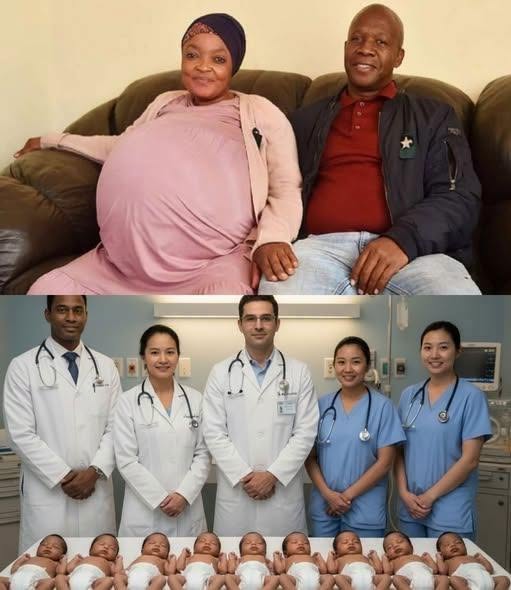
Why the Story Attracted So Much Attention
Multiple births naturally generate public interest.
Twins and triplets are familiar to many people, while pregnancies involving a larger number of babies are considerably less common.
That makes a claim involving ten infants particularly likely to spread online.
Posts about the alleged birth often combine photographs, emotional descriptions, and dramatic details about the pregnancy and delivery.
As the story is reposted, however, additional details can be added without clear evidence showing where they originated.
The Verified Record Is Nine Surviving Babies
According to Guinness World Records, the record for the most children delivered at a single birth who survived is nine.
The record belongs to Halima Cissé of Mali, who gave birth to nine babies in Casablanca, Morocco, on May 4, 2021. The babies were born prematurely at 30 weeks and were delivered by Caesarean section.
Guinness also records nine as the highest number of children delivered in a single birth overall, although an earlier 1971 Australian case had no surviving children.
As of 2026, Guinness continues to identify the Mali nonuplets as the surviving record holders.
How the Viral Ten-Baby Story Became Confusing
Claims about ten babies have appeared online before.
In 2025, fact-checkers investigated a widely shared story claiming that a woman named Amina had given birth to ten babies in the United Kingdom. The claim was found to be false, with investigators reporting that the accompanying material had been presented as viral content rather than a verified medical event.
Another similar claim circulated in 2025 alleging that a woman from the Comoros had delivered ten babies in Marseille, France. Africa Check found that the video was humorous or parodic material and that the claimed birth had not been reported by credible French news organizations.
These examples show how extraordinary birth stories can be recycled, repackaged, and presented as new events.
What About the “Unexpected Tenth Baby”?
One particularly dramatic version of the story claims that doctors initially believed there were fewer babies and then discovered an additional fetus during delivery.
There is a real element behind some stories of unusually large multiple pregnancies: prenatal imaging does not always identify every fetus at the earliest stage, particularly in extremely complicated pregnancies.
For example, Guinness records that doctors initially believed Halima Cissé was carrying seven babies before specialist care in Morocco revealed that she was actually carrying nine.
However, that documented case involved nine babies—not ten.
There is currently no reliable evidence supporting the dramatic claim that a tenth newborn was unexpectedly discovered in the delivery room in the story described here.
Why Extremely Large Multiple Pregnancies Require Specialized Care
Pregnancies involving a very large number of fetuses can be medically complex and require close monitoring.
Doctors may need to follow fetal growth, maternal health, placental conditions, and the possibility of premature delivery.
Delivery planning can also involve specialists from several areas of medicine because multiple newborns may require assessment and specialized care immediately after birth.
The Mali nonuplets, for example, were born prematurely and were transferred to incubators following their delivery. They remained under specialist care for an extended period.
The Real Story Is Extraordinary Enough
The verified story of Halima Cissé and her nine surviving children is already remarkable without adding unconfirmed details.
The babies were born on May 4, 2021, and Guinness continues to recognize them as the surviving record holders for the largest number of babies delivered in a single birth. In 2026, Guinness reported that the children had reached their fifth birthday and were preparing to start school.
That documented history is very different from the viral stories claiming that a woman recently delivered ten babies.
Why Verification Matters
Extraordinary stories naturally attract clicks and shares.
But the more unusual a claim is, the more important it becomes to check the source before repeating it as fact.
A photograph is not proof of a particular birth, and a social-media caption does not establish a medical record.
When an event would potentially establish a world record, reliable documentation from medical authorities, government agencies, established news organizations, or recognized record-keeping organizations becomes especially important.
The Takeaway
The claim that a woman recently gave birth to ten babies may sound like an incredible medical breakthrough, but the available evidence does not support presenting it as a confirmed event.
The verified record remains nine babies surviving from a single birth, achieved by Halima Cissé’s family in 2021.
So the next time a sensational story about an extraordinary pregnancy appears in your feed, it may be worth pausing before sharing it.
Sometimes the real story is remarkable enough—and checking the facts makes it even more interesting.