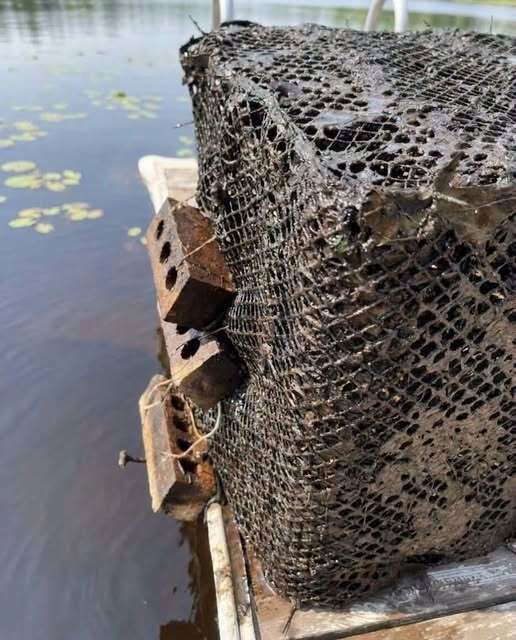
In colder regions, communities sometimes built fish cribs during winter when frozen lakes created a temporary work platform. People assembled structures on top of the ice, added heavy rocks or other weights, and positioned them over carefully selected locations. When spring arrived and the ice melted, the cribs sank into the water and settled onto the lake floor.
Other groups transported smaller structures by boat and lowered them using ropes. Regardless of the method, the purpose remained the same: create habitat where fish needed it most.
A newly placed crib did not instantly become a thriving ecosystem. The transformation happened slowly.
First, algae and tiny organisms began attaching themselves to the surfaces. Small aquatic insects arrived, feeding and reproducing among the growing habitat. Those insects attracted small fish searching for food. The young fish then used the spaces between branches and logs as protection from larger predators.
Over time, what began as a simple structure became a miniature underwater community.
The crib became a feeding area, a nursery, a hiding place, and a hunting ground all at once.
Young fish benefited especially from these protected spaces. Newly hatched fish and juveniles face many threats before reaching adulthood. Larger fish, birds, turtles, and other predators constantly search for easy meals.
A fish crib gives smaller fish a chance to escape.
The narrow gaps between branches, logs, and rocks create spaces that larger predators cannot easily enter. At the same time, food sources often gather around the structure, allowing young fish to feed without traveling far into exposed water.
A fish crib does not remove danger from the lake, but it adds complexity to the environment. That complexity gives more fish an opportunity to survive.
Interestingly, fish cribs do not only attract small fish.
Large predators eventually discover them as well. Bass, walleye, and other game fish often patrol the edges of these structures because they know smaller fish gather there.
This creates a natural food web. Small fish use the center of the habitat for protection, while larger fish hunt around the outside. Anglers benefit because these underwater communities often become reliable fishing locations.
Over generations, many families learned the exact locations of these hidden underwater structures. Before digital maps and advanced fish-finding equipment became common, anglers used shoreline landmarks to locate them.
A large tree on the shore, a distant building, or a unique rock formation could serve as a guide.
Knowing the location of a crib did not guarantee a successful fishing trip. Weather, seasons, water temperature, and fish behavior still mattered. But the structure increased the chances that life would be concentrated in that area.
What began as a fishing technique eventually became something much larger: a form of conservation.
Many lakes lost natural habitat because of shoreline development, erosion, vegetation removal, and human activity. Fallen trees that once provided shelter were often cleared away because people preferred cleaner-looking shorelines.
The problem was that fish depended on those natural structures.
Fish cribs offered a way to replace some of what had disappeared.
Over time, communities began seeing these structures not just as tools for catching fish but as investments in the health of the entire lake ecosystem.
Building fish cribs became a shared effort involving anglers, conservation groups, landowners, and volunteers. Some people provided materials. Others offered boats, equipment, or labor.
The work became a community tradition.
People were no longer simply trying to catch more fish for themselves. They were improving the lake for future generations.
For many families, fish cribs became part of their relationship with the water.
Parents taught children where the structures were located and explained why fish gathered there. Fishing trips became lessons about ecosystems, food chains, spawning areas, and the importance of protecting natural resources.
The hidden structure beneath the water became connected to memories above the surface.
A grandfather who helped build a crib as a teenager might return decades later with a grandchild to fish above the same location.
The crib carried more than fish.
It carried stories.
Modern fish habitat projects have evolved beyond traditional wooden structures. Today, some are built using PVC, plastic materials, mesh, and specially designed artificial habitats. These newer designs can last longer underwater and can be shaped to provide different types of shelter.
Some resemble underwater trees. Others look like cages, bushes, or open frameworks.
Although the appearance has changed, the purpose remains the same.
Create shelter, and life will follow.
However, successful fish cribs require careful planning.
A structure cannot simply be dropped anywhere and expected to help. Water depth, oxygen levels, seasonal changes, bottom conditions, and existing vegetation all affect whether a crib will become useful habitat.
A poorly placed structure may become buried in soft sediment, create hazards for boaters, or fail to provide the intended benefits.
That is why responsible projects often involve fisheries experts, lake managers, and local authorities. Proper materials and approved locations are essential.
Fish cribs are also not a solution to every problem facing a lake.
They cannot replace clean water, healthy vegetation, balanced fish populations, or responsible environmental management. A lake suffering from pollution, invasive species, or severe habitat loss requires much broader restoration efforts.
A crib is one piece of a much larger puzzle.
But it is an important piece.
A lake bottom that appears empty to people may be a challenging environment for fish. Without structure, there are fewer hiding places, fewer feeding areas, and fewer opportunities for young fish to survive.
A fish crib changes that by adding shape and complexity.
It creates shadows, surfaces, openings, and protected spaces where life can gather.
Perhaps the most remarkable thing about fish cribs is that they often work quietly.
Most people who visit a lake will never see one. They remain hidden beneath the surface, slowly becoming covered with algae and aquatic growth while fish move through their openings and insects cling to their surfaces.
Boats pass overhead. Families cast fishing lines. Children wait excitedly for a bite.
And below them, an unseen structure continues supporting life.
The story of fish cribs began with a simple observation: fish need shelter.
From that idea came a tradition of habitat restoration, community cooperation, and respect for the natural world.
Modern technology may improve the designs and make them easier to locate, but the basic principle remains unchanged.
When people care for the hidden places beneath the water, they help protect everything that depends on it.
The next tug on a fishing line may begin near a structure placed years earlier by someone who understood an important truth:
A healthy lake requires more than water.
It requires habitat, patience, and people willing to protect the things they may never see.