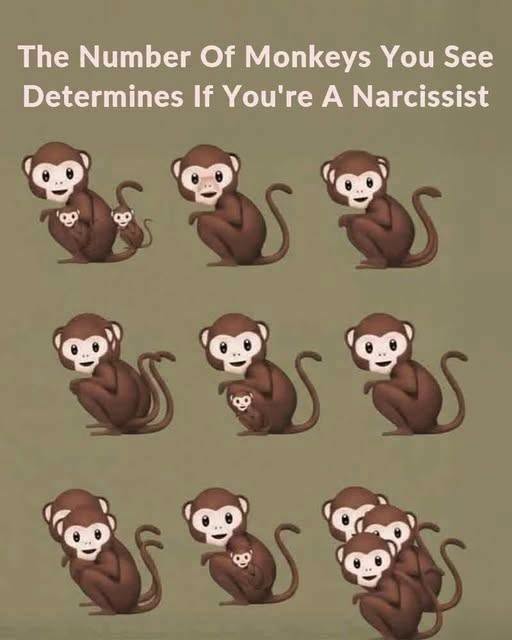
But there is an important distinction to make. While these visual puzzles can be entertaining, there is no reliable scientific basis for using the number of figures someone notices to determine whether they have narcissistic traits or any other specific personality characteristic.
The real science behind these images is much more interesting.
Why Do People Notice Different Things?
The human brain does not process every detail in our surroundings equally. Instead, it constantly filters information, directing attention toward certain features while allowing other details to remain in the background.
This means two people can look at exactly the same picture and notice different things first.
One person might immediately focus on the largest figures in the image. Another might begin searching for smaller shapes or patterns hidden within the overall design. Someone else might notice the colors, expressions, or arrangement before recognizing anything else.
These differences do not necessarily indicate that one person is more intelligent or more perceptive than another. They simply demonstrate that attention can work in different ways.
The Brain Loves Patterns
Our minds are naturally good at recognizing patterns.
When we look at a complicated image, the brain tries to organize what we see into familiar shapes and groups. This helps us understand information quickly without consciously analyzing every individual detail.
That ability is extremely useful in everyday life. It allows us to recognize faces, read signs, identify objects, and navigate familiar environments with relatively little effort.
However, it can also influence how we approach visual puzzles.
If an image encourages us to look for one particular answer, we may unconsciously focus our attention in that direction. Once we believe we have found the solution, we may stop looking for additional details.
That is one reason these puzzles can be so effective at holding our attention.
Why Personality Claims Can Be Misleading
Many viral puzzles make bold claims about what a person’s answer supposedly says about their personality.
Some suggest that your choice reveals whether you are confident, creative, analytical, emotional, or even narcissistic.
These claims can make a simple puzzle feel much more significant than it really is.
However, noticing a particular figure in a cartoon is not a recognized method for diagnosing a personality disorder or accurately measuring someone’s character. Personality assessment is far more complicated and, when done scientifically, relies on carefully designed methods rather than a single visual puzzle shared online.
So if you notice one group of monkeys before someone else notices another, there is no reason to assume that this reveals a hidden personality trait.
What the Puzzle Can Actually Teach Us
Although the personality claims may be exaggerated, the visual challenge itself can still teach us something interesting about perception.
Our first impression is not always the complete picture.
When we slow down and examine an image again, we may discover details that were invisible to us at first. This happens because attention is selective, and our brains naturally prioritize certain information.
The same principle applies outside of puzzles.
Sometimes we make quick judgments based on limited information. Taking a second look can reveal details we initially overlooked.
In that sense, these viral images can serve as a small reminder to remain curious and open-minded.
Why These Puzzles Become So Popular
There is a simple reason these challenges spread so quickly: they combine curiosity with self-discovery.
People naturally want to learn more about themselves.
A headline suggesting that a simple picture can reveal something hidden about your personality immediately creates a question:
“Could this really describe me?”
That curiosity encourages people to look closer, compare their answers with friends, and share the puzzle with others.
The result is a cycle of discussion and engagement that can quickly turn an ordinary image into a viral sensation.
The Real Answer May Be Simpler Than You Think
If you enjoy these puzzles, there is nothing wrong with treating them as lighthearted entertainment.
Just remember that an online image cannot provide a reliable diagnosis or define who you are.
Your personality is shaped by a complex combination of experiences, relationships, habits, values, and many other factors. It cannot be reduced to the number of cartoon figures you happen to notice first.
So the next time you encounter a viral visual puzzle claiming to reveal your “true personality,” enjoy the challenge—but keep the claim in perspective.
The most interesting discovery may not be what the image supposedly says about you.
It may simply be the realization that your brain, like everyone else’s, is constantly selecting, organizing, and interpreting the world around you.
And sometimes, taking a second look is all it takes to see something you missed the first time.