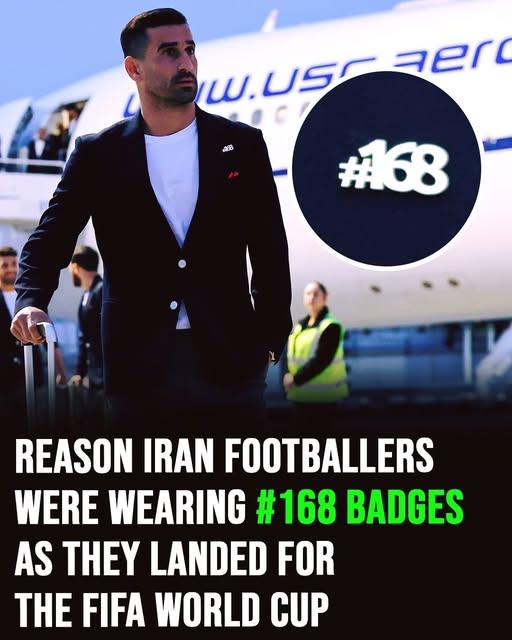
Iran’s participation in the FIFA World Cup has attracted attention not only for sporting reasons but also because of broader geopolitical developments surrounding the tournament. In recent days, focus shifted away from on-field competition after members of Iran’s national team were seen wearing jacket badges featuring the hashtag #168 during their arrival.
The symbol quickly generated discussion among football fans, journalists, and international observers, raising questions about its significance and the message it was intended to convey.
Tournament Participation Amid Diplomatic Challenges
Iran’s involvement in the tournament has taken place against a backdrop of diplomatic sensitivity and ongoing political tensions. The team’s scheduled matches in major U.S. cities, including Los Angeles and Seattle, have added further attention to its participation.
Before the tournament began, uncertainty surrounded the visa approval process for Iranian players and team personnel traveling to the United States. After weeks of review, visas were reportedly granted shortly before the team’s opening match.
According to reports from Reuters, however, not every member of the Iranian delegation received clearance. Several support staff members and federation representatives were reportedly denied entry, affecting parts of the team’s operational structure during the competition.
Team Base Relocated to Mexico
As a result of these travel limitations, the Iranian delegation adjusted its tournament logistics. The team established its operational base in Tijuana, Mexico, where players and staff could prepare for upcoming matches.
The relocation highlighted some of the organizational challenges faced by the delegation during the World Cup.
Meaning Behind the “#168” Badge
When the team arrived in Tijuana, media outlets and spectators noticed that several players were wearing badges displaying #168.
The symbol immediately became a topic of discussion, with many seeking clarification regarding its meaning.
Statements attributed to Iranian officials indicated that the badge was intended as a tribute related to the reported deaths of 168 children. According to those statements, the gesture was designed to honor their memory and draw public attention to the incident referenced by Iranian authorities.
The appearance of the badges introduced an additional humanitarian and political dimension to coverage of the team’s arrival.
Different Interpretations of the Symbol
The event connected to the number 168 has been interpreted differently by various governments, organizations, and media outlets.
Reports and official statements have presented differing accounts regarding the circumstances surrounding the tragedy and questions of responsibility. As a result, there is no single interpretation that has been universally accepted by all parties involved.
Because of these differing perspectives, reactions to the #168 badge have varied significantly across international audiences and news coverage.
FIFA Rules on Political Messaging
FIFA regulations generally restrict political, religious, and personal messages on team apparel and equipment during official competitions. The governing body’s rules are intended to preserve neutrality and prevent political advocacy within tournament settings.
In previous tournaments, FIFA has taken action when teams or players were found to have violated these guidelines.
In the case of the #168 badges, however, questions remain regarding whether FIFA regulations apply, since the badges were reportedly displayed during the team’s arrival rather than during official match activities.
As of now, discussion continues over whether the gesture falls within FIFA’s regulatory framework or outside the scope of competition-related rules.