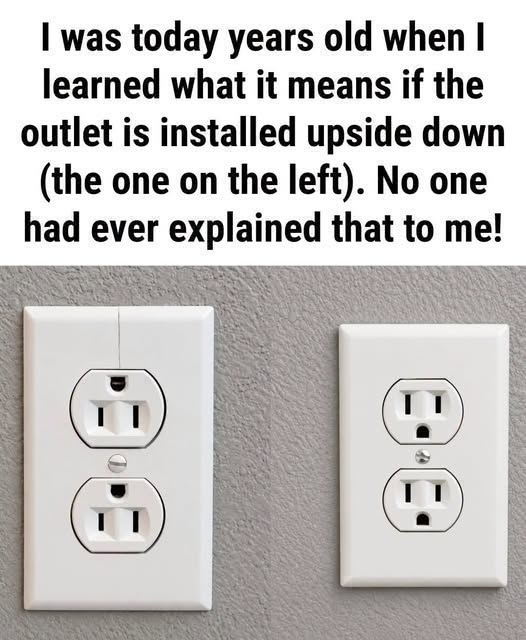
However, you may also encounter receptacles installed with the grounding opening facing upward.
The orientation itself doesn’t automatically tell you whether the outlet is wired correctly or incorrectly.
Electrical requirements focus on how a receptacle is installed, grounded, protected, and used. The National Electrical Code contains detailed requirements for receptacle installation and grounding, but the orientation people notice on an ordinary wall isn’t by itself proof of an electrical problem.
Why Would Someone Install It That Way?
There are several possible explanations.
In some installations, an electrician or property owner may choose an orientation for practical reasons related to the equipment being plugged in or the surrounding space.
One commonly discussed reason involves plugs and cords.
If a heavy plug or cord is positioned in a particular direction, changing the receptacle’s orientation may sometimes make the arrangement more convenient.
However, this shouldn’t be treated as a universal rule. Different electricians and jurisdictions may follow different conventions.
What About Safety?
The important issue isn’t whether the outlet looks upside down.
What matters is whether the receptacle and its wiring are properly installed and meet the applicable electrical requirements.
Modern electrical standards include detailed provisions concerning grounding, receptacle protection, and installation. Certain locations also have additional requirements designed to reduce electrical hazards.
For example, the NEC places restrictions on receptacles installed face-up in certain countertops, work surfaces, and areas beneath sinks because of concerns such as liquid entering the receptacle.
That’s very different from simply mounting a wall receptacle with the grounding opening at the top.
An Older Home Can Tell a Different Story
If you live in an older property, you may also encounter electrical outlets that don’t match what you see in newer homes.
Some older installations may have different types of receptacles or wiring arrangements.
Leviton, for example, notes that older homes can still contain two-slot, non-grounding receptacles. Replacing or modifying such outlets can involve specific electrical requirements, particularly when a proper equipment ground isn’t present.
So an unusual outlet shouldn’t automatically be judged by its appearance alone.
Should You Turn an Outlet Around Yourself?
This is where curiosity should stop and caution should begin.
A receptacle may look simple from the outside, but it is connected to household electrical wiring.
If you don’t know how the circuit is configured, don’t remove the cover plate or attempt to change the receptacle’s orientation yourself.
Electrical work should be performed by someone qualified to do it safely and according to the requirements that apply in your area.
If an outlet is loose, damaged, discolored, unusually warm, making noise, or showing other signs of a possible electrical problem, have it inspected rather than assuming the orientation is the cause.
So, Is an Upside-Down Outlet Wrong?
Not necessarily.
The unusual orientation may be intentional, it may reflect a particular installation practice, or it may simply be how that receptacle was mounted.
The important point is that you can’t determine whether an electrical outlet is safe simply by looking at which way the ground opening faces.
What appears to be a strange installation can sometimes have a perfectly ordinary explanation.
And the next time you notice one outlet that looks different from all the others, you may have a better question to ask:
Not “Who installed this upside down?”—but “What does the installation actually tell me?”