Why Do People See Different Things?
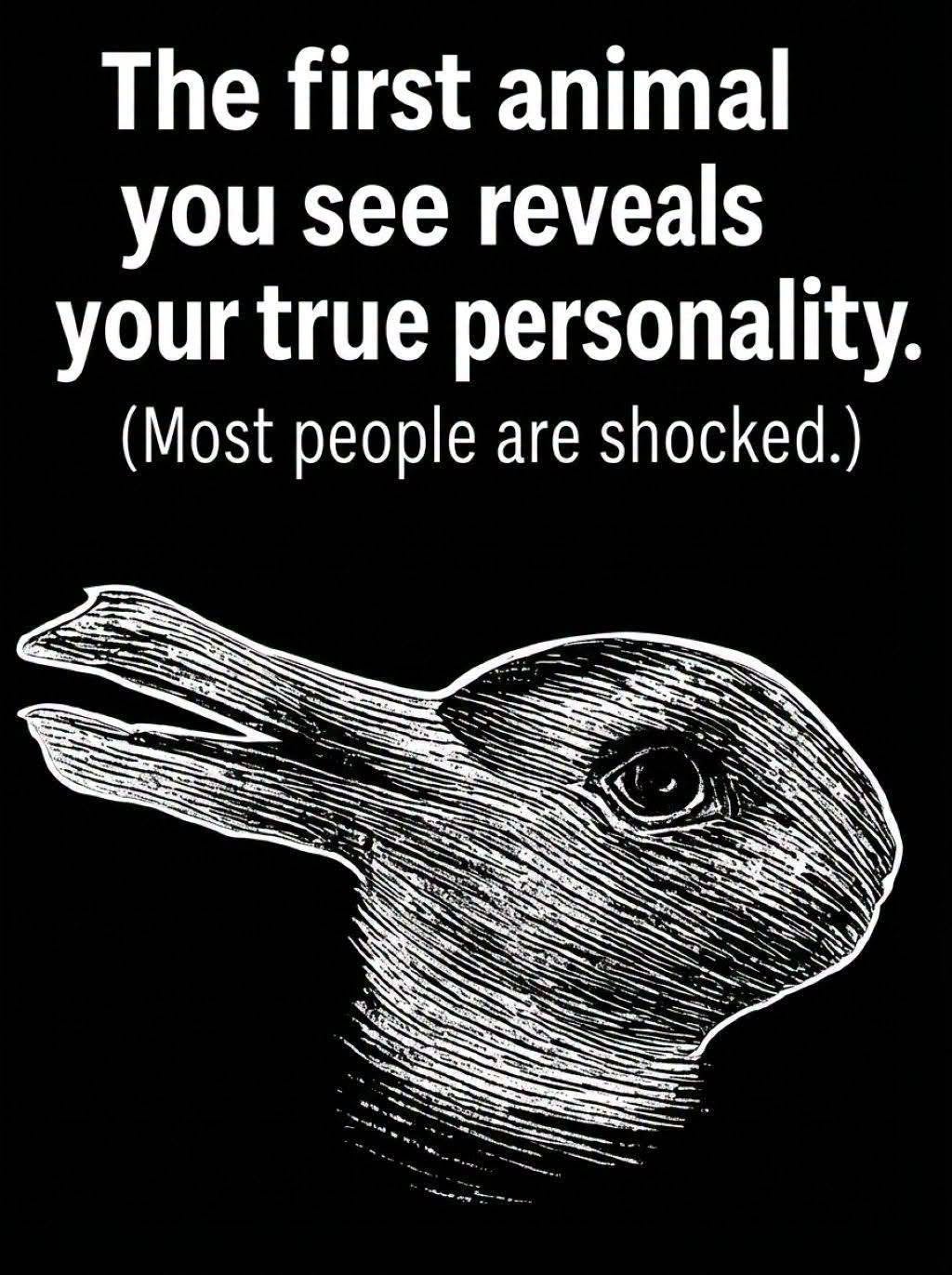
The image is an example of a reversible or ambiguous illusion—an image that can be interpreted in more than one way.
Your brain doesn’t simply record everything in front of your eyes like a camera. Instead, it constantly organizes shapes, edges, patterns, and familiar objects into something meaningful.
When an image can support multiple interpretations, your brain may settle on one version first.
That’s why two people can look at exactly the same picture and describe what they see differently.
If You Saw the Duck First
If the duck was the first animal you noticed, you might enjoy the common personality interpretation associated with it: being practical, observant, or detail-oriented.
But it’s important not to treat that interpretation as a diagnosis.
Your first impression can depend on many ordinary factors, including what part of the image caught your attention, how quickly you looked at it, your viewing angle, and what you were expecting to see.
In other words, seeing the duck first doesn’t automatically tell you what kind of person you are.
If You Saw the Rabbit First
The same is true if the rabbit immediately stood out.
Some versions of this puzzle describe rabbit-first viewers as imaginative, intuitive, or emotionally sensitive.
Those descriptions can be entertaining to consider, but they aren’t scientifically established personality categories based on this particular illusion.
You may simply have noticed a particular combination of lines and shapes before your brain interpreted the alternative.
The Most Interesting Part Comes Next
Here’s where the puzzle gets really fascinating.
After someone tells you that a second animal is hidden in the image, you may suddenly notice it.
The picture hasn’t changed.
Your eyes haven’t received new information.
Instead, your interpretation has changed.
This is one reason ambiguous images can be so satisfying. They demonstrate how dramatically a different interpretation can alter what we think we’re seeing.
Can Stress or Mood Change What You Notice?
Your attention can certainly be influenced by factors such as fatigue, distraction, expectations, and emotional state.
However, that doesn’t mean this particular image can accurately measure your mood or personality.
Human perception is complicated, and a single visual puzzle isn’t enough to draw meaningful psychological conclusions about someone.
That’s an important distinction between an entertaining optical illusion and a genuine psychological assessment.
What If You See Both Animals?
If you can eventually see both animals, you’ve solved the central trick of the picture.
Many people initially become “stuck” on one interpretation. Once they understand how the alternative shape works, the second animal becomes easier to recognize.
This can be a simple reminder that our first interpretation of something isn’t always the only possible interpretation.
That idea applies far beyond optical illusions.
Why These Puzzles Keep Fascinating Us
Ambiguous images have remained popular because they create a small moment of surprise.
You look at a picture and feel certain about what you’re seeing. Then someone points out another interpretation, and suddenly the same lines look completely different.
There is something surprisingly satisfying about that experience.
It reminds us that perception involves interpretation—not just seeing.
So, What Did You See First?
A duck?
A rabbit?
Or did you notice both almost immediately?
Whatever your answer, there’s no correct personality label attached to it.
The real fun of the puzzle is discovering how easily the brain can switch between two different interpretations of exactly the same image.
And perhaps that’s the most interesting lesson of all: sometimes changing what you see begins with simply knowing that there’s another way to look at it.
Note: This type of visual puzzle is intended for entertainment and observation. It should not be used as a scientific test of personality, intelligence, mental health, or psychological traits.