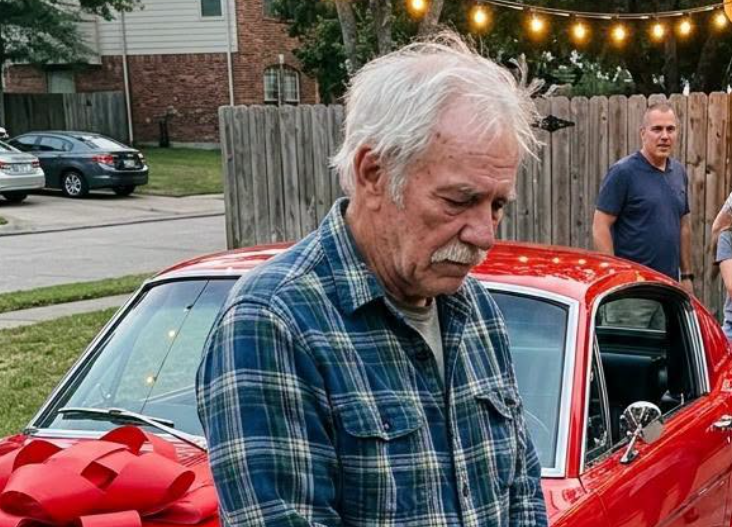
In 1971, Dottie was 21 years old when she bought the 1966 Ford Mustang with money she had saved over three years. It was candy-apple red, and it quickly became part of the family’s story.
She drove it on her first date with Gus. She took it to the hospital when their daughter, Carol, was born. Later, it carried the family on Sunday visits and ordinary outings that became the kind of memories people only fully appreciate years afterward.
Eventually, the Mustang stopped running. Gus parked it at the back of his garage and covered it with a tarp.
“Fix it up someday, Gus. Maybe one of the grandchildren will enjoy it.”
That was what Dottie used to tell him.
After Dottie died four years ago, Gus found comfort in the memories tied to the car. Two years later, Lily came over to help organize the garage. She found the Mustang under its cover and immediately recognized it from family photographs.
Her reaction gave Gus an idea: he would restore the car and give it to Lily for her 18th birthday.
Two years of work, and a few things left untouched
Gus kept the project a secret. For the next two years, he worked on the Mustang almost every day.
He rebuilt the 289 V8 engine, searched for original parts, replaced damaged sections of the floor, repaired the electrical system, and restored the interior with white vinyl similar to the original seats. The restoration cost about $19,000, much of it from his own savings.
The work was harder on him than it would have been years earlier. His knees were not as strong, and some evenings he had to stop after only a few hours. Still, he kept returning to the garage.
One detail mattered too much to change. Inside the glove compartment, Gus left Dottie’s old sunglasses and a tube of coral lipstick. They had been there for years, and to him, they still belonged with the car.
The birthday surprise changes tone
Lily’s 18th birthday celebration was held at her parents’ home, with family, friends, decorations and string lights in the backyard.
At six o’clock, Gus arrived in the restored Mustang. A large red bow sat on the hood, and the sound of the engine drew guests outside.
Lily covered her mouth with both hands when she saw it.
“Grandpa, is that really Grandma’s Mustang?”
Gus handed her the keys and told her Dottie had always hoped someone in the family would enjoy the car. Lily hugged him. Carol became emotional too. For a moment, the Mustang brought Dottie back into the center of the gathering.
Then Carol’s husband, Brent, approached.
Brent worked in commercial real estate and tended to look at vehicles through the lens of value, maintenance and practicality. After walking around the Mustang, he acknowledged the restoration but questioned whether it was the right car for Lily.
He pointed out that it was an older vehicle and did not have the same safety features as modern cars. He also said a newer vehicle might make more sense for someone preparing for college.
Lily was disappointed and said she loved the Mustang. The discussion grew uncomfortable when Brent suggested that selling the car might be worth considering.
Gus chose not to turn the party into an argument. He left quietly, hoping the family would have time to think about what the car represented.
The listing that made the title important
Two days later, Lily messaged Gus.
“Grandpa, I think you should see this.”
She attached a screenshot of an online listing. It showed Dottie’s Mustang parked outside Brent’s house. The description advertised the restored 1966 Ford Mustang for $38,000 and said a potential buyer had already shown interest.
Gus studied the photos. The paint shone, the chrome was polished, and the interior looked close to how he remembered it. But seeing the car offered for sale so soon after the birthday made one thing clear: he needed to check the paperwork.
In his filing cabinet, he found the Ohio Certificate of Title. It listed Dorothy and August Kowalski as the registered owners. After Dottie’s death, the car had legally passed to Gus through the proper ownership process.
Although he had handed Lily the keys at the party, he had not yet transferred the title to her. He had planned to do that with her the following week and had arranged an appointment at the Bureau of Motor Vehicles.
Legally, the Mustang was still his.
Bringing the Mustang back
That evening, Gus called his longtime friend Ray, who owned a towing business. They agreed to meet later that night.
Ray arrived shortly before midnight with a flatbed truck. He and Gus had known each other since childhood, and Ray understood the meaning of the car. When he saw it, he simply smiled and called it Dottie’s Mustang.
They carefully loaded the vehicle and secured it for the trip back to Gus’s garage.
Before leaving, Gus placed an envelope on the windshield of Brent’s vehicle. Inside was a copy of the title and a handwritten note explaining that the Mustang was still Gus’s property and that he intended to transfer it to Lily as originally planned. He also asked Brent to contact the interested buyer and return any money he had accepted.
Questions, documents and a deposit
The next morning, Brent found the Mustang missing from his driveway and called Gus repeatedly. Gus stayed calm and pointed to the title.
Later, an officer came to Gus’s garage after a report about the vehicle. Gus showed the ownership documents and explained the situation. The officer reviewed the paperwork and confirmed that the title was a key part of resolving the matter.
Brent then contacted the buyer to explain that the Mustang was not available for sale through him. The buyer had already given a $5,000 deposit, so returning that money became a priority.
A few days later, the buyer contacted Gus directly. His name was Harold, and he lived in Indianapolis.
Gus told him about Dottie, the restoration and why he wanted Lily to have the car. Harold listened and said he understood. He had recently lost someone close to him and appreciated what family memories could mean. He said he was no longer interested in buying the Mustang and would arrange to get his deposit back.
What the car meant to Carol
That afternoon, Carol visited Gus at the garage. She stood looking at the Mustang for a long time before apologizing for how uncomfortable Lily’s birthday had become.
She told Gus she knew how much the car had meant to her mother and that she should have made that clearer.
Then she walked to the driver’s side and ran her hand over the red paint. She said it looked just as it had when she was little.
When she opened the glove compartment, she found Dottie’s sunglasses and coral lipstick still inside. The sight brought tears, but also a smile. Carol sat in the driver’s seat for a while, remembering Sunday drives and family outings.
For Gus, that afternoon confirmed what the restoration had always been about. It was not only a car project. It was a way of keeping family memories close.
Brent’s apology and Lily’s new title
About ten days later, Brent came to the garage. His usual confidence had softened.
He apologized to Gus and admitted he had focused too much on the Mustang’s financial value and practicality while missing its sentimental importance. He also explained that he had been thinking about Lily’s future and wanted her to have something reliable for college.
Gus told him that concern for Lily’s safety was understandable, but that family gifts also deserved respect for the memories and effort behind them.
The conversation became easier. Gus handed Brent a pair of work gloves and invited him to help with an oil change. Brent stayed for the afternoon and helped with simple maintenance tasks.
The following week, Gus and Lily drove the Mustang to the Bureau of Motor Vehicles. They completed the paperwork and officially transferred ownership into Lily’s name.
When the clerk handed her the new title, Lily smiled and told Gus she could not believe the Mustang was really hers.
Brent later offered to contribute toward professional safety improvements. The family discussed having the vehicle inspected by a qualified classic-car specialist and making appropriate upgrades so Lily could enjoy it responsibly.
A Mustang now tied to three generations
Lily eventually took the Mustang with her to college. She does not drive it every day, but she uses it for special occasions and keeps it maintained.
She still calls Gus on Sundays. When people ask about the car, she tells them her grandfather spent two years restoring it for her and that it belonged to her grandmother.
Dottie’s sunglasses remain in the glove compartment.
For Gus, watching Lily care for the Mustang is the reward. He spent 41 years repairing vehicles, but this restoration was different. Every part he replaced reminded him of Dottie and the life they built together.
The red Mustang is now more than a classic automobile. It carries years of work, family memories and a connection between three generations.
And each time Gus hears the familiar 289 engine start, he remembers Dottie asking him to fix it up someday.