I stared at it.
“What’s inside?”
“I don’t know.”
“You haven’t opened it?”
“No.”
That surprised me.
Jett was usually the kind of manager who opened every forgotten receipt, checked every abandoned item, and knew exactly what was happening in his restaurant.
But now he seemed hesitant.
He pushed the envelope toward me.
My name was written across the front.
For the waitress.
I felt a strange chill.
“How would they know my name?”
“They probably don’t,” Jett said. “Your name is on your receipt pad. Maybe they saw it.”
I picked up the envelope.
It was heavier than I expected.
Inside was a folded piece of paper and a small black key.
I unfolded the paper.
There were only a few words:
I’m sorry about the bill. Please don’t blame the girl.
I read it twice.
Then I looked at Jett.
“What does that mean?”
He shook his head.
“I don’t know.”
I turned the paper over.
Nothing.
No name.
No explanation.
Just those words.
For a moment, neither of us spoke.
Then Jett noticed something else inside the envelope.
A photograph.
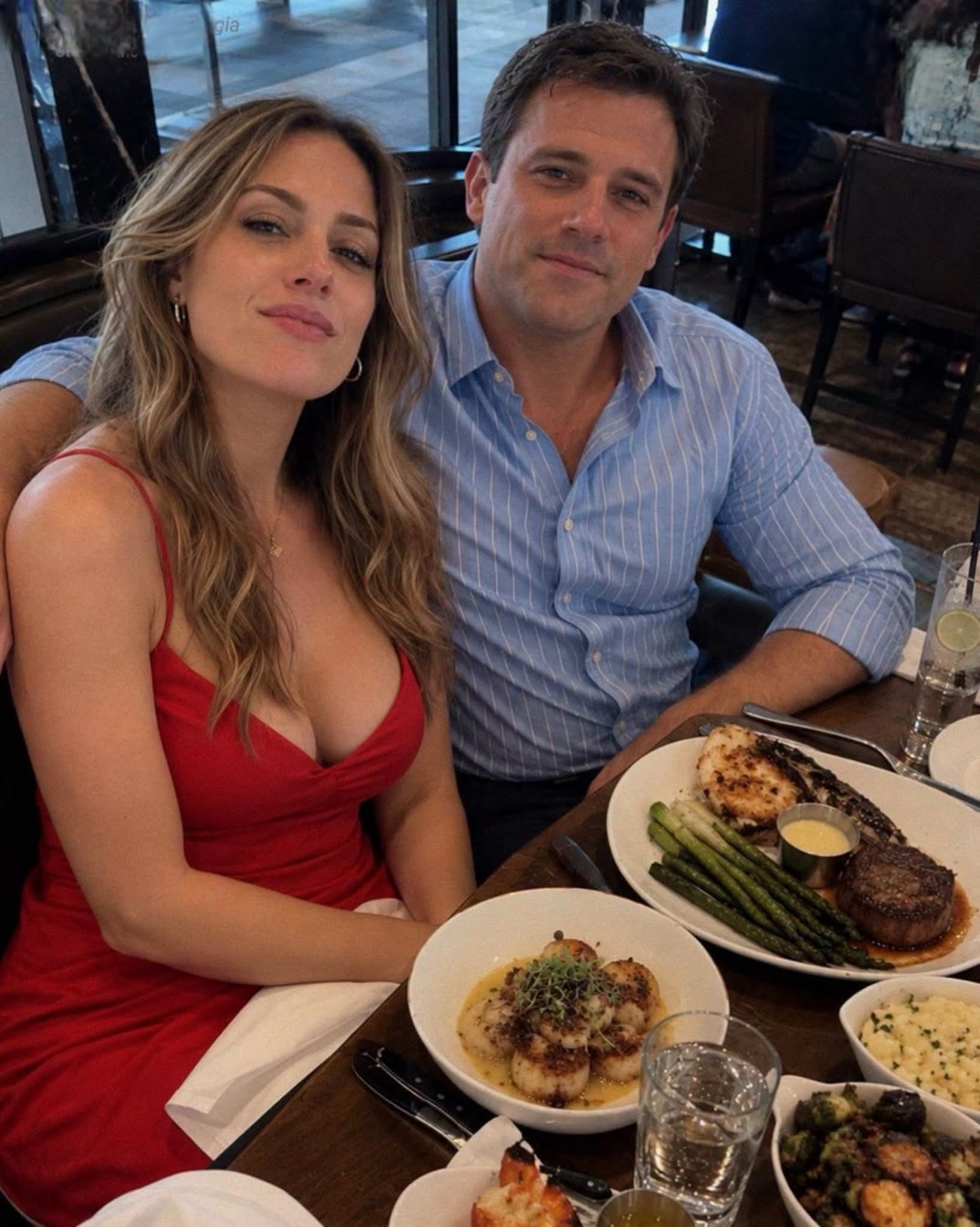
It showed the couple sitting at the restaurant the previous evening.
But there was something strange about it.
The photograph hadn’t been taken from our security cameras.
It looked older.
Much older.
The woman in the picture looked exactly like the woman I’d served.
The man beside her looked like the same man too.
But the photograph itself appeared faded and slightly damaged.
On the back was a date.
Twenty-three years earlier.
I stared at it.
“That’s impossible.”
Jett took the photograph from my hand.
His expression changed.
“What?”
“Look at the restaurant.”
I did.
The room was unmistakably ours.
Same brick wall.
Same long windows.
Same wooden booths.
Even the old brass light fixture hanging above the bar was there.
But there was one problem.
The restaurant had supposedly been renovated into its current design only eight years ago.
And according to the date on the photograph, this image had been taken fifteen years before that.
Jett walked toward the office.
“Stay here.”
He returned a few minutes later carrying an old binder.
“What is that?”
“Property records.”
He flipped through several pages.
Then he stopped.
“This building used to belong to someone else.”
“Who?”
Jett looked at the photograph again.
“A family named Mercer.”
My stomach tightened.
“Does that mean anything?”
“Not to me.”
He turned another page.
Then his face went pale.
“Actually…”
“What?”
“The Mercers owned the restaurant before the current owners bought the property.”
He showed me an old newspaper clipping attached to the file.
The headline was faded, but I could still make out the words:
LOCAL BUSINESSMAN DISAPPEARS WITH WIFE AFTER FINANCIAL TROUBLE
I looked at the photograph.
Then at the clipping.
Then back at Jett.
“That’s them.”
“That’s what I was thinking.”
The article said the couple had disappeared more than two decades earlier.
They had reportedly left behind unpaid debts and several confused business partners.
No one knew where they had gone.
But the article mentioned something else.
The couple had a daughter.
Her name was Elena Mercer.
I read the name again.
“Where is she now?”
Jett didn’t answer.
Instead, he pointed toward the photograph.
“Look at the woman.”
I studied her face.
There was something different about her now.
Not the eyes.
Not the hair.
Something about the expression.
Then I noticed a tiny scar near her eyebrow.
I remembered seeing it the previous evening.
“That’s her.”
Jett nodded.
“That’s what I thought too.”
We stood in silence.
The couple who had walked out on a $400 dinner appeared to be the same couple who had disappeared from the property records more than twenty years ago.
But why had they returned?
And why leave the envelope for me?
I picked up the note again.
I’m sorry about the bill. Please don’t blame the girl.
“The girl,” I whispered.
Jett looked at me.
“What if they weren’t talking about me?”
I felt a knot forming in my stomach.
“What do you mean?”
“What if ‘the girl’ was someone else?”
Before I could respond, the restaurant’s front door opened.
An elderly woman walked inside.
She looked around slowly.
Then her eyes landed on me.
She walked directly toward the counter.
“Are you Nora?”
I nodded.
“Yes.”
She reached into her purse and pulled out another photograph.
“This belongs to you.”
I stared at it.
It showed a young woman standing outside the restaurant.
She looked about my age.
I recognized her immediately.
It was me.
Except the photograph was dated fifteen years earlier.
My hands started shaking.
“I don’t understand.”
The woman sat down.
“Neither did I,” she said.
“Who are you?”
“My name is Margaret.”
She looked toward the booth where the couple had been sitting.
“That couple came here because they knew they couldn’t stay away forever.”
“Why?”
Margaret looked at me for several seconds.
“Because this restaurant wasn’t the only thing they left behind.”
She placed another envelope on the counter.
This one was sealed.
And this time, my name wasn’t written on it.
Instead, there were three words:
Open when ready.
I looked at Jett.
He seemed just as confused as I was.
“What’s inside?”
Margaret shook her head.
“That’s something you need to discover yourself.”
I opened the envelope.
Inside was a letter.
The first sentence made my heart stop.
Nora, if you’re reading this, then your mother never told you the truth about your father.
I couldn’t breathe.
My mother had died six years earlier.
She had always refused to talk about my father.
I’d spent my childhood believing he had simply abandoned us.
Now, suddenly, I wondered whether that had ever been true.
I kept reading.
The letter explained that the man from the restaurant had known my mother many years ago.
They had been young.
They had made plans.
And then something happened that forced them apart.
According to the letter, my father hadn’t disappeared because he didn’t care about me.
He had been trying to find us.
For years.
The woman from the restaurant—the woman everyone believed had vanished decades earlier—was his sister.
She had come back because she finally knew where I was.
But there was still one question.
Why had my father walked into the restaurant, ordered a $400 dinner, and left without paying?
The answer was on the final page.
He hadn’t been trying to steal from us.
He had wanted to make sure I was still working there before he approached me.
He had been afraid.
Afraid that if he walked up and introduced himself as my father, I would reject him.
So he left the envelope instead.
And then he disappeared again.
I looked at Jett.
“Where is he?”
Jett pointed toward the front window.
A man was standing across the street.
Older than the man in the photograph.
Gray hair.
Dark coat.
Hands in his pockets.
He wasn’t moving.
He was simply watching the restaurant.
I walked outside.
He immediately looked away.
“Wait!”
He stopped.
For several seconds, neither of us spoke.
Then I said the only thing that came to my mind.
“Are you my father?”
The man closed his eyes.
When he opened them again, they were filled with tears.
“I’ve been waiting twenty-three years for you to ask me that.”
I didn’t know what to say.
I didn’t know whether to hug him, yell at him, or walk away.
So I simply stood there.
He reached into his coat and pulled out something small.
A photograph.
It was my mother holding me as a baby.
On the back, in her handwriting, were six words:
“One day, she deserves the truth.”
And suddenly, the $400 bill didn’t matter anymore.
The real thing they’d left behind wasn’t money.
It was a story.
A family secret.
And the chance for me to finally decide what to do with the truth.