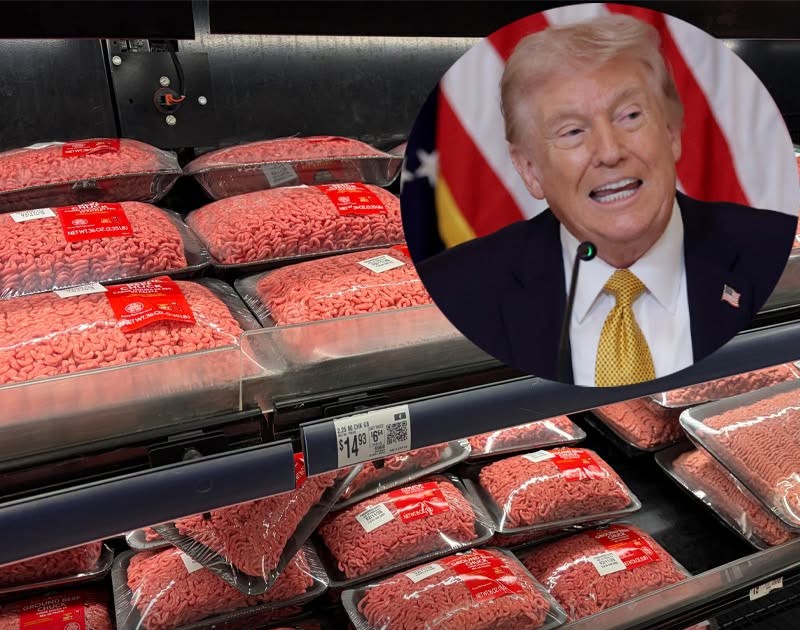
Lean beef trimmings are particularly important to the ground-beef supply because they can be combined with higher-fat beef to produce familiar blends such as 80/20 and 90/10.
That means imported beef does not necessarily show up as a package labeled simply “imported beef.” It can become part of a ground-beef product.
And that’s where label confusion can begin.
A USDA stamp doesn’t mean the cattle were American
One of the easiest assumptions for shoppers to make is that a USDA inspection mark means the meat itself originated in the United States.
It doesn’t.
The USDA inspection mark primarily indicates that the product was inspected under federal meat-inspection requirements. It is not, by itself, a country-of-origin claim.
A product processed or inspected at a U.S. facility can involve meat originating elsewhere.
That’s an important distinction when you’re standing in the meat aisle trying to determine exactly what you’re buying.
What “Product of USA” means
There is, however, a major difference between a USDA inspection mark and an explicit U.S.-origin claim.
Under USDA’s current rules for voluntary U.S.-origin claims, single-ingredient meat products carrying the claims “Product of USA” or “Made in the USA” must be derived from animals born, raised, slaughtered and processed in the United States.
Those claims therefore carry considerably more information about U.S. origin than simply seeing a USDA inspection symbol.
Shoppers may also see other voluntary claims describing U.S. production, such as statements about where an animal was raised or slaughtered.
But it’s important to distinguish these voluntary claims from mandatory country-of-origin requirements.
There’s a surprising catch with ground beef
Here’s the part many shoppers may not realize:
Beef and ground beef are not currently subject to the federal mandatory Country of Origin Labeling requirements that once applied to them.
Congress rescinded mandatory COOL requirements for beef, pork, ground beef and ground pork in 2015. USDA’s Food Safety and Inspection Service says ground beef therefore does not have to carry a mandatory country-of-origin label simply because it is ground beef.
That means shoppers shouldn’t assume every package will provide a detailed “born, raised and slaughtered” history.
When origin information is voluntarily provided, however, it can be useful.
And for products that contain meat from multiple countries, USDA guidance allows ground meat made from raw materials of different origins to be commingled, with the applicable countries identified when an origin claim is being provided under the relevant labeling rules.
Don’t confuse “USDA Choice” with American beef
There’s another common misunderstanding worth clearing up.
USDA Prime, USDA Choice and USDA Select are quality grades—not country-of-origin labels.
They describe characteristics of the meat, including factors such as marbling and expected eating quality.
So a package marked USDA Choice is not necessarily telling you that the cattle were born and raised in America.
Likewise, the USDA inspection symbol and USDA quality grade serve completely different purposes.
Think of it this way:
- USDA inspection: concerns inspection and food-safety requirements.
- USDA quality grade: describes characteristics and expected quality.
- U.S.-origin claim: provides information about where the animal and product came from.
Those distinctions can make the label much easier to understand.
What should shoppers look for?
If buying beef that is specifically identified as U.S.-origin matters to you, don’t rely solely on the USDA inspection stamp or the words “USDA Choice.”
Instead, look for an explicit U.S.-origin statement such as “Product of USA” or “Made in USA,” where applicable.
You can also check for other voluntary statements identifying where the animal was born, raised or slaughtered.
And remember that “processed in the USA” is not necessarily the same thing as “cattle raised in the USA.”
The USDA’s labeling rules were specifically strengthened to make authorized “Product of USA” and “Made in USA” claims reflect animals born, raised, slaughtered and processed in the United States.
The bigger issue is transparency
The debate over imported beef isn’t simply about whether imported meat is safe or unsafe. Meat entering the U.S. food supply is subject to applicable federal inspection requirements.
The bigger consumer question is often much simpler:
Where did this beef actually come from?
With the U.S. beef supply under pressure and the government taking temporary steps to increase supplies, that question is likely to remain part of the grocery conversation.
For shoppers, the lesson is straightforward: don’t assume that every USDA symbol means “American beef.”
Take a moment to distinguish inspection, quality grade and country-of-origin claims.
A few extra seconds with the label can tell you much more than the USDA stamp alone.