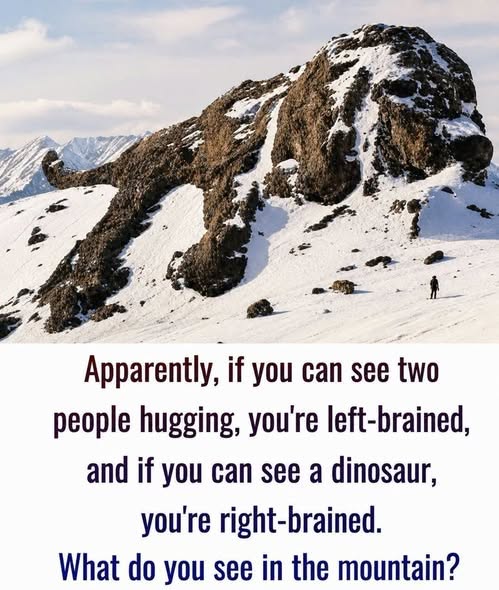
What Do You Notice First?
Before reading any further, take a moment to look at the picture.
Do you see two people? A prehistoric creature? Or something else entirely?
The interesting part of this puzzle is that the image encourages you to interpret its shapes before you have examined all the details. Your first impression may feel convincing, even though another interpretation is possible.
There is no right or wrong personality type associated with any of these answers. The fun lies in discovering how differently the same picture can appear to different viewers.
The Hidden Shape Revealed
If you are having trouble spotting the dog, begin by looking toward the left side of the image.
Search for a dark shape that resembles a nose and eye. Then look for the outline of the head and floppy ears. From there, follow the larger curved shape across the snowy scene.
The ridge that first appeared to be a mountain can begin to look like the dog’s back, while the shapes around it become easier to interpret as paws and body.
Once you recognize the animal, it may become difficult to return to your original interpretation. The picture itself has not changed; you have simply found a new way to connect its visual details.
Why Does the Illusion Fool Our Eyes?
Our brains constantly organize visual information into recognizable patterns.
When we encounter an unfamiliar or complicated image, we often use familiar objects and previous experiences to make sense of what we see. This process is usually helpful, but it can also lead us to interpret ambiguous shapes in unexpected ways.
In this picture, the snowy background and overlapping contours make the dog’s outline less obvious. Some areas resemble shadows or hills, while others can suggest entirely different objects.
Once someone points out the hidden animal, those same shapes may suddenly seem much easier to understand.
Does Your First Answer Reveal Whether You Are Left-Brained or Right-Brained?
Online captions sometimes claim that seeing one shape rather than another reveals whether a person is “left-brained” or “right-brained.”
That claim should be treated as entertainment, not a scientific test.
The popular idea that people are either predominantly left-brained and logical or right-brained and creative oversimplifies how the brain works. Different brain regions do have specialized functions, but complex tasks generally involve networks across both hemispheres.
Research has not established that choosing one interpretation of a viral optical illusion can reliably identify a person’s thinking style, intelligence, or personality.
So if you saw the dog first, that does not prove you are more creative or observant than someone who saw something else.
Why Do Different People See Different Things?
Several factors can influence what someone notices first, including the shapes they recognize, their expectations, and the clues that attract their attention.
If a person is told to search for a dinosaur, they may concentrate on contours that resemble a head, neck, or body. Someone expecting to see people might focus on a different part of the picture.
Neither response necessarily reveals anything deep about the viewer. It simply demonstrates how expectations can influence the interpretation of an ambiguous image.
Try the Challenge With Friends
For a fun experiment, show the picture to a friend without revealing the answer.
Ask what they see first and give them a few moments to examine it. Then, if they need a hint, direct their attention toward the left side of the snowy scene.
You may be surprised by how quickly their interpretation changes once they notice the dog’s face.
The challenge works best when everyone treats it as a lighthearted puzzle rather than a measure of intelligence or mental ability.
The Real Lesson Behind the Picture
Optical illusions remind us that seeing something is not always the same as immediately understanding it.
A familiar shape can emerge from an unusual arrangement of shadows and contours, and a small hint can completely change the way we interpret an image.
The hidden dog is a charming example of this effect. It does not reveal which side of your brain dominates, but it does offer an entertaining opportunity to pause, look again, and reconsider your first impression.
So, what did you see first—the embracing figures, the dinosaur, or the sleeping dog?
Whatever your answer, the most interesting part is how a single picture can invite so many different interpretations.