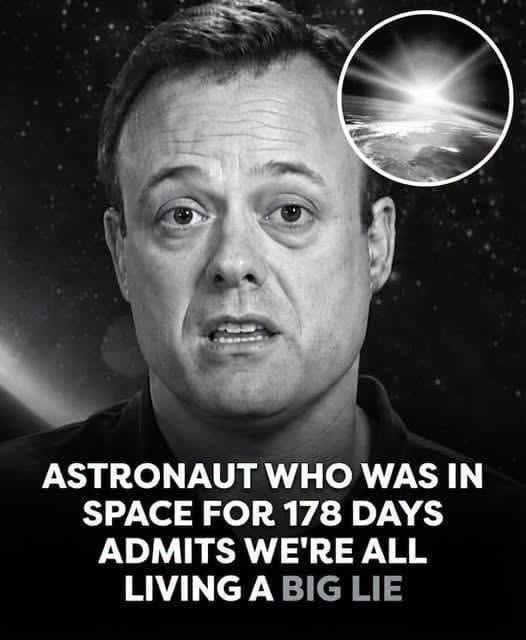
From space, Garan could see that layer along Earth’s curved horizon.
The sight made the planet appear less like an indestructible world and more like a delicate system surrounded by an environment where humans could not survive without protection.
For Garan, that perspective became difficult to forget.
Borders Disappeared From Orbit
Something else was missing from the view.
National borders.
From the International Space Station, Garan could see continents, oceans, storms, cities, deserts, and coastlines.
But the political boundaries that dominate so much of life on the ground were invisible.
The contrast changed the way he thought about humanity’s divisions.
Problems that can feel enormous when viewed from within one country suddenly looked different when the entire planet could be seen at once.
Astronauts Call It the “Overview Effect”
Garan’s experience is often described through a phenomenon known as the overview effect.
The term refers to the psychological shift some astronauts report after seeing Earth from space.
Instead of experiencing the planet mainly as separate countries and regions, they begin seeing it as one interconnected system.
For some astronauts, that view creates an intense awareness of Earth’s vulnerability and of how dependent people are on the same environment.
Garan has repeatedly spoken about how strongly that perspective affected him.
The Biggest Realization Was About Earth
His time in orbit may have taken him farther from ordinary life than most people will ever travel, but the lesson he carried back was not really about space.
It was about what was happening below.
From orbit, environmental damage, conflict, political divisions, and competing national interests could be viewed against the reality that everyone still depended on the same planet.
Garan came to believe that many human systems focus too heavily on separation when the larger reality is interdependence.
A Thin Layer Protects Everything We Know
The image of Earth’s atmosphere became especially powerful for him.
That narrow band contains the conditions that allow billions of people, animals, plants, and entire ecosystems to exist.
Beyond it is an environment hostile to human life.
Seeing that contrast directly made the planet’s protective systems feel far less abstract.
The atmosphere was no longer something represented in diagrams or discussed in scientific terms.
He had seen it surrounding Earth with his own eyes.
178 Days Changed His Perspective
Garan returned from space with a stronger focus on cooperation and environmental responsibility.
He has since spoken publicly about humanity’s shared dependence on Earth and the need to think beyond national or institutional boundaries when dealing with global problems.
His message is not that differences between countries disappear simply because Earth looks peaceful from orbit.
Rather, the view gave him a different scale for thinking about those differences.
From hundreds of kilometers above the surface, humanity’s disagreements exist inside something much larger that everyone shares.
Earth Looks Different When You Can See All of It
Most people will never experience Earth from the International Space Station.
But photographs and accounts from astronauts provide a glimpse of what that perspective can do.
From orbit, there is no visible line separating one country from another.
There is only a planet surrounded by darkness and protected by a remarkably thin atmosphere.
For Garan, spending 178 days above that planet changed the way he understood what was happening on it.
And the lesson he brought home was simple:
Earth may look enormous from where we stand, but from space, it becomes clear just how much everyone depends on the same fragile home.
Do you think seeing Earth from space would permanently change the way you look at life on the planet? Share your thoughts in the comments.