Look Beyond the Water Level
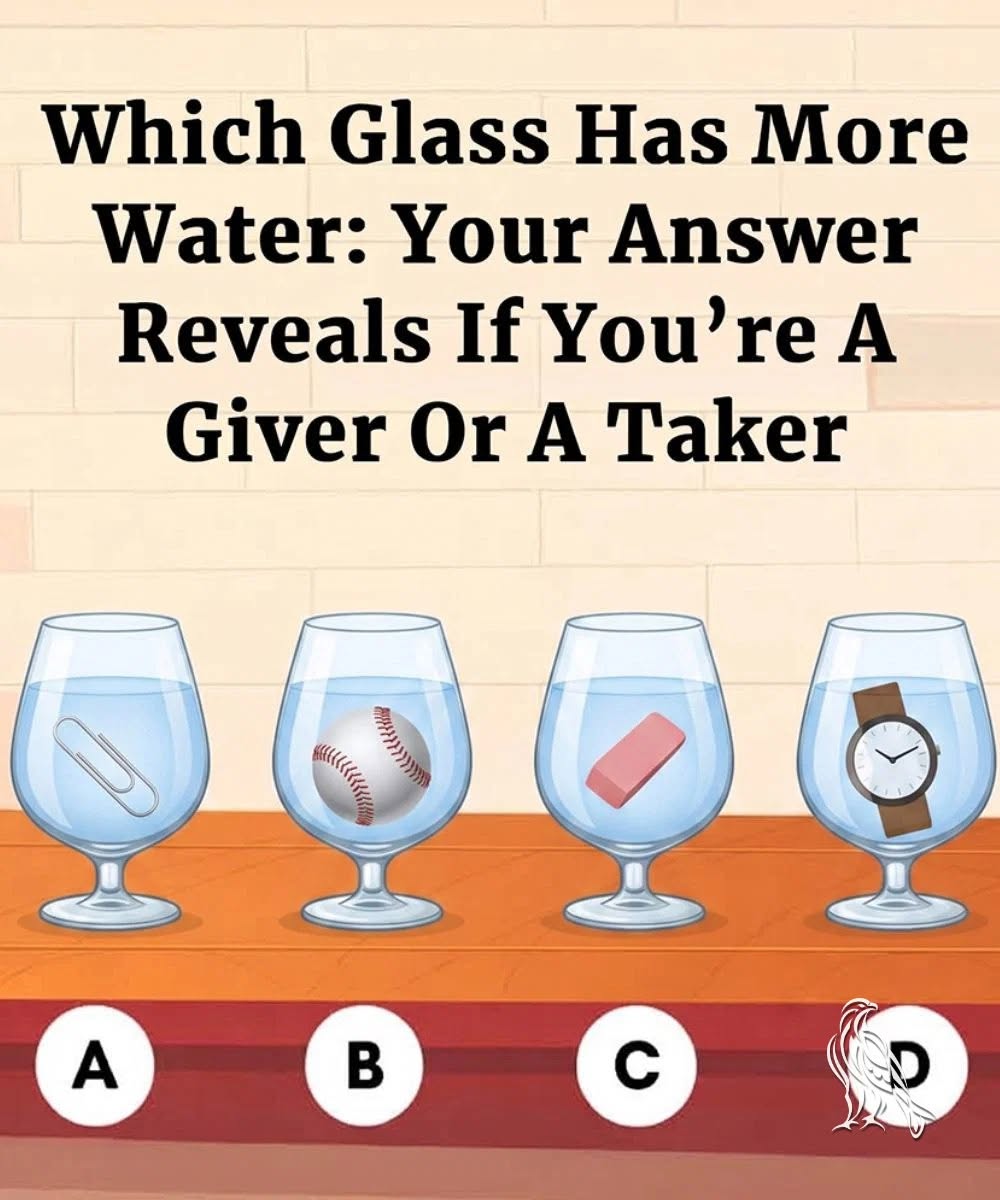
Imagine four glasses filled to the same visible level.
- Glass A contains a paperclip.
- Glass B contains a baseball.
- Glass C contains an eraser.
- Glass D contains a wristwatch.
If you judge only by the water level, the glasses may appear identical.
But the objects inside them are taking up space.
That means the amount of water isn’t necessarily the same.
The Science Behind the Puzzle
When an object is placed into water, it occupies part of the space that could otherwise be filled with water.
This is known as displacement.
A larger submerged object generally displaces more water than a smaller one. Therefore, if the four glasses have the same total volume up to the same waterline, the glass containing the smallest submerged object will contain the greatest volume of water.
Under the assumptions of this puzzle, that would be Glass A, which contains the paperclip.
The baseball in Glass B occupies substantially more space, while the eraser and wristwatch also take up more space than a small paperclip.
So the visual appearance can be misleading.
Why Our Eyes Can Get It Wrong
The interesting part of the puzzle isn’t just the answer. It’s the way our brains approach the problem.
When several objects appear similar at first glance, we often focus on the most obvious feature—in this case, the water level.
We may not immediately consider the volume of the objects inside the glasses.
That’s an example of how visual information can encourage quick assumptions.
The puzzle gives us a reason to slow down and ask a second question:
What else is affecting what I’m seeing?
Is It Really a Personality Test?
Online versions of puzzles like this are sometimes presented as personality tests.
For example, someone might claim that choosing Glass A means you’re analytical, while choosing another glass supposedly indicates that you’re intuitive, creative, or emotionally driven.
Those descriptions can be entertaining, but they shouldn’t be treated as psychological assessments.
There is no reliable scientific basis for determining someone’s personality simply by asking which glass they notice or choose first.
Your answer may reflect how you approached that particular puzzle, but it doesn’t provide a complete picture of who you are.
The Bigger Lesson
That’s what makes this little puzzle surprisingly useful.
It reminds us that the most obvious answer isn’t always the complete answer.
Sometimes, solving a problem requires looking beyond what is immediately visible and considering the factors that aren’t as noticeable.
In this case, the important detail isn’t simply the water level.
It’s the space occupied by the objects inside the glasses.
A paperclip may look insignificant compared with a baseball, but its smaller size is exactly what makes the difference in the calculation.
So, Which Glass Did You Choose?
If you chose Glass A, your answer matches the displacement principle described above, assuming the objects are fully submerged and the glasses have the same visible water level.
If you chose another glass, don’t worry. The puzzle is designed to encourage a quick visual judgment before revealing the underlying principle.
The next time you encounter a visual puzzle, try pausing for a moment before deciding.
Look at what’s obvious—but also look for the small detail that might change everything.
Sometimes, the answer isn’t hidden in plain sight.
It’s hidden in the part you didn’t think to measure.