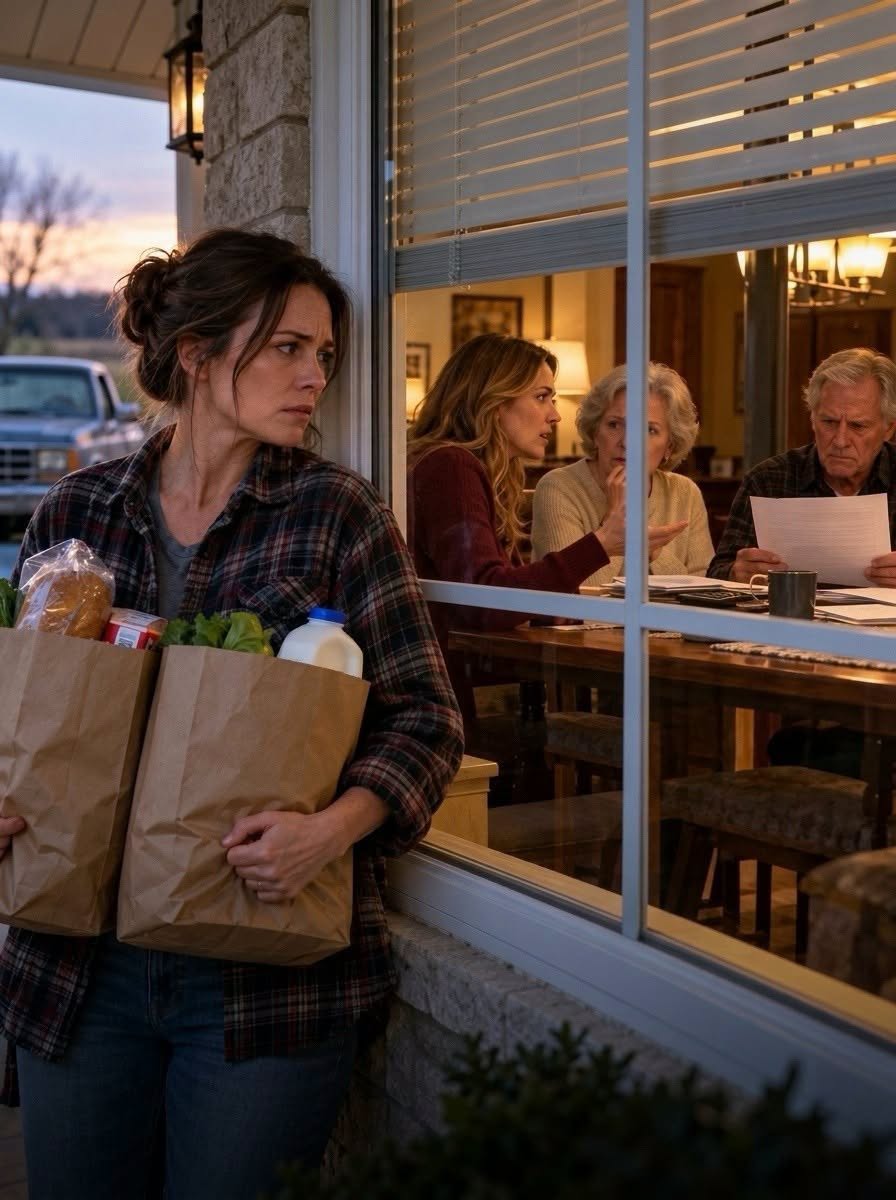
He looked away.
Then Sarah returned from her phone call.
“My mother says we can stay with her.”
“Good.”
“She lives an hour away!”
“I’m sorry about the inconvenience.”
Her eyes narrowed.
“You’re really doing this over a bedroom?”
“No. I’m doing this because I own my home, and I’m entitled to decide how it’s used.”
David looked at her.
“How long were you actually planning to stay?”
Sarah hesitated.
“Six months, maybe a year if necessary.”
David went pale.
“A year?”
She sighed. “You would’ve panicked if I told you the whole plan.”
“What whole plan?”
She finally admitted that she had already given notice on their apartment the previous week.
David stared at her.
“You ended our lease without telling me?”
“We couldn’t keep throwing money away on rent.”
“You said we would decide together!”
“I handled it because you overthink everything.”
I watched my son absorb the truth. He had asked me for eight weeks of help while his wife had been planning for a much longer stay.
But that wasn’t all.
David soon revealed that Sarah had changed their mailing address to my home two weeks earlier. She had redirected bank statements and insurance documents, registered her consulting business at my address, and even ordered renovation samples for the upstairs bathroom.
She had been planning to make herself comfortable before asking whether I agreed.
David looked sick.
“She assumed you’d say yes,” he admitted.
I shook my head.
“No. She assumed I would eventually stop saying no.”
That was the real problem.
A small demand had become another. My coffee maker had been moved to make room for Sarah’s espresso machine. Pantry shelves had been rearranged. Michael’s photograph had been removed from the mantel and placed face down in a drawer because it didn’t match the decor.
None of those actions seemed enormous on its own.
Together, they told a story.
My home was slowly becoming someone else’s home, and my comfort was being treated as an inconvenience.
Sarah insisted she had done nothing wrong.
David finally asked her, “Why did you move Dad’s picture?”
“Because we’re living here now.”
Those four words changed his expression.
Living here now.
Not visiting. Not staying temporarily.
Living here.
He turned to his wife.
“You knew Mom only agreed to eight weeks.”
“Plans change.”
“Not only ours,” he replied.
For the first time that morning, my son seemed to understand that my life counted too.
“Forgiveness Isn’t Permission”
Eventually, the movers agreed to redirect the shipment. Sarah and David loaded their luggage into the SUV and prepared to leave for Linda’s house.
Before David got into the car, he approached me.
“I’m sorry.”
Two simple words.
I wanted to hug him. I wanted to tell him everything was fine.
But everything wasn’t fine.
“I’m glad you’re sorry,” I said. “But being sorry doesn’t undo your choices.”
He nodded, his eyes wet.
“When Sarah said she wanted your bedroom, I told her you’d never agree. She said I always let you control things.”
“Did you believe her?”
“No. But I didn’t defend you because I was afraid she’d get angry.”
I let that admission settle between us.
“And making me angry felt safer?”
He looked ashamed.
“Yes.”
I thought about all the times I had rescued him from uncomfortable situations. I had called him gentle when he surrendered to louder personalities. I had called it kindness when he avoided difficult conversations.
Maybe I had helped him believe that keeping peace meant letting someone else pay the price.
“Forgiveness isn’t permission, David.”
“I understand.”
“Do you?”
“I’m starting to.”
Sarah called from the car, impatiently demanding that he hurry up.
David picked up two suitcases.
Then he returned for the others.
I helped with nothing.
Not because I hated him, but because some weights belong to the person who made the choices.
When the vehicles finally disappeared, my hands began trembling.
Courage had kept me steady during the confrontation. Now my body was collecting its payment.
My neighbor Ellen found me sitting on the porch.
“I saw the moving truck,” she said.
“You saw quite a show.”
“I saw people leaving. That’s different.”
I told her everything.
When I finished, she took my hand.
“You’re going to feel guilty tonight.”
“How do you know?”
“Because you’re you. You’ll remember David as a little boy and wonder where they’ll sleep. You’ll imagine every possible disaster.”
I sighed. “Probably.”
“Then remember this: they had choices. Before today, this morning, and tonight. You are not required to become their consequence cushion.”
I laughed despite myself.
“Michael would’ve liked that phrase.”
“Then he had good taste.”
That afternoon, I called a locksmith and changed the locks. David and Sarah had spare keys, and I wanted no uncertainty about who could enter my home.
Then I went upstairs.
My master bedroom remained untouched. My dresser stood beside the window. Michael’s reading chair rested in its usual corner. His photograph was back on the mantel.
I picked up the frame.
Michael was fifty-eight in the picture, his nose sunburned and his gray hair beginning to show at the temples. He was laughing at something outside the frame.
“I almost gave them our room,” I whispered.
Then I cried.
Not entirely because of Sarah or David.
I cried because, after Michael died, I had grown so afraid of conflict that I had slowly stopped protecting my own needs. I accepted canceled plans, forgotten birthdays, late repayments, and thoughtless remarks because I didn’t want to lose anyone else.
I thought I was protecting my family.
Perhaps I was teaching them that I didn’t need protecting.
That realization hurt.
But it was also the beginning of something new.
The First Honest Conversation
David called the next morning.
He sounded exhausted.
“Sarah and I had a fight,” he said.
“I’m sorry.”
“Don’t be. We needed it.”
Then he admitted something else: he had been demoted at work two months earlier after repeatedly covering for another manager. His income had dropped by about twenty percent, and he had hidden the problem out of embarrassment.
Sarah knew about the demotion. They had been arguing over bills, credit cards, and their hopes of buying a house.
Instead of facing their financial situation together, they had tried to solve it by moving into my home.
David looked at me through the phone as though he could see my expression.
“I helped this happen,” he said. “I knew Sarah wanted to stay longer. I knew she wanted the master bedroom eventually. I didn’t know she’d ended the lease, but I knew enough.”
“Yes,” I said gently. “You did.”
He was quiet.
“I’m sorry without asking you to make me feel better.”
That was different.
I could hear the difference.
“What are you going to do now?” I asked.
“We’re finding an apartment.”
“Can you afford a house?”
“No.”
“Then don’t buy one yet.”
He laughed weakly.
“Dad would’ve said that.”
“Your father said it often.”
We talked for another twenty minutes. For once, neither of us tried to make the conversation easier by avoiding the truth.
Before we hung up, David asked if he could visit the following afternoon.
“Alone?” I asked.
“Yes.”
“One hour.”
“Okay.”
“And we won’t discuss moving back.”
“I understand.”
The next day, he arrived exactly at noon.
He held his house key in his palm and extended it toward me.
“Here.”
I took it.
“Thank you.”
He paused at the doorway.
“Can I come in?”
That question nearly broke my heart.
My son had walked through that door without knocking for most of his life. Now he was asking permission.
“Yes,” I said.
Inside, he stopped at Michael’s photograph.
“I remember that day. Lake Erie. Dad dropped the cooler off the dock.”
“You pushed it.”
“I was nine!”
“You still pushed it.”
We laughed, and for a moment, the tension softened.
Then David looked at me.
“I’ve spent my whole life trying to prevent struggle,” I admitted. “Maybe I confused love with preventing consequences.”
He nodded.
“And I confused love with letting other people decide everything for me.”
We sat quietly.
There was no single villain in that room. Sarah had crossed boundaries. David had enabled her. I had sometimes erased my own boundaries in the name of keeping everyone happy.
Those responsibilities were different, but they were all real.
Before leaving, David told me that he and Sarah had found a small month-to-month apartment.
“Good,” I said.
“Good?”
“You won’t have a walk-in closet problem.”
He stared at me, then laughed.
For the first time in a long while, we could laugh together without pretending nothing had happened.
An Apology I Didn’t Expect
Over the next few weeks, David called every Sunday.
He told me about their budget, the furniture they sold, and the meals they cooked instead of ordering takeout. They were learning to live within their means.
Sarah didn’t call, and I appreciated the distance.
Then an envelope arrived with her handwriting on the front.
I left it on the counter for several hours before opening it.
Inside were four handwritten pages.
The letter began simply.
Kimberly, I behaved badly.
I read slowly.
Sarah admitted that embarrassment had turned into entitlement. She had been frightened by the prospect of losing their apartment and had treated my home as a resource rather than someone else’s sanctuary.
She acknowledged moving Michael’s photograph.
She called that action cruel, not careless.
She also wrote about her childhood, when her family had moved repeatedly between rental homes. She had spent years dreaming of having a place where she could control everything around her.
I understood that longing.
But understanding why someone behaves badly does not erase the harm they cause.
Sarah seemed to understand that, too.
Near the end, she wrote:
I kept thinking security meant having the biggest room. Now I think security means nobody has to fear your reaction.
The final paragraph was even more surprising.
I am not asking you to forgive me or let us move back. I am apologizing because you deserved an apology. Whatever relationship we have in the future, I will respect your boundaries.
I folded the letter and placed it in my desk.
I wasn’t ready to call her.
But I didn’t throw it away.
That mattered.
Autumn arrived, and I began making changes of my own.
I joined Ellen for a pottery class, where I produced two bowls so lopsided that we could barely look at them without laughing. I kept both.
I invited friends over on Wednesdays for soup, bread, cards, and conversation.
For years, my house had become a memorial to Michael. His books remained untouched, his coats still occupied half the hall closet, and his workshop looked exactly as he had left it.
Keeping those things had comforted me.
Eventually, though, they had started keeping me.
One Saturday morning, I opened his workshop and began sorting through the tools. His favorite things stayed. Broken items went. I donated three winter coats but kept his green flannel jacket.
At the bottom of an old cabinet, I found a wooden box full of receipts, warranty cards, and miscellaneous screws.
Beneath them lay a sealed envelope.
My name was written on the front.
Kim.
I sat on the workbench stool and held it for several minutes before opening it.
The letter was in Michael’s unmistakable handwriting.
Kim,
If you’re reading this, you finally cleaned my cabinet.
I laughed through my tears.
Then I continued.
Do not turn our house into a waiting room. Live here. Change things. Paint something ugly. Invite loud people. Buy furniture I would hate.
My laughter faded as I reached the next lines.
Most of all, do not make yourself smaller because I’m gone.
This house protected our family. It should protect you, too.
Anyone who loves you will understand the difference between being welcomed and taking over.
I stopped reading.
My hands were trembling.
Then I forced myself to continue.
David will always need reminders that kindness needs a spine. He gets that from you. Unfortunately, he gets avoiding arguments from me.
I laughed aloud.
“Oh, you liar.”
Michael had loved arguments, especially with customer-service departments.
The letter ended with words I would remember for the rest of my life.
Fill the rooms again.
But only with people who respect the woman who kept them standing.
Love, Mike.
I pressed the letter against my chest and cried.
This time, grief felt different. It still hurt, but gratitude had found room beside it.
The next morning, I drove to the hardware store and bought warm yellow paint for the guest room.
Michael hated yellow.
That was exactly why I chose it.
I turned the former guest room into a sewing room and moved my old sewing supplies downstairs to create a small reading room. Michael’s reading chair found a new place beside the yellow room’s window.
Not because anyone demanded it.
Because I wanted it there.
That distinction mattered.