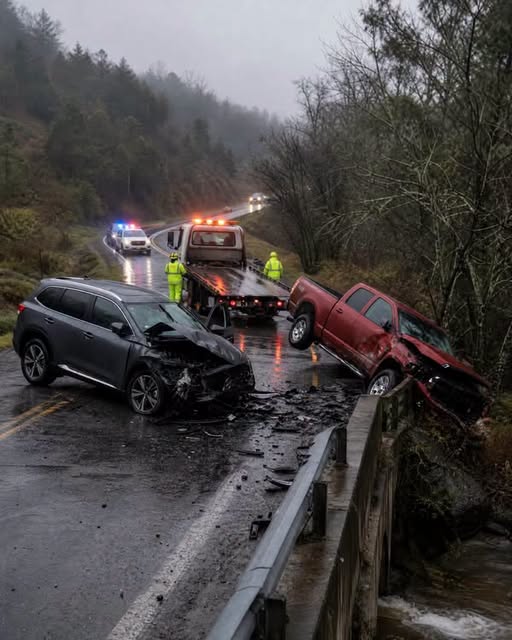
Teams from the Minas Gerais Military Fire Department, SAMU, the Federal Highway Police, and the Civil Police responded to the scene.
Both vehicles had sustained severe damage and were located away from the main roadway. Several people were trapped inside the wreckage, requiring rescuers to use specialized hydraulic equipment to reach them.
The nighttime conditions and difficult location of the vehicles added to the challenge.
Seventeen people were traveling in the van.
Nine died at the scene, including eight adults and one child. Their bodies were transported to the Instituto Médico Legal in Montes Claros for identification and the required forensic procedures.
At least eight other people traveling in the van were injured.
Early reports identified an 8-year-old child who was in stable condition and a 27-year-old man who was in critical condition and required assisted ventilation. A 36-year-old woman and a 26-year-old man were also reported to be in stable condition. Other injured passengers were transported to hospitals in Francisco Sá for evaluation and treatment.
The truck had two occupants, including the driver and a passenger. Both sustained minor injuries and were treated at the scene.
Highway Closed for Hours After the Crash
The severity of the collision prompted authorities to close BR-251 in both directions.
The road remained closed for approximately six hours while emergency crews carried out rescue operations, investigators documented the scene, and the damaged vehicles were removed.
Traffic was restored at about 3:40 a.m. on Wednesday, May 14.
Forensic investigators examined evidence that could help reconstruct the moments before the collision, including tire marks, debris distribution, impact points, and conditions on the roadway.
At this stage, authorities had not established a definitive cause.
What Investigators Are Examining
Several factors may be considered during a crash investigation, including driver behavior, vehicle condition, visibility, weather, and the physical characteristics of the highway.
Rain was reportedly present around the time of the collision, potentially affecting visibility and traction. However, investigators had not confirmed that weather caused or contributed to the crash.
The section of BR-251 involved in the collision also contains curves and changes in elevation, with limited shoulder space in some areas.
The truck’s unloaded condition may also form part of the technical examination, although there was no official confirmation that it contributed to the accident.
Determining the cause of a serious collision requires more than eyewitness impressions. Investigators typically compare physical evidence from the scene with vehicle information and witness accounts before reaching a conclusion.
Why BR-251 Continues to Raise Safety Concerns
The crash has also renewed attention on BR-251, an important transportation corridor connecting regions of Brazil.
Long-distance trucks and passenger vehicles regularly use the highway, making road conditions particularly important for both professional drivers and families traveling between states.
Parts of the route have been associated with difficult driving conditions, including curves, steep sections, limited visibility, and stretches without significant physical separation between opposing lanes.
The highway has also acquired the grim nickname “rodovia da morte,” or “road of death,” reflecting long-standing concerns about serious crashes.
Figures cited in reports about the highway have further fueled calls for improvements, including stronger enforcement, vehicle inspections, and infrastructure upgrades.
A project known as Rota Gerais has proposed improvements involving BR-251, although its implementation remains subject to technical and administrative processes.
A Tragedy That Extends Beyond the Crash Site
For the families of those who died, the consequences of the collision go far beyond the hours spent at the accident scene.
A fatal highway crash can leave families facing the loss of loved ones, medical treatment for survivors, transportation challenges, insurance matters, and sudden financial uncertainty.
For injured passengers, recovery can take weeks or months. For families who depend on a person’s income, even a temporary inability to work can create another layer of hardship.
These consequences highlight why highway safety is more than an infrastructure debate.
For people who travel BR-251 every day, road design, vehicle maintenance, responsible driving, enforcement, and emergency response can have consequences measured not in statistics, but in lives.
Investigation Continues
The May 13 crash left nine families grieving and several injured passengers facing recovery.
Authorities continued examining the evidence to determine precisely how the two vehicles came into collision and whether any specific factors contributed to the tragedy.
Until investigators complete that work, speculation about the cause should be treated cautiously.
What is already clear is the scale of the loss.
Another deadly collision on BR-251 has brought renewed attention to the risks faced by people traveling one of northern Minas Gerais’ most important highways—and to the continuing need for safer roads, careful driving, effective enforcement, and infrastructure capable of protecting the people who depend on them.