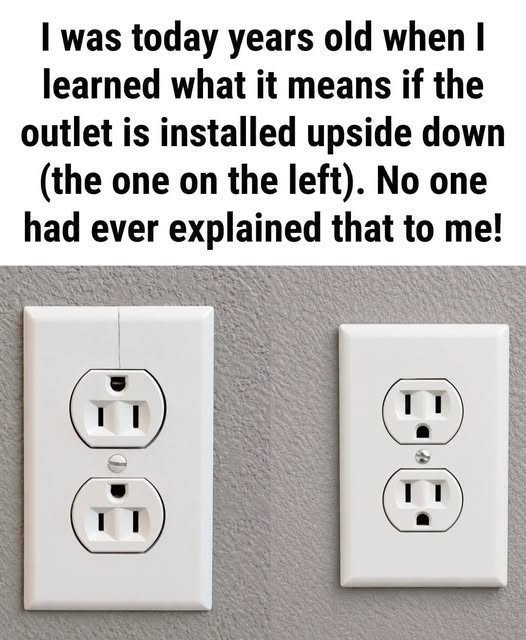
In some homes, an outlet installed with the grounding opening at the top may indicate that the receptacle is connected to a wall switch—or that one portion of the receptacle is controlled separately.
However, the orientation by itself does not reliably tell you whether an outlet is switched or what type of circuit it is connected to. Installation practices can vary, so an upside-down appearance isn’t necessarily a universal code or safety signal.
The Connection to Older Lighting Systems
The idea becomes easier to understand when you look at how some older homes were designed.
Before recessed lighting and modern ceiling fixtures became common, rooms often depended on table lamps or floor lamps for lighting.
Instead of installing a dedicated ceiling fixture, an electrician could connect a wall receptacle to a nearby wall switch.
The basic setup was simple:
Plug in a lamp → flip the wall switch → the lamp turns on.
This arrangement is still found in many homes today, particularly in rooms where a ceiling light isn’t installed.
Why Would Someone Want a Switched Outlet?
A switched receptacle can make a room more convenient.
Rather than walking over to a lamp every time you enter the room, you can control the connected light from the wall.
This can be especially useful for floor lamps, table lamps, and other plug-in lighting.
Some receptacles are also designed so that only one half is controlled by the wall switch while the other remains continuously powered. That allows a homeowner to have both switched lighting and a regular power connection in the same location.
Does an Upside-Down Outlet Always Mean It’s Switched?
Not necessarily.
This is one of the most important details to remember.
There is no universal rule that says an outlet with the grounding opening at the top must be controlled by a wall switch. Electricians may orient receptacles differently for various reasons, and local electrical requirements can also influence installation.
In other words, the position of the outlet can be a clue in some homes, but it isn’t proof of how the circuit works.
If you’re unsure, don’t rely on appearance alone.
A Small Detail With a Bigger Story
The next time you notice an outlet that appears to be upside down, you may be looking at nothing more mysterious than a different installation choice—or, in some cases, a receptacle associated with a switched lighting arrangement.
What looks like an error can sometimes have a practical explanation.
Still, electrical systems aren’t something to experiment with based on internet tips. If you need to determine whether a receptacle is switched, partially switched, or wired in a particular way, a qualified electrician can inspect it safely.
Sometimes, the smallest details around a home can reveal interesting clues about how the house was designed and how people used it over the years.